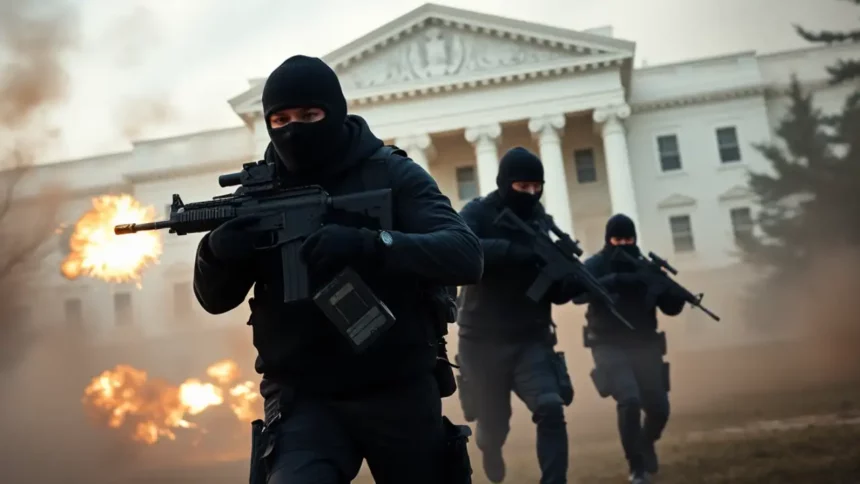
In a dramatic turn of events in Chad, at least 19 individuals have been killed following an armed attempt to storm the presidential complex in N’Djamena, the capital of Chad. The security forces successfully foiled the attack, which took place on Wednesday evening, but the incident resulted in significant casualties.
According to the Chadian government, 18 of the 24 armed assailants were killed during the fierce gun battle with the security forces. In addition, one member of Chad’s security forces lost their life, while three others sustained injuries, one of them critically. Abderaman Koulamallah, Chad’s foreign minister and government spokesman, confirmed the death toll, adding that six of the attackers were also injured during the exchange of fire.
Koulamallah later appeared in a video alongside soldiers, with a firearm on his belt, assuring the public that “the situation is completely under control” and that the attempt to destabilize the government had been thwarted. The attack took place just hours after an official visit by China’s Foreign Minister Wang Yi, who had been in Chad to meet with President Mahamat Idriss Deby and other senior officials. Deby, who had been present in the presidential complex during the assault, was unharmed, according to Koulamallah.
The attack on the presidential complex occurred just two weeks after Chad held a contentious general election. The election was touted by the government as a crucial step towards ending military rule, although it was marred by allegations of fraud and low voter turnout. The opposition had called for a boycott, which ultimately paved the way for candidates supporting the president to dominate the race.
The group behind the assault was initially reported to be Boko Haram militants, but Koulamallah later dismissed this theory, suggesting that the attackers were more likely to be a disorganized group of rebels or criminals. He described them as “Pieds Nickeles,” a term used in French culture to refer to hapless and inept individuals, often seen as comic characters. Another security source indicated that the attack might have been an “attempted terrorist attack.”
The assailants, in three vehicles, reportedly launched an attack on military camps surrounding the presidential office, but the army was quick to neutralize the threat, preventing any significant damage to the complex. Residents in the area reported hearing loud gunfire during the exchange, adding to the tension that had already been mounting due to the political instability in the country.
The attack also occurred against the backdrop of significant geopolitical changes in the region. Chad recently made the decision to end defense and security agreements with France, calling them “obsolete” in November. This move followed France’s withdrawal from several Sahelian countries, including Mali, Burkina Faso, and Niger, which had also expelled French military forces in the wake of rising anti-France sentiment among military governments in the region. Chad, which is rich in oil resources, had hosted France’s last remaining military bases in the Sahel but is now in the process of distancing itself from France, which had maintained a military presence in the region for decades.
Chad’s military leadership, under the rule of President Mahamat Idriss Deby, came into power in 2021 following the death of his father, the long-time president Idriss Deby. The younger Deby’s rise to power has been marked by significant political unrest, including challenges to his rule from armed groups and political opposition factions. His leadership has been closely monitored by both regional and international players, with the ongoing situation in Chad continuing to be a focal point for security concerns in Central Africa.
The foiled attack on the presidential complex serves as a stark reminder of the volatile security situation in Chad and the broader Sahel region, where armed groups continue to pose a significant threat to stability. As the country navigates through political transitions and changing international alliances, the government’s ability to maintain control over key institutions like the presidency will be critical to ensuring the nation’s long-term security and political future.
The situation in Chad highlights the complexity of the ongoing struggle for power in the Sahel, with foreign military forces pulling back, local armed groups remaining active, and political instability continuing to shape the region’s future. Chad’s ability to maintain its security in the face of such challenges will likely be a key factor in determining the trajectory of its political and social developments in the coming years.