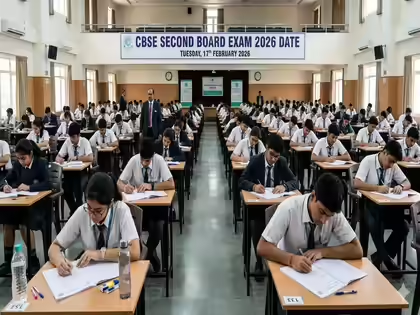
The Central Board of Secondary Education has officially begun the second phase of the Class 10 board examinations for the 2026 academic session, marking a major shift in India’s school assessment system. The optional second board examination cycle started on May 15 with Mathematics Standard and Mathematics Basic papers being conducted across examination centres nationwide.
The new examination framework, introduced for the first time this year, has drawn significant attention from students, parents, schools and education experts alike. More than 6.68 lakh students have registered for the second examination cycle, making it one of the largest optional academic improvement initiatives ever introduced by the board.
The overwhelming response highlights the growing pressure among students to improve academic scores in a highly competitive education environment. According to official figures released by CBSE, the majority of students appearing for the second examination are attempting to improve marks secured in the main board examinations conducted earlier this year.
Education experts believe the new system could gradually transform the way Indian students approach board examinations by reducing pressure associated with a single high-stakes test and offering students another opportunity to strengthen their academic performance.
More Than 6.68 Lakh Students Register For Second Attempt
CBSE data shows that 6,68,854 regular candidates have registered for the second board examination cycle. Out of these, over 5.25 lakh students applied specifically under the improvement category, indicating that a large number of students are seeking better scores for future academic opportunities.
Another 85,285 students registered under the compartment category after failing to clear one or more subjects during the main examination cycle. Meanwhile, nearly 58,000 candidates opted for both compartment and improvement categories simultaneously.
The high participation numbers demonstrate the importance students now place on maximizing board scores, especially for admissions into higher secondary streams and competitive academic institutions.
School administrators across several states reported heavy attendance at examination centres from early morning hours, particularly for the Mathematics paper, which is often considered one of the most critical subjects in Class 10 assessments.
Students were advised to reach centres well before reporting time due to enhanced verification procedures and revised guidelines issued by the board for the second examination phase.
Why CBSE Introduced Two Board Examinations
The introduction of a dual-board examination system is being viewed as one of the most significant reforms in CBSE’s assessment structure in recent years.
Under the revised format introduced from the 2026 academic session, the first board examination held in February remains mandatory for all students. The second examination phase, however, is optional and allows candidates to improve their marks or clear subjects in which they were unsuccessful earlier.
CBSE officials have described the move as an attempt to reduce stress associated with a single examination cycle while also creating a more student-friendly assessment environment.
For years, students and parents have argued that a single board examination often creates extreme psychological pressure, particularly because board scores play a major role in stream selection and future academic opportunities.
The new policy aims to address that concern by giving students an additional opportunity without forcing them to lose an academic year.
Under the updated rules, students can appear in a maximum of three subjects during the second examination cycle. Importantly, the board will retain the best score achieved between the two attempts, ensuring that students are not penalized for opting to improve their performance.
Education analysts believe this model brings the CBSE system closer to international assessment practices where multiple testing opportunities are common.
Detailed Examination Schedule Released
According to the official timetable, the second examination cycle will continue until May 21.
After the Mathematics examination on May 15, students will appear for English Communicative and English Language and Literature papers on May 16.
Language and elective subject examinations are scheduled for May 19. These include major regional languages such as Hindi, Tamil, Telugu, Bengali, Marathi, Gujarati, Punjabi and Urdu, along with several foreign languages offered by the board.
Home Science and select vocational subjects will also be conducted on the same day.
On May 20, examinations will be held for Sanskrit, Painting, Artificial Intelligence and Information Technology subjects.
The examination cycle will conclude on May 21 with the Social Science paper, which remains one of the highest-enrollment subjects in the CBSE Class 10 curriculum.
Schools and examination authorities have implemented additional monitoring and logistical arrangements to ensure smooth conduct of the optional examination phase.
Students Hope To Improve Competitive Prospects
For many students, the second board examination is not merely an academic formality but a crucial opportunity to improve future career prospects.
Class 10 board scores continue to play a significant role in determining admissions into Science, Commerce and Humanities streams at higher secondary levels. In some schools, stream allocation depends heavily on subject-wise performance percentages.
Students aiming for competitive academic tracks often seek marginal score improvements that could influence admission decisions later.
Several students appearing for the Mathematics paper on Friday said the second examination cycle gave them a sense of relief and reduced pressure associated with earlier results.
Parents have also largely welcomed the move, describing it as a more practical and compassionate approach to academic evaluation.
Education counsellors believe the flexibility provided by the new system may gradually improve student confidence and reduce anxiety surrounding board examinations.
However, some experts have also cautioned that the policy could unintentionally increase competition by encouraging students to continuously pursue higher marks even after initial results.
Despite those concerns, the overall response from schools and families has remained largely positive during the first year of implementation.
Teachers And Schools Adapt To New Academic Structure
The introduction of two board examination cycles has also forced schools and teachers to adapt academic schedules, teaching strategies and internal assessments.
Many schools extended revision sessions and support classes after the declaration of main board results to help students prepare for improvement examinations.
Teachers reported that students appearing for the second examination phase appeared more focused and confident because they had already experienced the board examination environment earlier in the year.
Some educators believe the second attempt system could eventually improve overall learning outcomes by allowing students additional time to strengthen weaker concepts instead of depending entirely on one examination window.
At the same time, schools are also facing operational challenges related to managing admissions and academic calendars while waiting for second examination results.
Several institutions have indicated that future academic scheduling may need adjustments if the dual-exam structure continues permanently.
Result Date Expected Within One Month
CBSE has indicated that the results for the second board examination cycle are expected to be announced within a month after the conclusion of exams.
Once declared, students will be able to complete admission procedures for higher secondary education without major delays.
The board is likely to release results online through official portals, allowing students to access digital mark sheets and updated performance records.
The final scorecards will reflect the best performance achieved by students across both examination attempts.
Officials believe the faster evaluation process is necessary to ensure that admissions for Class 11 are not disrupted due to the new examination framework.
The board has also instructed schools to provide necessary counselling support to students during the result period, particularly for those appearing under the compartment category.
Education Reform Signals Bigger Changes Ahead
The successful implementation of the second examination cycle could influence broader reforms in India’s school education system in the coming years.
Education policymakers have increasingly focused on reducing rote learning, minimizing exam-related stress and creating more flexible academic evaluation systems.
The National Education Policy has already emphasized competency-based learning and holistic assessment models. The two-board-exam system appears aligned with that broader vision.
If the initiative proves successful, similar reforms may eventually be considered for higher classes and other education boards across the country.
For now, lakhs of Class 10 students are hoping the second opportunity offered by CBSE will help them improve scores, secure better academic streams and move forward with greater confidence.
As the examinations continue over the next week, the success of this new system will be closely watched by educators, policymakers and millions of families across India.