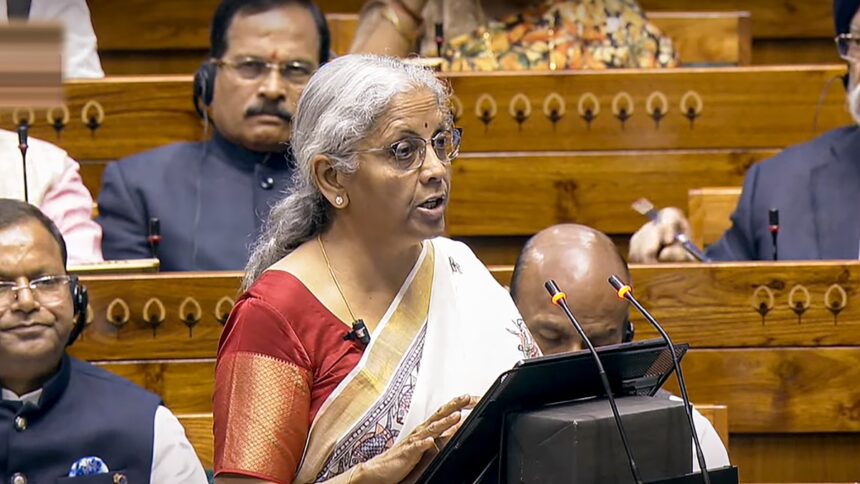
Finance Minister Nirmala Sitharaman, while responding to the Budget debate in Rajya Sabha on Thursday, emphasized that the Union Budget aims to accelerate economic growth and boost private sector investments. She dismissed the Opposition’s claim that the Budget favors NDA-ruled states, calling such allegations “unfounded.” She underscored that the government had taken into account key demographics—poor, youth, farmers, and women—while drafting the Budget.
Highlighting capital expenditure, Sitharaman stated that the total projected capex stands at ₹15.48 lakh crore, compared to the revised estimates of ₹13.18 lakh crore for 2024-25. She clarified that grants-in-aid provided to states are recorded as revenue expenditure in the Union government’s books, but they are ultimately used for capital expenditure, reinforcing infrastructure growth. Adding further perspective, she said when the capital outlay from public enterprises is included, the total capital investment for 2025-26 is expected to be ₹19.8 lakh crore.
The Finance Minister criticized the Congress for its approach to capital expenditure during its tenure, pointing out that the capex had declined from 31% in 2004 to 16% of the Budget by 2014. She urged senior Congress leader and former Finance Minister P. Chidambaram to advise Opposition-ruled states not to cut down their capital spending.
Addressing inflation concerns, Sitharaman cited fresh data indicating that Consumer Price Index (CPI) inflation for January 2025 fell to 4.31% from 5.22%, aligning closer to the Reserve Bank of India’s target range. She attributed the decline to a sharp correction in tomato, onion, and potato prices, alongside tariff-free imports of pulses that the country does not produce in sufficient quantities.
On the issue of the rupee’s depreciation against the US dollar, Sitharaman called it a global trend, emphasizing that the rising dollar index had impacted currencies across Asia. She noted that major Asian currencies, including those of Korea, Indonesia, and Malaysia, had depreciated, along with G10 currencies, which saw a decline of over 5.5%. She argued that overvalued currencies can harm national competitiveness by making exports expensive.
Defending the government’s tax relief measures, Sitharaman countered criticism that the new income tax provisions benefit the wealthy disproportionately. She highlighted that individuals earning up to ₹12 lakh per annum receive 100% tax relief, while those earning ₹24 lakh will pay 26.82% less tax than before. Similarly, taxpayers earning ₹50 lakh will pay 9.24% less, and those with an annual income of ₹1 crore will pay 4.08% less tax. She remarked that those opposing these tax relief measures were “probably against these benefits.”
Refuting claims that social sector spending had been reduced, she asserted that technology now enables the government to track unspent funds lying with the states. She urged state governments to utilize these funds before demanding additional allocations, arguing that increased borrowing would only burden the Centre with higher interest payments.
Dismissing accusations that Opposition-ruled states were not consulted in the Budget process, Sitharaman reiterated that state finance ministers are actively involved before the Budget is finalized. In response to allegations of favoritism towards Bihar, she reminded the House that Union Minister Nitin Gadkari had stated in December that Punjab alone had received 38 national highway projects in the last three years.
Indirectly targeting the West Bengal government, she alleged that while funds for PM Awas Yojana Gramin and MGNREGA had been released, the state administration engaged in irregularities by selecting ineligible households while excluding those who were actually eligible. She expressed confidence that the people of Bengal, whom she referred to as “survivors,” would overcome such obstacles.
TMC MP Derek O’Brien objected to her remarks, stating that under parliamentary rules, no statement should be made against a state government without prior notice. He also claimed that despite achieving 99% compliance, funds under MGNREGA had been denied to West Bengal. However, Leader of the House J.P. Nadda defended Sitharaman’s statement, asserting that no derogatory remarks had been made against any state government. He urged the Chair to prevent further interruptions and allow the Finance Minister to complete her speech.