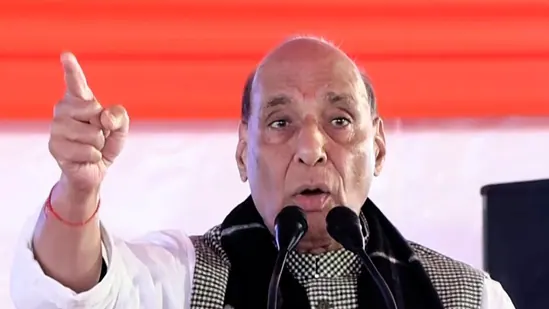
India’s Defence Minister, Rajnath Singh, suggested that although the Sindh region currently lies within Pakistan’s borders, historical and civilisational ties mean that “borders can change” and the region could one day be reintegrated into India.
Civilisational Ties and Historical Context
Speaking at an event addressed to the Sindhi community, the minister reflected on the legacy of partition and the lingering emotional connection many Sindhi Hindus feel with their ancestral land. He cited veteran BJP leader L.K. Advani, noting that members of his generation have never fully accepted the separation of Sindh from India. Singh pointed out that while today Sindh may not legally belong to India, civilisationally it remains part of the Indian cultural sphere. He invoked the Indus River, sacred to many in the Sindhi community, as a symbol of the enduring link.
In his address he stated: “Today, the land of Sindh may not be a part of India, but civilisationally, Sindh will always be a part of India. And, as far as land is concerned, borders can change. Who knows, tomorrow Sindh may return to India again.” He further added that Sindhis who hold the Indus River sacred “will always be our own,” regardless of where they live.
Singh emphasised that the words of India’s national anthem itself — referencing “Punjab, Sindh, Gujarat, Maratha…” — reflect the historical inclusion of Sindh as part of India’s civilisational identity. He asserted that this identity cannot be undone by shifting political borders.
Implications and Strategic Messaging
Singh’s remarks carried deeper implications beyond cultural symbolism. By declaring that borders can change, he implicitly affirmed India’s long-standing claim on Pakistan-occupied territories. He reiterated the Government of India’s stance that regions like Pakistan-occupied Kashmir (PoK) are integral parts of India and would eventually merge with the country because the people there desire freedom from what he termed “Pakistani occupation.”
His comments came amid heightened India-Pakistan tensions and followed the May-2025 “Operation Sindoor,” an Indian military action targeting alleged terror infrastructure in Pakistan. Analysts note that while Singh did not specify any immediate action on Sindh, his remarks serve as a diplomatic signal that the Indian government reserves the right to claim territory based on historical and cultural grounds.
At the event, Singh also referenced the Citizenship Amendment Act (CAA), arguing that it was necessary to protect persecuted minority communities from neighbouring countries—including those from Sindh—who had faced violence, forced conversion, and discrimination. By linking the Sindhi diaspora’s experience to broader policy initiatives, he presented a narrative connecting cultural heritage, migration, and identity to border policy.
The statement is expected to draw strong reactions from Pakistan, which views such claims as destabilising the line of control and questioning the permanence of the Partition. Observers believe it signals that India may adopt a more assertive posture on territorial issues moving forward.