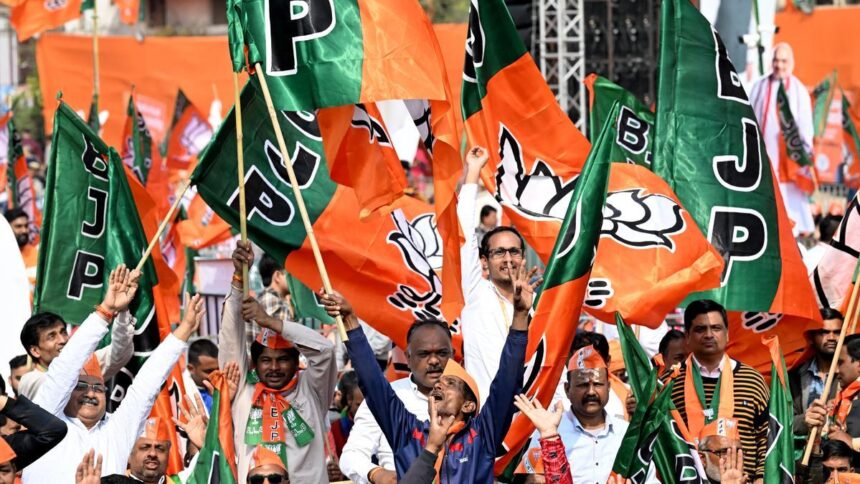
The Bharatiya Janata Party has emerged as the top recipient of political donations in the financial year 2024–25, securing contributions worth over ₹6,074 crore, according to a report by the Association for Democratic Reforms. The amount is more than ten times the total donations received by all other national parties combined during the same period, highlighting a significant financial gap in India’s political funding landscape.
The analysis is based on donations above ₹20,000 disclosed by political parties to the Election Commission, providing insight into the funding patterns of major national parties.
BJP Dominates Political Funding Landscape
According to the report, the BJP received ₹6,074.015 crore through 5,522 donations in FY25, making it the largest beneficiary of political contributions by a wide margin. This level of funding significantly surpasses the combined total declared by other national parties, underlining the party’s strong financial backing.
The findings reflect a growing concentration of political funding, where one party commands a disproportionately large share of contributions. Such dominance can influence campaign strategies, outreach capabilities, and overall political competitiveness.
The report focuses specifically on donations exceeding ₹20,000, as these are required to be disclosed to the Election Commission. Smaller contributions, which may also form part of a party’s funding, are not included in this analysis.
Transparency and Disclosure of Political Donations
The ADR report is based on data submitted by political parties as part of mandatory disclosure requirements. These disclosures aim to promote transparency in political funding by providing information on sources and amounts of contributions.
However, experts have often pointed out that the current system captures only a portion of total political funding, as contributions below ₹20,000 do not require detailed disclosure. This has led to ongoing debates about the need for greater transparency and reforms in political finance.
The report highlights the importance of publicly available data in understanding funding trends and ensuring accountability. It also raises questions about the distribution of financial resources among political parties and its impact on democratic processes.
Implications for Political Competition
The significant gap in donations between the BJP and other national parties has implications for political competition. Higher funding enables parties to invest more in election campaigns, advertising, and organisational infrastructure.
This financial advantage can translate into greater visibility and reach during elections, potentially influencing voter engagement. At the same time, it places smaller parties at a relative disadvantage, limiting their ability to compete on equal terms.
Political analysts note that funding patterns often reflect broader trends in political support and organisational strength. However, the concentration of resources in one party also raises concerns about the balance of competition in a multi-party system.
Debate on Political Funding Reforms
The findings of the ADR report are likely to fuel discussions on political funding reforms in India. Calls for greater transparency, stricter disclosure norms, and improved regulatory mechanisms have been ongoing.
Reform advocates argue that a more transparent system would enhance public trust and ensure a level playing field for all political parties. Suggestions include lowering the disclosure threshold, increasing scrutiny of funding sources, and introducing mechanisms for real-time reporting.
The debate also extends to the role of corporate donations and electoral bonds, which have been subjects of discussion in recent years. The ADR report adds to this conversation by highlighting disparities in funding distribution.
The ADR report underscores the dominance of the BJP in political funding during FY25, with donations far exceeding those of other national parties combined. While the findings reflect the party’s strong financial support, they also raise important questions about transparency, competition, and the future of political funding in India.
As discussions on reforms continue, the focus will remain on ensuring accountability and maintaining a balanced democratic framework where all parties have the opportunity to compete effectively.