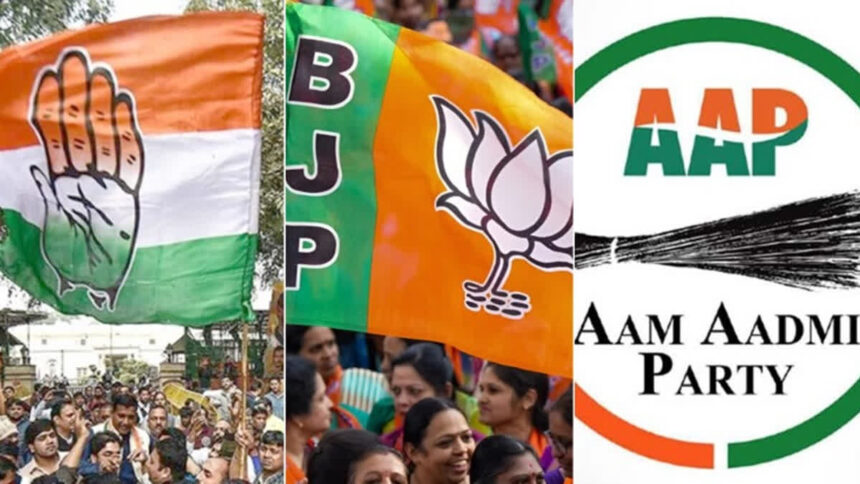
As Delhi gears up for its upcoming assembly elections, the Bharatiya Janata Party (BJP) is aiming to break a 27-year-old electoral jinx and wrest control of the national capital from the Aam Aadmi Party (AAP). For nearly three decades, the BJP has struggled to gain a foothold in the Delhi assembly, despite sweeping victories in the national elections. With February’s election just around the corner, the saffron party has launched an all-out effort to change its fortunes, focusing on issues like governance, party strategy, and a new leadership team that promises to deliver the crucial victory it seeks.
The BJP’s campaign is led by union home minister Amit Shah, who has meticulously designed a strategy that involves the formation of a powerful team of 27 senior leaders. These leaders, carefully selected for their political experience and organizational acumen, have been tasked with an ambitious agenda: to secure a victory for the BJP in the upcoming assembly elections. This team, which includes union ministers like Mansukh Mandaviya, Piyush Goyal, Dharmendra Pradhan, and Bhupender Yadav, alongside prominent party office-bearers and members of parliament, will play a key role in strengthening the BJP’s ground game in Delhi. They are expected to engage directly with voters, manage booth operations, and ensure that the party’s message reaches every corner of the capital.
Sources close to the party’s strategy reveal that the special team has been assembled to work specifically on the booth level, ensuring that the BJP is able to capitalize on every opportunity to sway voters in its favor. While the team will not be involved in high-profile campaigning or public speeches, their focus will be on the behind-the-scenes work necessary for a strong electoral performance. This includes detailed assessments of voter behavior and ensuring that the BJP’s supporters turn out to vote in large numbers. The party’s focus will be on the 51 constituencies where it is locked in tight contests with both the AAP and Congress, areas that are critical to winning the overall majority.
Each of the 27 leaders will be assigned two constituencies, where they will focus their efforts on ensuring that BJP supporters are mobilized and that any gaps in voter support are addressed. Their role is not to engage in public rallies or speeches but to work closely with local party workers, monitor election activities, and assist the candidates in these constituencies. According to a source familiar with the strategy, the BJP is not looking for aggressive campaigning but rather a meticulous and targeted approach that ensures all bases are covered. This methodical approach aims to deliver a win for the BJP in areas where it has historically struggled to convert support into electoral success.
The party is confident that this ground-level focus will prove to be the difference-maker in the Delhi elections. Since the BJP has won every seat in Delhi during the last three Lok Sabha elections, it believes that it can carry this momentum into the assembly elections by fixing the issues that have previously prevented it from translating its national wins into local victories. The BJP’s campaign is focusing on addressing voter concerns in areas like infrastructure, security, and corruption, with the aim of presenting itself as a viable alternative to the AAP-led government.
In addition to the 27-member team, the BJP has also enlisted the help of 40 star campaigners, including high-profile leaders such as Prime Minister Narendra Modi, who is expected to hold several rallies leading up to the election. BJP national president JP Nadda and chief ministers from BJP-ruled states like Pushkar Singh Dhami, Himanta Biswa Sarma, and Devendra Fadnavis are also on the campaign trail, lending their support to the party’s efforts in Delhi. One of the most high-profile campaigners will be Uttar Pradesh chief minister Yogi Adityanath, who is set to hold 14 public meetings in the lead-up to the polls.
Despite these efforts, the BJP faces an uphill battle in Delhi, where it has not formed a government since 1993. The AAP, led by Arvind Kejriwal, has dominated the Delhi political scene in recent years, with Kejriwal serving as the chief minister three times. Following a series of corruption allegations that led to Kejriwal’s imprisonment, the AAP has nominated Atishi as the interim chief ministerial candidate. If the AAP retains power, it is likely that Kejriwal will return as the chief minister, making the BJP’s challenge even more difficult.
The BJP’s alliances also play a significant role in the party’s election strategy. The BJP is contesting 68 of Delhi’s 70 assembly seats, with one seat each given to its allies, Nitish Kumar’s JD(U) and the LJP (Ram Vilas) party led by union minister Chirag Paswan. Another NDA partner, the Shiv Sena, has expressed its support for the BJP candidates but has opted not to field candidates of its own.
With less than two weeks to go before the elections, the BJP’s back-end operation, led by its 27-member team, is set to play a crucial role in the outcome. These leaders will be responsible for managing the party’s election strategy on the ground, ensuring that the party’s message resonates with voters and that its resources are allocated effectively. Their direct reporting to Amit Shah and BJP president JP Nadda will ensure that the party remains focused on the core issues and delivers the necessary results in these crucial constituencies.
As Delhi prepares to vote on February 5, the BJP is putting all its resources into securing a win, relying on its strategic team and high-profile campaigners to turn the tide in its favor. The results of this election will determine not only the political future of Delhi but also the future of the BJP’s presence in the national capital.