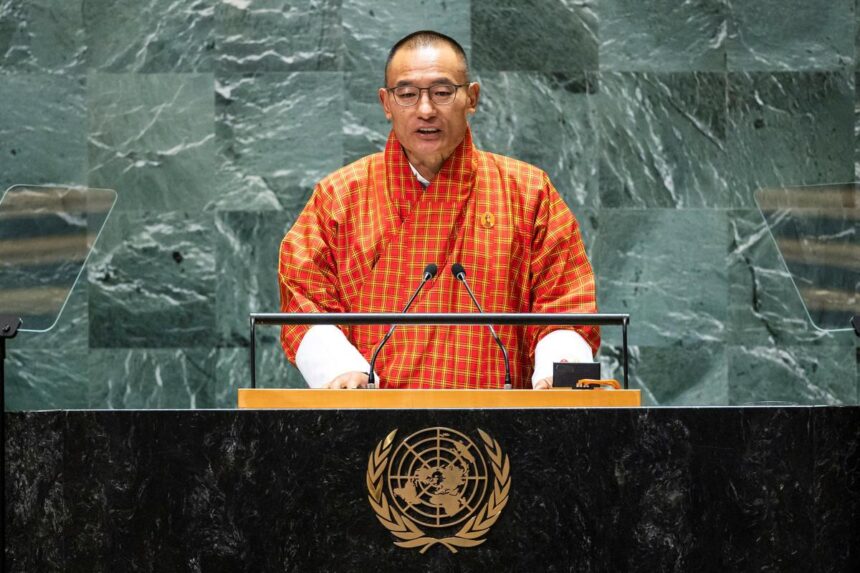
In a significant address at the 79th United Nations General Assembly, Bhutan’s Prime Minister Tshering Tobgay called for a comprehensive reform of the United Nations Security Council (UNSC), advocating for the inclusion of India and Japan as permanent members. His remarks underscored the need for the global body to adapt to the evolving geopolitical and economic realities of the 21st century.
Outdated Structure and Need for Reform
Prime Minister Tobgay highlighted that the current composition of the UNSC is outdated and fails to adequately reflect the contemporary international order. “The United Nations must evolve to meet the realities of today’s world. The Security Council, as it stands, is a relic of the past. We need a Council that reflects the current geopolitical and economic landscape,” he asserted. He stressed that reforming the Council is not merely a procedural adjustment but a necessary step to ensure that the UN remains relevant, representative, and effective in addressing contemporary global challenges.
Bhutan has consistently championed the expansion of both permanent and non-permanent seats on the Security Council. Prime Minister Tobgay emphasised that broadening the Council’s composition would make it more representative of global demographics, economic realities, and the geopolitical influence of emerging powers. According to him, such reforms are essential for fostering legitimacy and strengthening multilateral decision-making.
Support for India and Japan
During his address, Prime Minister Tobgay explicitly endorsed India’s bid for a permanent UNSC seat, citing its substantial economic growth, strategic influence in the Global South, and active contribution to international peace and development. “India, with its significant economic growth and leadership in the Global South, deserves a permanent seat at the Security Council,” he said.
He also extended Bhutan’s support to Japan, recognising its consistent role as a leading donor and peacebuilder in international forums. “Similarly, Japan, a leading donor and peacebuilder, warrants permanent membership,” Prime Minister Tobgay added, emphasising that Japan’s contributions to peacekeeping, humanitarian aid, and international development merit recognition at the highest decision-making level of the UN.
Implications for Global Governance
Bhutan’s position reflects a growing consensus among smaller and medium-sized nations that the Security Council’s structure must be modernised to accommodate the realities of a multipolar world. Advocates for reform argue that the inclusion of countries like India and Japan would not only enhance the Council’s legitimacy but also strengthen its capacity to address pressing global issues, including security, climate change, economic stability, and humanitarian crises.
Prime Minister Tobgay’s address comes at a time when the debate over UNSC reform has intensified, with multiple countries urging an overhaul of the Council to make it more inclusive, transparent, and effective. Bhutan’s endorsement of India and Japan signals a coordinated push among like-minded nations to advocate for equitable representation in global governance structures.
By advocating for UNSC reform and supporting India and Japan for permanent membership, Bhutan reiterates its commitment to a more balanced and representative global order. Prime Minister Tobgay’s address underscores the urgent need for the United Nations to evolve, ensuring that its principal organs reflect contemporary realities and remain effective in maintaining international peace, security, and development