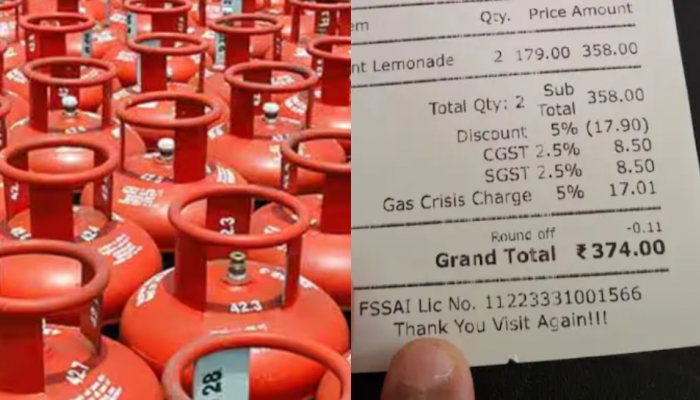
Bengaluru has once again found itself at the centre of an online debate after a cafe introduced a new surcharge on customer bills amid the ongoing LPG crisis across the country. A receipt from a cafe in the city showing a “Gas Crisis Charge” quickly went viral on social media and triggered strong reactions from users who questioned the logic behind the additional fee. The controversy started when a customer shared a photo of a bill issued by Theo Cafe in Bengaluru. The receipt showed a separate charge labelled “Gas Crisis Charge”, which caught the attention of internet users and soon sparked a heated discussion online. According to the bill circulating on social media, the customer had ordered two mint lemonade drinks. Each lemonade was priced at ₹179, taking the total cost of the drinks to ₹358. At first the cafe applied a 5% discount worth ₹17.90 on the order. However, the bill then included another line adding a 5% charge of ₹17.01 described as “Gas Crisis Charge”. Along with this, the standard GST components including CGST and SGST were added. As a result, the total bill payable by the customer reached ₹374. The image of the receipt quickly spread across social media platforms where users began questioning the justification for such a charge.
Many people pointed out that lemonade preparation generally does not require cooking gas, raising doubts about the purpose of the surcharge. Some social media users accused the cafe of introducing a creative excuse to increase prices during a time when consumers are already facing rising living costs. Others described the extra fee as the “digital avatar of inflation”, suggesting that businesses were trying new ways to pass operational costs on to customers. The viral post led to a wave of reactions, memes and debates online, with many users sharing similar experiences of hidden or unexpected charges at restaurants and cafes.
Viral Receipt Triggers Debate Over Pricing Practices
The incident has sparked a wider conversation about transparency in restaurant billing and the ethics of crisis-related surcharges. Consumer rights advocates argue that businesses should clearly communicate all charges to customers before billing them. In this case, critics said that offering a discount and then immediately adding a crisis charge created confusion and raised questions about fairness. Some observers believe the incident highlights the economic pressures currently faced by restaurants and cafes across the country. Rising fuel prices, higher electricity costs and supply chain disruptions have increased operational expenses for many hospitality businesses. Some establishments respond by increasing menu prices while others introduce service charges or temporary surcharges to offset costs. However, critics say such charges should be clearly justified so customers understand exactly what they are paying for. The role of social media in exposing such billing practices has also been highlighted by the controversy. In recent years, restaurant bills with unusual charges have frequently gone viral, forcing businesses to clarify their policies or even withdraw controversial fees.
LPG Crisis and Government Measures Affecting Supply
The controversy comes during a period when India is facing supply disruptions linked to the LPG crisis triggered by global geopolitical tensions and logistical challenges in energy supply chains. Earlier this month, the government had temporarily restricted the supply of commercial LPG cylinders in order to prioritise domestic consumption and manage limited resources. Later, the Ministry of Petroleum announced that distribution of commercial cylinders had resumed across 29 states and union territories after the earlier restrictions were lifted. Authorities stated that the decision was taken to ensure restaurants, hotels and other commercial establishments could continue operating without severe disruptions.
Meanwhile, India has also been receiving LPG shipments from overseas to maintain domestic supply stability. Recently, the LPG carrier ship Shivalik reached Gujarat’s Mundra Port carrying approximately 46,000 metric tons of LPG from Qatar. The ship successfully crossed the strategically important Strait of Hormuz, which has become a sensitive maritime route due to ongoing tensions in the Middle East. Another Indian-flagged vessel named Nanda Devi carrying a similar quantity of LPG is expected to arrive soon. In addition, an oil tanker transporting Murban crude oil is also heading toward India. These shipments are considered critical for stabilising the country’s fuel supply during the ongoing crisis.
New LPG Supply Rules Introduced During Gas Shortage
Alongside efforts to secure international fuel shipments, the government has introduced new rules to manage LPG distribution more efficiently. One of the most significant changes affects households that already have piped natural gas connections. According to the revised policy, households with active PNG connections will no longer be allowed to maintain or refill domestic LPG cylinders. Authorities say the decision aims to ensure that LPG cylinders are available for households that rely entirely on them for cooking. Under the new rules, having both PNG and LPG connections in the same household will be considered illegal. Consumers who currently have both connections must surrender their LPG cylinders immediately so that the supply can be redirected to households without alternative gas sources.
The government has also revised booking rules for domestic LPG cylinders several times within a short period to balance supply and demand. Initially, the lock-in period for booking domestic cylinders was fixed at 21 days. Later, due to rising demand in urban areas, it was increased to 25 days. In rural areas the booking interval has been extended to 45 days. Officials have clarified that people who voluntarily surrender their LPG connections will not face any penalties. However, legal action could be taken against those who continue to maintain both PNG and LPG connections in violation of the updated rules. The Bengaluru cafe controversy has therefore emerged against a backdrop of wider economic pressures, supply challenges and rising fuel costs. While businesses are attempting to adapt to the changing situation, the viral receipt highlights how sensitive pricing practices can become during times of crisis.