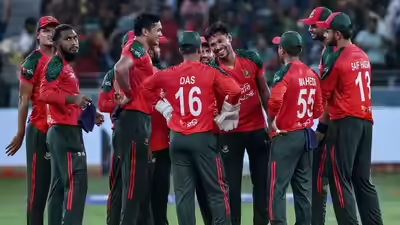
Bangladesh Cricket Board denies receiving any deadline from ICC, says discussions on T20 World Cup participation remain ongoing.
The Bangladesh Cricket Board has categorically dismissed reports claiming that the International Cricket Council imposed a January 21 deadline for a final decision on Bangladesh’s participation in the 2026 men’s T20 World Cup. The clarification comes amid intense speculation surrounding Bangladesh’s reluctance to play its scheduled matches in India and ongoing negotiations over venue arrangements. By denying the existence of any ultimatum, the board has sought to reset the narrative around its dialogue with global cricket’s governing body, emphasising that discussions remain open and unresolved. The statement has added a new layer to an already complex situation involving scheduling, security concerns, tournament logistics and the broader relationship between national cricket boards and the ICC.
BCB’s Clarification on Deadlines and Ongoing ICC Discussions
The Bangladesh Cricket Board’s position is clear: no formal deadline has been communicated by the International Cricket Council regarding a final decision on Bangladesh’s participation in the upcoming T20 World Cup. Board officials have stated that while meetings and discussions with ICC representatives have taken place, at no point was a specific date conveyed as an ultimatum. According to the board, media reports suggesting a January 21 cut-off misrepresent the nature of the conversations and create unnecessary pressure around an issue that remains under deliberation.
The clarification follows days of speculation that Bangladesh had been asked to confirm its participation or risk being replaced in the tournament lineup. Such reports fueled uncertainty not only among fans but also within the cricketing community, raising questions about tournament integrity and preparation timelines. By publicly rejecting the notion of a deadline, the BCB has underscored that it is still engaged in dialogue and that decisions of this magnitude cannot be rushed without due consideration of player welfare and national interests.
Central to Bangladesh’s concerns is the issue of venue allocation. The T20 World Cup is scheduled to be co-hosted by India and Sri Lanka, with Bangladesh’s group matches initially slated to take place in India. The BCB has repeatedly expressed reservations about this arrangement, citing concerns related to security, player comfort and recent developments that have affected confidence in traveling to India for international fixtures. While the board has not framed its stance as a refusal to participate in the tournament itself, it has insisted that alternative venues be considered.
During meetings with ICC officials earlier this month, the BCB reiterated its request for Bangladesh’s matches to be shifted to locations outside India, preferably within the existing co-host framework. Board representatives have indicated that these discussions were exploratory rather than conclusive, with the ICC acknowledging the concerns and stating that they would be reviewed through appropriate channels. The absence of a communicated deadline, according to the BCB, reflects the fact that the ICC is still assessing the situation rather than enforcing a unilateral decision.
The board has also sought to counter the perception that it is delaying proceedings or acting unreasonably. Officials have stressed that Bangladesh remains committed to international cricket and recognises the importance of the T20 World Cup as a global event. However, they argue that participation must align with assurances around safety, dignity and equitable treatment. By denying deadline claims, the BCB appears intent on maintaining negotiating space while avoiding the impression that it is defying the ICC.
Tournament Uncertainty, Wider Implications and Cricket Governance
The denial of a January 21 deadline does not resolve the broader uncertainty surrounding Bangladesh’s participation, but it does highlight deeper issues within international cricket governance. As the start of the T20 World Cup approaches, questions about scheduling stability, team readiness and contingency planning have grown louder. The ICC, responsible for delivering a seamless global tournament, must balance logistical constraints with the legitimate concerns raised by member boards.
For Bangladesh, the issue goes beyond a single tournament. The board’s stance reflects ongoing debates about how international cricket navigates political sensitivities, regional tensions and player welfare. By pressing for venue adjustments rather than withdrawing outright, Bangladesh is attempting to assert its position within the framework of ICC negotiations while avoiding drastic measures that could isolate it within the cricketing ecosystem.
The situation has also reignited discussions about consistency in decision-making. In past instances, venue changes and neutral-site arrangements have been implemented when teams expressed reservations about touring certain countries. Observers have pointed out that how the ICC handles Bangladesh’s request could set a precedent for future tournaments. A rigid refusal may signal a tightening of governance norms, while accommodation could encourage other teams to raise similar demands under different circumstances.
From the ICC’s perspective, maintaining the tournament schedule is critical. Broadcast commitments, sponsorship agreements and ticketing arrangements depend on clarity and stability. Any alteration to match venues can trigger a cascade of logistical challenges, affecting not only teams but also fans and commercial partners. This reality places pressure on the governing body to reach a resolution quickly, even as it navigates the diplomatic sensitivities involved.
The uncertainty has inevitably sparked speculation about potential replacements should Bangladesh ultimately opt out. While the BCB has not acknowledged such scenarios as imminent, reports naming alternative teams have circulated widely. The board’s denial of a deadline appears aimed in part at dispelling these narratives and reaffirming that Bangladesh remains in talks rather than on the brink of withdrawal.
Beyond logistics, the episode has broader implications for how cricket is governed in an increasingly complex global environment. The balance between authority and consensus, between fixed schedules and flexible diplomacy, is being tested. Boards like Bangladesh’s are asserting their right to raise concerns, while the ICC is tasked with safeguarding the collective interests of the sport.
As discussions continue, the absence of a fixed deadline suggests that the situation remains fluid. Whether this flexibility leads to a mutually acceptable solution or prolongs uncertainty will depend on the willingness of both sides to compromise. For now, the BCB’s statement has clarified one aspect of the debate, even as larger questions about participation, venues and governance remain unresolved.