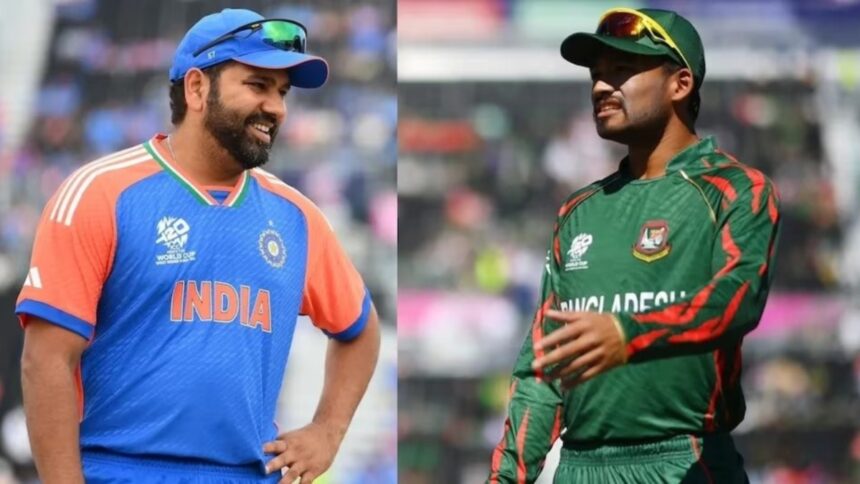
Bangladesh has announced a six-match white-ball home series against India for August–September 2026, confirming three One-Day Internationals and three T20 Internationals even as broader political tensions and sensitive cross-border issues continue to influence public and administrative discourse.
The Bangladesh Cricket Board confirmed the development on Friday while unveiling its full international home calendar for the 2026 season. According to the announcement, the Indian cricket team is scheduled to arrive in Bangladesh on August 28, with the ODI series slated for September 1, 3, and 6, followed by the T20I leg on September 9, 12, and 13. The tour revives a limited-overs series that had been postponed earlier, with officials from both boards now agreeing on fresh dates.
BCB’s cricket operations head Shahriar Nafees said the rescheduling marked the revival of a previously deferred bilateral engagement. His confirmation underscored Bangladesh’s intent to proceed with its sporting calendar while navigating a complex regional environment. Once the six matches conclude, the Indian team is expected to return home without extending the tour into red-ball cricket.
Series scheduling amid political strain and pending Indian clearance
While the cricketing itinerary has been outlined by the Bangladesh Cricket Board, the proposed series unfolds against a backdrop of political unrest and strained relations between India and Bangladesh. Reports of violence and the killing of Hindus in Bangladesh have heightened sensitivities, pushing the focus onto whether the Board of Control for Cricket in India will formally approve the tour as scheduled.
Cricbuzz reports suggest that Bangladesh has completed its internal planning and venue allocation, but final confirmation from the Indian side remains pending. Given the prevailing political climate, the series has moved beyond a routine bilateral contest to become a subject of broader debate, where sporting continuity intersects with diplomatic caution. Observers note that while cricket has historically acted as a bridge between the two neighbours, current circumstances may require additional consultations before final clearance is granted.
If the tour proceeds as planned, it will represent one of India’s key white-ball engagements in 2026, fitting into an already packed international calendar. Administrators on both sides are aware that postponements or cancellations at this stage could disrupt preparation cycles, broadcast commitments, and player workloads. At the same time, the sensitivity of the political situation means that decisions may be influenced by factors beyond the cricketing sphere.
Player milestones, IPL spillovers, and wider cricketing implications
From a sporting perspective, the proposed Bangladesh series carries notable implications for India’s senior players. If the BCCI gives its nod, Rohit Sharma and Virat Kohli are expected to feature prominently, taking their projected ODI appearances for the year to 21 matches. Such volume would be significant as India shapes its long-term plans ahead of the 2027 ODI World Cup.
For Virat Kohli in particular, the three ODIs in Bangladesh could play an important role in his pursuit of a landmark 100th international century. Achieving the milestone before the next World Cup would see him surpass Sachin Tendulkar’s long-standing record, adding further narrative weight to the series if it goes ahead.
The tour announcement has also intersected with ongoing debate around the Indian Premier League and cross-border participation. Kolkata Knight Riders co-owner Shah Rukh Khan has faced criticism following his franchise’s signing of Bangladeshi fast bowler Mustafizur Rahman at the IPL 2026 auction. While the auction took place in December, subsequent political developments have cast uncertainty over Mustafizur’s participation.
Amid the controversy, India’s Sports Ministry clarified that there is no prohibition in national sports policy against competing with Bangladesh or fielding Bangladeshi players in domestic leagues. Officials stated that the final decision rests with the BCCI. A senior BCCI official echoed this position, saying the board had received no government directive restricting Bangladeshi players and would act based on prevailing guidelines.
Taken together, the proposed India–Bangladesh white-ball series has become emblematic of how modern cricket tours are shaped by a confluence of sport, politics, public sentiment, and administration. While fixtures are in place and preparations outlined, the final shape of the tour will depend on approvals that extend beyond the boundary rope, making the coming months critical for both boards and players.