Newswise — Arizona’s mountain snowmelt provides a significant portion of the Phoenix metropolitan water supply.
Results from a new airborne snow survey over northeastern Arizona found that due to a dry and warm winter, most of the snow water measured in January and February had melted by mid-March, offering water managers an unusually clear view of how quickly the season changed.
Gathering critical data on just how much water is available can help Salt River Project manage it.
The Upper Black River Basin in eastern Arizona, where the surveys were conducted, may be remote, but the snow that falls there feeds the Salt River system upstream of Roosevelt Dam. It is part of SRP’s network of reservoirs that supply water to more than 2.5 million people in the Phoenix metropolitan area.
Three airborne snow surveys conducted this winter tracked how much water was stored in the basin’s snowpack.
The first flight in January measured about 9.1 thousand acre-feet (TAF) of snow water equivalent. A second survey in February measured 9.5 TAF, showing only modest accumulation during the heart of winter. By the time the third survey flew on March 12, however, the basin held just 0.8 TAF of snow water.
An acre-foot is typically enough water to supply three single-family homes for a year.
That represents a drop of more than 90% in less than three weeks.
Enrique Vivoni, director of Arizona State University’s Center for Hydrologic Innovations and affiliated with the Arizona Water Innovation Initiative, a statewide project from ASU’s Julie Ann Wrigley Global Futures Laboratory in collaboration with the Ira A. Fulton Schools of Engineering, leads the effort to integrate the airborne snow maps into advanced hydrologic models.
“For the first time, we were able to quantify the changes in Arizona’s snow conditions using airborne observations,” Vivoni said. “Despite near-average conditions early in the season, a snow drought across the western U.S. since late December has limited accumulation. By early March, the Upper Black River Basin was nearly snow-free.”
What does this mean for the Valley’s water supply?
For SRP, even small changes in mountain snowpack can affect how much water eventually flows into reservoirs during the spring melt season.
“This kind of information helps us understand not just how much water we have, but when it’s going to arrive,” said Bo Svoma, SRP climate scientist and senior meteorologist. “That timing is critical for how we manage our reservoirs heading into the spring and summer.”
SRP delivers 260 billion gallons of water each year, and most of that water comes from a 13,000-square-mile watershed that includes an extensive system of reservoirs, wells, irrigation laterals, and 131 miles of canals.
Armed with information about how much, or in this case how little, there is will help SRP hydrologists decide by early this summer where to store the water and how much groundwater they will have to use.
Even though there was not much snow to measure, the research project is still valuable to SRP. If a hydrologic model can successfully simulate an extreme year like this one, it could improve the forecasting abilities for more typical years, Svoma said.
ASU-SRP research collaboration is key
ASU researchers play a key role in translating the measurements from the flights into actionable forecasts for SRP.
Those models estimate how much snowmelt will eventually reach SRP reservoirs and when that water is likely to arrive.
The impact of incorporating the airborne data can be substantial. When the January survey was assimilated into the basin’s snow model, the modeled snow-covered area increased from 31% to 96%, significantly refining estimates of how much water was stored in the basin.
By combining airborne measurements, satellite data and advanced modeling tools, ASU researchers are working to reduce one of the biggest uncertainties in western water management: predicting how mountain snow turns into downstream water supply.
“These airborne datasets are helping us train artificial intelligence models using satellite imagery,” Vivoni said. “That allows us to turn daily images into estimates of snow cover and water content, essentially expanding from three snapshots to nearly 90 days of observations.”
Seeing the whole watershed
What makes these surveys particularly valuable is how the snow is measured.
Traditional snow monitoring relies on a limited number of ground sensors scattered across mountain ranges, each measuring snow conditions at a single location. In Arizona’s rugged, forested terrain, snow can vary dramatically from one slope to another, leaving gaps in the picture.
The airborne surveys provide something water managers have never had before in Arizona: a basin-wide snapshot.
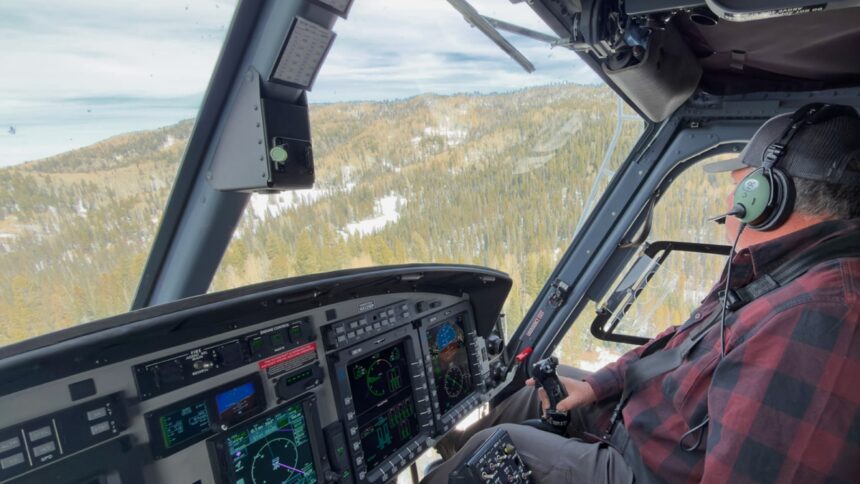
Using NASA Jet Propulsion Laboratory-developed lidar and imaging spectrometer technology, an aircraft operated by Airborne Snow Observatories mapped snow depth and water content across the entire watershed at high resolution.
Instead of extrapolating from a handful of monitoring stations, scientists can see how snow is distributed across hundreds of square miles.
“With basin-wide snow mapping, we can track where snow is building up and where it’s melting between flights,” said Vivoni, who is also Fulton Professor of Hydrosystems Engineering in the School of Sustainable Engineering and the Built Environment. “That level of detail across the landscape hasn’t been possible before.”
Why it matters for Arizona
Arizona’s water outlook is increasingly complex.
Colorado River supplies remain uncertain amid prolonged drought across the river basin and ongoing negotiations among basin states, while groundwater levels continue to decline. As those pressures grow, the reliability of Arizona’s in-state river systems, including the Salt and Verde rivers, becomes even more important for the Phoenix metropolitan area.
Why this research matters
Research is the invisible hand that powers America’s progress. It unlocks discoveries and creates opportunity. It develops new technologies and new ways of doing things.
Learn more about ASU discoveries that are contributing to changing the world and making America the world’s leading economic power at researchmatters.asu.edu.
That makes accurate snow forecasting increasingly valuable for water managers.
Knowing how much water is stored in mountain snow and how quickly it melts helps utilities like SRP make better decisions about reservoir operations and long-term planning.
Looking ahead
This winter’s flights marked the first time the airborne snow-mapping technology has been deployed in Arizona.
For ASU researchers, the goal goes far beyond measuring a single season’s snowpack.
Each survey helps improve the forecasting systems that scientists are developing to better track snowpack and predict runoff in the years ahead.
“We’re building toward what we call a ‘digital watershed twin,’ a virtual version of the basin that shows how water is changing over time,” Vivoni said. “By combining airborne data, satellite imagery and models, we can help water managers better track conditions and plan for what’s ahead.”
As water pressures intensify and Arizona’s water portfolio continues to evolve, the ability to more precisely measure the state’s “mountain savings account” will play an increasingly important role in how Valley cities manage their water.
Funding for this project came from: United States Bureau of Reclamation, Arizona Water Innovation Initiative, Salt River Project; collaborators included: Salt River Project, United States Bureau of Reclamation, Airborne Snow Observatories.
https%3A%2F%2Fwww.newswise.com%2Farticles%2Fasu-srp-snow-surveys-show-much-of-arizona-s-headwater-snowpack-melted-in-weeks%2F%3Fsc%3Drsla