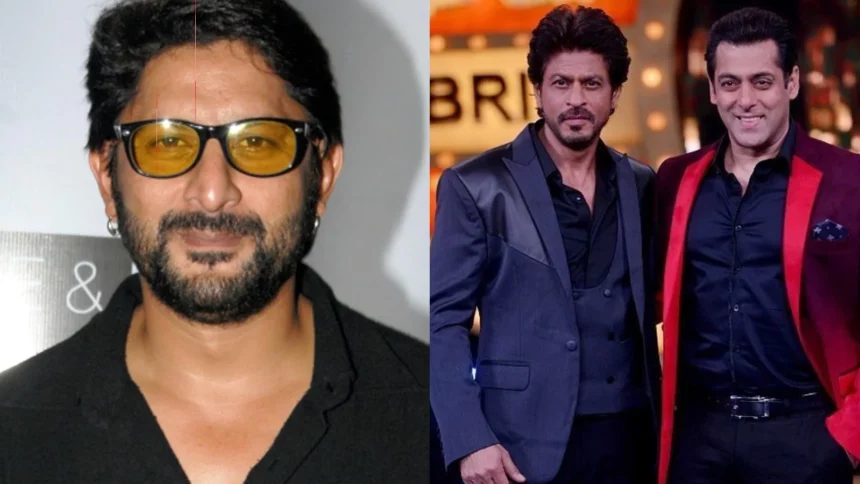
Actor Arshad Warsi has shared candid reflections on his experiences working with two of Hindi cinema’s biggest stars, Shah Rukh Khan and Salman Khan, offering a rare glimpse into their contrasting personalities, work ethics and off-screen demeanour. Speaking in a recent interview, Warsi described Shah Rukh Khan as a thorough gentleman with deep theatrical discipline, while characterising Salman Khan as a “bad boy” figure whose private persona, he said, is far more playful and warm than his public image suggests. The actor’s comments come as he prepares to reunite with Shah Rukh Khan on screen in an upcoming film slated for release in 2026.
Warsi’s observations have resonated widely because they come from someone who has worked closely with both superstars at different points in his career. Rather than fuelling rivalry narratives that often surround the two icons, his remarks focus on temperament, professionalism and human qualities, highlighting how stardom can coexist with very different approaches to life and work.
Shah rukh khan as an old-school professional and composed gentleman
Arshad Warsi spoke at length about his admiration for Shah Rukh Khan, recalling their earlier collaboration in the 2005 film Kuchh Meetha Ho Jaye. According to Warsi, Shah Rukh’s approach to acting reflects an old-school theatrical grounding, marked by preparation, discipline and respect for the craft. He noted that Shah Rukh arrives on set fully prepared, remembering all his dialogues and understanding the emotional and narrative demands of every scene.
Warsi emphasised that what sets Shah Rukh apart is not just his star power but his humility and composure. He said he has never witnessed Shah Rukh raise his voice on set, even under pressure, describing him as calm, respectful and supportive toward co-actors and crew members alike. This, Warsi suggested, creates an environment where others feel comfortable and encouraged to perform at their best.
Beyond professional conduct, Warsi also spoke about Shah Rukh’s personal values, mentioning that his children, Suhana and Aryan, are well-mannered and grounded. He attributed this to the family’s emphasis on humility despite extraordinary fame. Warsi recalled that when he was approached for Shah Rukh’s upcoming film King, he accepted the offer instantly, underscoring both his respect for the actor and his enthusiasm for working with him again.
In the interview, Warsi also echoed Shah Rukh’s own assessment of his place in Hindi cinema, agreeing with the superstar’s remark that he considers himself the last of a certain era of superstardom. Warsi said he believes Shah Rukh represents a unique blend of charisma, consistency and audience connection that is difficult to replicate in a rapidly changing industry. For him, Shah Rukh’s longevity is not merely the result of commercial success but of sustained discipline and emotional intelligence.
The forthcoming reunion in King is therefore seen not just as another casting announcement, but as a meeting of experience and mutual respect. With the film expected to release in 2026, fans are already keen to see how the dynamic between the two actors unfolds on screen, particularly given Warsi’s praise for Shah Rukh’s working style and creative seriousness.
Salman khan’s bad-boy image and the lighter side of his private life
In contrast, Arshad Warsi described Salman Khan as someone who carries the image of a “bad boy,” a label that has followed the actor throughout his career. Warsi clarified that this description was not meant as criticism but as a reflection of Salman’s public persona, which often projects toughness, rebellion and effortless charm. According to Warsi, Salman appears like a handsome, carefree bad-boy type, while Shah Rukh comes across as more refined and gentlemanly.
However, Warsi was quick to add that Salman’s private life presents a very different picture. He said that away from the spotlight, Salman is relaxed, humorous and deeply family-oriented. At home, Warsi noted, Salman jokes constantly and enjoys life with a sense of playfulness that contrasts sharply with his intense on-screen roles and media portrayal. He described the Khan household as lively and full of humour, suggesting that laughter and fun are central to their family dynamic.
Warsi stressed that there is nothing inherently negative about either personality. In his view, Shah Rukh and Salman simply represent two different ways of being, both as individuals and as stars. One embodies composure and old-world discipline, while the other thrives on spontaneity and a rebellious charm. Both, he said, have earned their place in Indian cinema through distinct strengths rather than through comparison or competition.
His remarks also touched on how public perception often simplifies complex personalities. Salman’s bad-boy image, Warsi implied, can overshadow the warmth and generosity he displays in private. By sharing these observations, Warsi offered a more nuanced understanding of the actor, reminding audiences that celebrity personas are often partial reflections rather than complete truths.
The contrast drawn by Warsi highlights a broader reality of the Hindi film industry, where superstardom accommodates a wide spectrum of temperaments and working styles. Both Shah Rukh Khan and Salman Khan have commanded massive fan followings for decades, yet they have done so without conforming to a single mould. Warsi’s reflections suggest that this diversity of personality may, in fact, be one of the reasons for their enduring appeal.
As Arshad Warsi looks ahead to sharing screen space with Shah Rukh Khan again in 2026, his comments serve as both a tribute and an insight. They reveal not just how two of Bollywood’s biggest stars differ, but how professionalism, humility, humour and individuality can coexist at the highest level of fame. For fans, these behind-the-scenes perspectives add depth to familiar faces, offering a reminder that icons are shaped as much by their character as by their performances.