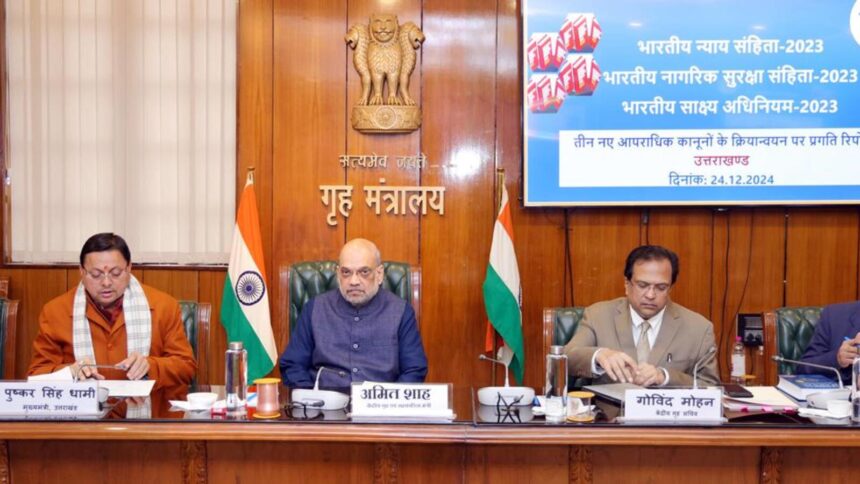
Union Home Minister Amit Shah on Monday chaired a review meeting in Delhi to assess Goa’s implementation of the newly introduced criminal laws. He emphasized that the primary objective of these laws is to ensure swift justice and urged officials to make Goa a “model state” for their execution.
During the meeting, Amit Shah took note of three key initiatives launched by the Goa Police and directed officials to evaluate their effectiveness and consider scaling them up for implementation in other states. The Union Ministry of Home Affairs (MHA) later released a statement emphasizing Amit Shah’s goal of achieving a 90% conviction rate in cases where the prescribed punishment exceeds seven years. He also instructed the police to ensure that recovered property from criminals is returned to rightful owners in accordance with the provisions of the new laws.
The high-level meeting was attended by the Union Home Secretary, Goa Chief Secretary, Goa Director General of Police (DGP), Director General of the Bureau of Police Research and Development (BPRD), Director of the National Crime Records Bureau (NCRB), and other senior officials from the MHA and Goa government.
Rahul Gupta, Superintendent of Police (SP), Crime and Cyber Crime, Goa, presented an overview of various initiatives launched by the Goa Police in the past year. Following the presentation, Amit Shah directed officials to closely study three of these initiatives.
The first initiative is an AI-based tool designed to analyze and detect “radical content” online. Developed in collaboration with BITS Pilani, Goa, the tool aims to counter extremist propaganda and online radicalization. It scans social media platforms and other online spaces for potentially radical content, including videos up to 25 minutes long in English, Hindi, and Urdu. SP Gupta stated that the tool is expected to be fully implemented in Goa by next month.
The second initiative, a ‘Quick Pass’ mobile application, is designed to streamline traffic compliance and improve vehicle movement. The app generates an instant QR code after a commuter undergoes document verification, which acts as proof of compliance. The QR code, sent as a web link via SMS, remains valid for 12 hours, preventing repeated document checks at multiple traffic points. Additionally, the app features real-time traffic data analysis, geo-tagging, and violation hotspot mapping to enhance overall traffic management.
The third initiative focuses on cybercrime prevention through a cloud-based call center for the 1930 cybercrime helpline. Developed under the AI and machine learning (AI-ML) lab of the Goa Police, the system enhances call-handling capabilities, allowing for real-time monitoring, conference calling, and efficient management of cyber scam reports. The call center is designed to manage a large volume of complaints, ensuring swift responses to victims of cyber fraud.
With the Home Minister’s directive, these innovative initiatives by the Goa Police could serve as a blueprint for wider implementation across the country, strengthening law enforcement and public service efficiency.