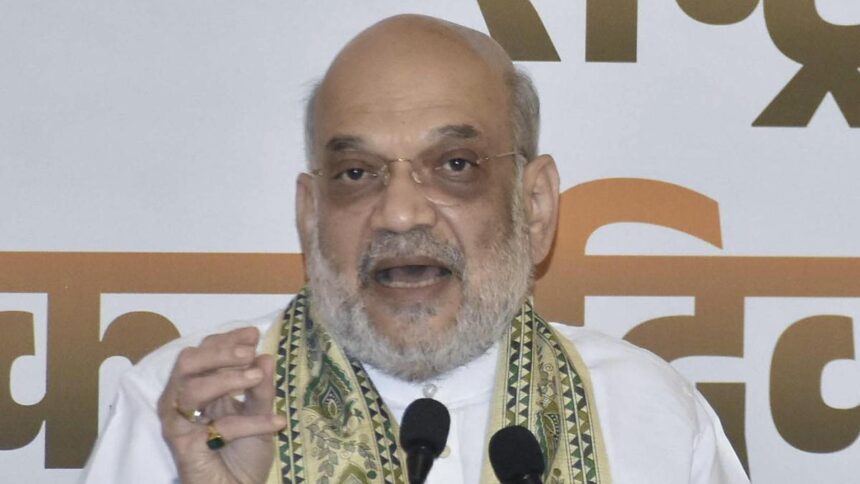
Union Home Minister Amit Shah launched a fierce political counterattack against Congress leader Rahul Gandhi during his campaign rallies in Bihar, accusing him of insulting India’s cultural heritage by making remarks about Chhath Puja. Amit Shah, addressing four consecutive rallies in poll-bound Bihar, claimed that Gandhi’s comments reflected a disconnect with Indian traditions and alleged that his “maternal roots in Italy” prevented him from understanding the country’s religious and emotional sentiments. The Home Minister asserted that the people of Bihar would “avenge the insult to Chhathi Maiyya” through the ballot box and predicted a complete wipeout of the INDIA bloc in the state.
Amit Shah’s Cultural Counterattack and Political Appeal
Amit Shah accused Rahul Gandhi of “denigrating Chhath Puja,” one of Bihar’s most sacred festivals, by allegedly mocking leaders who participated in the worship. “Rahul Baba said that Prime Minister Modi and others who worshipped Chhathi Maiyya were indulging in drama. His maternal roots are in Italy, and hence he is incapable of appreciating Indian sensibilities,” Amit Shah said at a rally, sparking loud cheers from the crowd. He urged voters to press the EVM buttons bearing NDA symbols “with such force that the tremors are felt in Italy.”
The Home Minister also accused the Congress and its allies in the INDIA bloc of disrespecting Indian culture repeatedly. He reminded the audience that just months ago, Congress workers in Bihar had allegedly hurled abuses at Prime Minister Modi’s mother. “The people of Bihar will not tolerate such insults. This is the land of devotion, culture, and sacrifice, and those who disrespect our deities will face the people’s wrath,” Amit Shah declared.
Continuing his cultural rhetoric, Amit Shah accused the Congress party of obstructing the construction of the Ram temple in Ayodhya for 70 years. He said, “For five centuries, people struggled for the Ram Mandir—from the Mughal period to the British rule—and yet Congress and its allies kept blocking it. It was Prime Minister Modi who finally fulfilled the centuries-old dream.” He praised the NDA government’s development of a modern university in Nalanda, stating that “no marauder like Bakhtiyar Khilji will ever be able to destroy it again.”
Amit Shah also highlighted the government’s efforts to promote religious tourism and preserve Bihar’s cultural identity. He announced that the Modi government had allocated nearly Rs 850 crore for the renovation and beautification of Punaura Dham in Sitamarhi district, believed to be the birthplace of Goddess Sita. “In two years, you will see Prime Minister Modi performing the consecration ceremony at Punaura Dham,” he said, drawing loud applause.
Beginning his Nalanda rally by invoking the names of Chanakya and Chandragupta Maurya, Amit Shah called them the “torchbearers of Indian statecraft” and claimed that the NDA was continuing their legacy by ensuring governance rooted in nationalism and good administration. He contrasted their historical contributions with what he described as the “lawlessness and corruption” of past regimes in Bihar.
Attacks on RJD, Praise for NDA’s Governance and Development
Amit Shah used his Bihar campaign trail to attack the Rashtriya Janata Dal (RJD) and its leaders, accusing them of reviving the “jungle raj” that plagued the state during the tenure of Lalu Prasad Yadav and Rabri Devi between 1992 and 2004. “Bihar witnessed over 32,000 kidnappings and 12 major massacres during the Lalu-Rabri rule. Nitish Kumar ended that jungle raj, but RJD now wants to bring it back with a new face,” Amit Shah alleged.
He also targeted Tejashwi Yadav, the INDIA bloc’s chief ministerial face, for claiming that the NDA would “recover with interest” money deposited into women’s bank accounts through welfare schemes. “Nobody can dare to take that money back. The RJD should stop misleading the women of Bihar,” Amit Shah said.
Drawing a sharp comparison between Nitish Kumar’s tenure and the RJD regime, Amit Shah said, “In the last 20 years of Nitish Kumar’s rule, not a single massacre has taken place in Bihar. Under RJD rule, Naxal-hit areas saw 38 massacres. Ever since Nitish Kumar joined hands with the NDA again, murders have dropped by 20 percent, and cases of dacoity and kidnapping have fallen by 80 percent.”
Amit Shah highlighted several development projects initiated under the NDA government. He said the Centre had invested Rs 18 lakh crore in Bihar’s roadways, railways, and expressway infrastructure, Rs 9,500 crore in reviving the Barauni fertilizer plant, and Rs 900 crore in new infrastructure projects in Munger. He also mentioned the creation of a Makhana Board and the granting of a Geographical Indication (GI) tag to the famous Katrani rice from the region.
Reiterating the Modi government’s commitment to Bihar’s progress, Amit Shah announced that a new medical college would be established in Lakhisarai within two years, named after Bihar’s first chief minister, Shri Krishna Sinha. “This is Modi’s guarantee to Bihar’s youth,” he said.
The Home Minister also sought to appeal to young voters by highlighting sports initiatives, saying, “We are preparing the youth of Bihar to win medals in the 2036 Olympics, which will be hosted in India.” He contrasted this vision with the alleged corruption and mismanagement of the UPA government, which he said had “looted the country through scams worth Rs 12 lakh crore.”
Amit Shah emphasized that neither Prime Minister Modi nor Chief Minister Nitish Kumar had ever been accused of corruption, unlike RJD leader Lalu Prasad Yadav, who he said was embroiled in multiple scandals including the fodder scam, land-for-jobs scam, bitumen scam, and flood relief scam. “Bihar has moved from corruption to construction under NDA,” Amit Shah said.
He credited Modi’s leadership for strengthening national security, citing the surgical strikes, Balakot airstrikes, and Operation Sindoor against Pakistan-backed terrorism. “During the UPA regime, terrorists spread mayhem across the country. But under Modi, India responds to attacks with power and precision,” Amit Shah said. He further pledged that the NDA government would “drive out infiltrators from Bihar who are stealing foodgrains meant for the poor and indulging in anti-national activities.”
At the end of his speech, Amit Shah appealed to voters to support NDA candidates, including Deputy Chief Ministers Vijay Kumar Sinha from Lakhisarai and Samrat Choudhary from Tarapur in Munger. Referring to them as future leaders, Amit Shah said, “They are on their way to becoming big men.” His endorsement of Choudhary, who has rapidly risen in the BJP ranks over the past decade, drew attention from the Congress, whose spokesperson Pawan Khera later remarked on X, “Only chief minister is bigger than the Deputy CM. Hope Nitish Kumar is listening.”
Throughout his campaign trail, Amit Shah sought to reinforce the narrative of cultural pride, governance stability, and development, while positioning the NDA as the defender of Bihar’s heritage and future. He projected the upcoming election as a referendum on respect for faith and culture, contrasting it with what he termed as “the politics of insult” practiced by the INDIA bloc. By invoking Chhathi Maiyya, Ram Mandir, and Sita’s birthplace, Amit Shah blended emotional and developmental appeals in a single narrative aimed at mobilizing voters across Bihar.