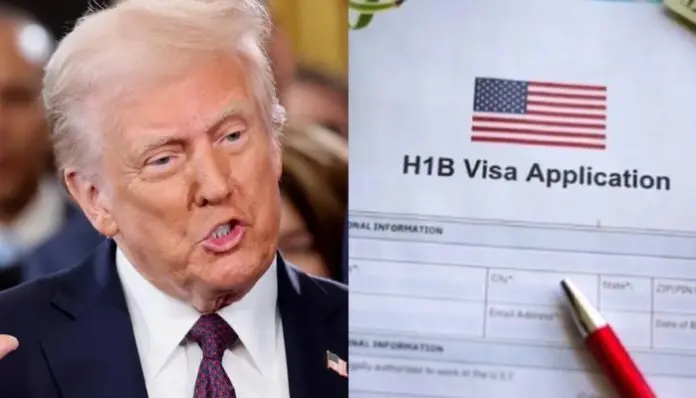
US President Donald Trump’s threat to hike tariffs on Indian goods has sparked a new wave of anti-immigration rhetoric from far-right Republicans. In a controversial social media post, Republican Congresswoman Marjorie Taylor Greene called on Donald Trump to go a step further and end the issuance of H1B work visas to Indians, alleging that they are replacing American jobs. Her remarks have ignited fresh debate around US-India trade relations, skilled immigration, and the impact of foreign workers on the American economy.
Marjorie Taylor Greene’s Push for H1B Restrictions
Marjorie Taylor Greene, a hard-right politician known for her nationalist stance and MAGA-aligned rhetoric, responded to Donald Trump’s recent post on Truth Social in which he announced a plan to “substantially raise” tariffs on Indian goods. Donald Trump cited India’s continued oil trade with Russia as a reason for this decision. Marjorie Taylor Greene, however, suggested an alternative punitive measure: stopping the issuance of H1B visas to Indian nationals.
Marjorie Taylor Greene claimed that Indian workers on H1B visas are replacing American employees in core sectors, particularly in technology. She argued that instead of raising tariffs, Donald Trump should prioritize protecting the American workforce by curbing skilled immigration. Her post also reflected her frustration with the broader direction of the Republican Party, which she accused of abandoning its “America First” principles.
The H1B visa program allows US companies to temporarily hire foreign professionals in specialty occupations such as information technology, engineering, and research. For decades, the US tech industry has relied heavily on Indian talent to fill positions in areas where there is a persistent shortage of local expertise.
According to data from previous years, Indian nationals consistently account for about 72% of H1B visa recipients. In 2023 alone, over 65% of H1B holders were employed in computer-related occupations, and their median salary was $118,000—nearly double the US national average. This data challenges the perception that foreign workers are undercutting wages or displacing American workers.
Diverging Views in Donald Trump’s Circle on H1B and Immigration
Marjorie Taylor Greene’s position is not universally shared among Republicans or even within Donald Trump’s own camp. Tech billionaire Elon Musk, who once aligned with Donald Trump but has since distanced himself, has supported the H1B visa system while calling for reform. He has argued that foreign-born talent strengthens America’s competitiveness, especially in high-tech industries.
In contrast, Donald Trump’s former strategist Steve Bannon has echoed Marjorie Taylor Greene’s hardline stance. Bannon has called for the complete elimination of H1B visas and even student visas, blaming them for weakening domestic labor and educational institutions. These opposing views underscore a deep ideological divide within the Republican Party regarding immigration and globalization.
Marjorie Taylor Greene has been increasingly vocal about her belief that Republicans are failing their working-class base by continuing to support immigration programs. In the same post where she called for ending H1B visas, she also demanded that the US stop sending financial aid to Ukraine. She blamed the ongoing Russia-Ukraine war on Democratic leadership—specifically former President Barack Obama and current President Joe Biden—as well as on what she termed “neocon” ideology, which supports global democratic expansion.
Meanwhile, Donald Trump’s post about raising tariffs on India has drawn attention to the geopolitical tension between Washington and New Delhi. Donald Trump criticized India’s “massive” purchases of Russian oil and argued that this economic behavior warranted punishment through elevated tariffs.
Last week, Donald Trump moved ahead with a 25% reciprocal tariff on Indian goods, including an additional penalty tied to India’s energy dealings with Moscow. The decision marks a renewed effort by Donald Trump to assert economic pressure on countries that maintain ties with Russia amid the ongoing conflict in Ukraine.
India has pushed back strongly against the move. In a public statement, the Ministry of External Affairs noted that both the US and the European Union have continued trade with Russia, particularly in the energy sector. It further reminded Washington that when the Russia-Ukraine war disrupted global oil supplies, the US itself had encouraged India to import Russian oil to maintain global market stability.
India stressed that the targeting of its economic decisions was unfair and politically motivated. The statement added that as a sovereign economy, India would take all necessary steps to protect its national interests and ensure economic security.
Donald Trump’s new tariff policy and the accompanying calls from Marjorie Taylor Greene to restrict skilled immigration are unfolding in the backdrop of a shifting global order. With the US presidential election on the horizon, these moves appear aimed at rallying Donald Trump’s conservative base by reigniting issues around nationalism, job protection, and economic sovereignty.
While Marjorie Taylor Greene’s proposal to end H1B visas for Indian nationals might resonate with some corners of the American electorate, it risks alienating powerful business interests and sectors dependent on global talent. The US tech industry, in particular, has repeatedly warned that restricting skilled immigration could stifle innovation and lead to a brain drain, as companies may be forced to move operations overseas.
Moreover, Marjorie Taylor Greene’s views reflect a broader isolationist trend gaining traction in far-right political circles. Her conflation of foreign policy, trade issues, and immigration underscores an inward-looking political strategy that prioritizes national security and economic independence over global cooperation.
Donald Trump, known for his unpredictability and transactional style, has yet to endorse Marjorie Taylor Greene’s call to end H1B visas. However, his record during his presidency shows that he has often flirted with restrictions on legal immigration, including a temporary freeze on H1B processing during the COVID-19 pandemic.
The current developments also highlight how India has become a flashpoint in US domestic politics. As a growing global power and strategic partner, India finds itself increasingly caught between its own national interests and the shifting political tides in Washington.
The debate around H1B visas is not new, but it has taken on renewed urgency in the face of rising protectionism, geopolitical rivalry, and upcoming elections. Whether Donald Trump chooses to heed Marjorie Taylor Greene’s suggestion or pursue a different course remains to be seen, but the implications of these policy choices will have far-reaching consequences for US-India relations, global talent mobility, and the future of the American workforce.