Prime Minister Narendra Modi has firmly declared that India will not compromise on the interests of its farmers, even in the face of economic challenges posed by steep new US tariffs. Responding to US President Donald Trump’s decision to raise import duties on Indian goods to 50%, PM Modi said that safeguarding the livelihoods of farmers, fishermen, and dairy workers remains his government’s top priority. The announcement came as part of PM Modi’s address at the MS Swaminathan Centenary International Conference in Delhi, where he paid tribute to the late agricultural scientist and reinforced India’s stance on self-reliance in the face of global pressure.
Donald Trump’s recent executive order imposes an additional 25% tariff on Indian exports, citing national security concerns linked to India’s continued oil trade with Russia. The order, which will take full effect in 21 days, excludes only those goods already in transit or explicitly exempted. This move has escalated tensions in US-India trade relations and could impact key sectors, including agriculture, textiles, and pharmaceuticals.
India refuses to yield on agricultural market access
One of the central friction points between the two countries has been Washington’s persistent demand for greater access to India’s agricultural sector. During recent trade negotiations, the US pushed for the removal of barriers on commodities such as corn, soybeans, and cotton, aiming to open India’s vast and protected rural market to American agribusinesses. However, the Indian government has consistently resisted such pressures, citing the risks such liberalization poses to millions of small and marginal farmers who depend on agriculture for survival.
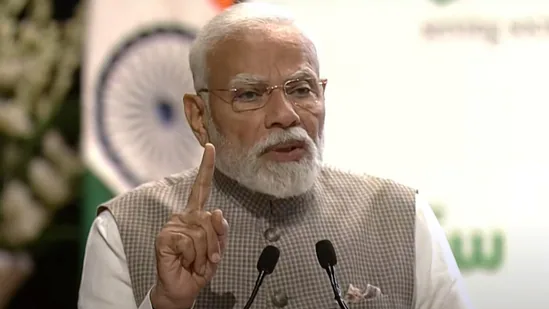
PM Modi, while addressing a gathering of agricultural scientists, policy experts, and farmers at the Swaminathan conference, made it clear that India is prepared to face the economic fallout of its protective stance. “For us, the interest of our farmers is our top priority,” he asserted. “India will never compromise on the interests of farmers, fishermen and dairy farmers. I know we will have to pay a heavy price for it, and I am ready for it. India is ready for it.”
Donald Trump’s move comes at a time when global trade tensions are already high, and India’s ties with Russia have drawn increasing scrutiny. According to the executive order, India’s ongoing purchases of Russian crude oil, whether directly or indirectly, are seen as a violation of US sanctions and a national security threat. The Biden administration had earlier shown flexibility, but Donald Trump’s return to hardline policies marks a shift in tone.
Swaminathan remembered as India’s agricultural visionary
While the tariff tensions dominated headlines, the event also marked a significant occasion in Indian agricultural history—the centenary of Mankombu Sambasivan Swaminathan, the father of India’s Green Revolution. PM Modi used the platform to honour Swaminathan’s immense contributions by releasing a commemorative coin and postage stamp in his name.
Swaminathan, who passed away in 2023 at the age of 98, played a transformative role in reshaping Indian agriculture during the 1960s and 70s. His pioneering work in introducing high-yielding varieties of wheat and promoting modern farming techniques helped India move from food-deficient to self-sufficient in grain production. At a time when the country faced widespread hunger and dependency on foreign aid, Swaminathan’s innovations provided a foundation for food security and rural development.
Born in 1925 in Kumbakonam, Tamil Nadu, Swaminathan remained committed throughout his life to advancing science in service of society. His focus was not just on yield but on sustainability, nutrition, and equity for smallholder farmers. PM Modi highlighted these values in his speech, urging India to continue Swaminathan’s legacy by investing in technology, soil health, and agricultural education.
As the government braces for a potential trade backlash, PM Modi’s speech appeared aimed at rallying both domestic support and international attention to India’s rural economy. By refusing to open up sensitive sectors to foreign competition, the administration is signalling that food security and farmer welfare are strategic priorities, not negotiable trade variables.
The new US tariffs, although yet to take full effect, could deal a blow to India’s export sectors. The textile industry, pharmaceutical exports, and certain food products are all likely to be affected. India had previously retaliated in 2019 by imposing tariffs on US goods, including almonds and apples, after the Donald Trump administration withdrew preferential trade status under the Generalized System of Preferences (GSP). Similar measures might be on the table again, although the Indian government has not officially announced any countersteps.
Donald Trump’s executive order includes provisions for adjustments based on how India and other countries respond, as well as the evolving nature of the “national emergency” cited in the order. This language leaves open the possibility of future negotiations or softening, depending on political developments in both countries.
Despite rising pressure, India’s messaging remains consistent: domestic producers come first. As PM Modi continues to position India as a global voice for the Global South and an advocate of self-reliance through “Atmanirbhar Bharat,” the agricultural sector is central to both his political vision and economic strategy. His comments serve as a warning that India will not be strong-armed into abandoning its rural base for short-term trade gains.
The unfolding situation now hinges on how both countries manage the tension between trade ambitions and domestic interests. With elections on the horizon in the US and key political transitions occurring globally, the durability of these tariffs and India’s strategic calculus may still evolve. For now, however, the message from New Delhi is unambiguous: India is prepared to pay the price to protect its farmers.