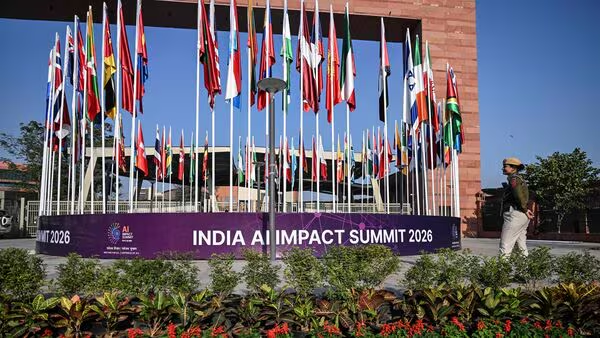
The AI Impact Summit 2026 opens in New Delhi with global leaders gathering to debate artificial intelligence’s promise, risks, and governance from a Global South perspective.
The Artificial Intelligence Impact Summit 2026 began on February 16 in New Delhi, marking a significant moment in India’s growing ambition to shape global conversations on emerging technologies. The five-day summit brings together political leaders, technology executives, researchers, and policymakers from across the world to discuss how artificial intelligence is transforming economies, societies, and governance systems. With participation expected from nearly 100 countries, the event underlines India’s intent to position itself not merely as a consumer of advanced technologies but as a key architect of global AI norms.
Prime Minister Narendra Modi formally inaugurated the summit by opening the India AI Impact Expo 2026, a sprawling exhibition showcasing India’s AI capabilities alongside pavilions from 13 other countries. The Expo is designed to highlight applications of artificial intelligence across sectors such as healthcare, agriculture, climate resilience, education, governance, and manufacturing. Officials described the Expo as a platform to demonstrate how AI can be leveraged to address developmental challenges while fostering innovation-led growth.
The summit is being held at Bharat Mandapam, a landmark venue that previously hosted the G20 Leaders’ Summit in 2023. The choice of venue carries symbolic weight, reinforcing India’s aspiration to remain at the centre of multilateral dialogue on global issues, from economic governance to digital transformation. Organisers emphasised that hosting the AI Impact Summit in India signals a deliberate effort to bring the perspectives of developing and emerging economies into debates that have so far been dominated by the Global North.
This year’s gathering is the fourth edition of the AI Impact Summit, following earlier meetings hosted by the United Kingdom, South Korea, and France. Indian officials have highlighted that this is the first time the summit is being convened in a Global South country, framing it as an opportunity to broaden the discourse on artificial intelligence beyond advanced economies. The focus, they said, will be on balancing innovation with inclusion, safety, and ethical responsibility.
Global Participation and India’s Strategic Push on Artificial Intelligence
The AI Impact Summit 2026 has drawn an impressive roster of global technology leaders and policymakers, reflecting the growing urgency around artificial intelligence governance. Among the most prominent industry figures expected to attend are Sundar Pichai, the chief executive of Google, and Sam Altman, who has emerged as one of the most influential voices in the AI sector. Their presence underscores the central role that private technology companies play in shaping the development and deployment of advanced AI systems.
Delegations from around 20 countries, including Brazil and France, are expected to participate at senior political and ministerial levels. In total, representatives from nearly 100 countries are slated to attend various sessions, workshops, and side events throughout the week. This broad participation reflects the global nature of AI-related challenges, which range from data governance and algorithmic bias to workforce disruption and national security concerns.
For India, the summit represents a strategic opportunity to articulate its vision for artificial intelligence as a tool for inclusive development. Government officials have repeatedly stressed that India’s approach to AI is anchored in solving real-world problems at scale, particularly in areas affecting large populations. Initiatives showcased at the Expo include AI-driven diagnostic tools for rural healthcare, predictive models for crop management, language technologies designed to bridge digital divides, and governance platforms aimed at improving service delivery.
India has also used the summit to highlight its growing ecosystem of startups and research institutions working on artificial intelligence. With a large pool of engineering talent and a rapidly expanding digital economy, the country has emerged as a significant hub for AI innovation. Policymakers argue that India’s experience in deploying digital public infrastructure, such as identity and payments systems, offers valuable lessons for integrating AI into public services while safeguarding privacy and accountability.
At the multilateral level, Indian representatives are expected to push for greater cooperation among countries on AI standards, safety frameworks, and capacity building. Officials have indicated that discussions at the summit will explore mechanisms for sharing best practices, promoting interoperability, and ensuring that smaller and less-developed economies are not left behind in the AI race. The emphasis on collaboration reflects concerns that fragmented regulatory approaches could stifle innovation or exacerbate global inequalities.
The summit agenda also includes deliberations on the economic implications of artificial intelligence, particularly its impact on jobs and productivity. As automation and generative AI tools become more widespread, governments face mounting pressure to manage workforce transitions and invest in reskilling initiatives. Indian officials have framed this challenge as an opportunity to create new categories of employment while upgrading existing skills, provided that policy frameworks keep pace with technological change.
Controversies, Ethics, and the Global South Narrative
While the AI Impact Summit 2026 has been positioned as a forward-looking forum, it has not been without controversy. The expected participation of Bill Gates has drawn criticism from some quarters due to renewed scrutiny over his past association with convicted sex offender Jeffrey Epstein. Critics argue that the presence of high-profile figures facing reputational questions risks diverting attention from substantive policy discussions, while supporters contend that the focus should remain on the issues at hand rather than individual controversies.
Organisers have sought to keep the spotlight on the ethical and governance dimensions of artificial intelligence, which form a central pillar of the summit’s discussions. Sessions are expected to address concerns around data privacy, surveillance, misinformation, and the potential misuse of AI in both civilian and military contexts. With generative AI tools increasingly capable of producing realistic text, images, and videos, policymakers are grappling with the implications for democratic processes and public trust.
A key theme running through the summit is the need to ensure that AI development aligns with human values and societal priorities. Speakers are expected to emphasise the importance of transparency, accountability, and explainability in AI systems, particularly those deployed in sensitive areas such as law enforcement, finance, and healthcare. The challenge, as many participants acknowledge, lies in translating high-level ethical principles into enforceable rules and technical safeguards.
The Global South narrative has been prominently woven into the summit’s framing, reflecting India’s desire to amplify the voices of developing countries in global technology debates. Officials have argued that AI systems trained predominantly on data from advanced economies may fail to account for the linguistic, cultural, and socioeconomic diversity of the Global South. As a result, there is a risk that AI applications could reinforce existing biases or prove ill-suited to local contexts.
By hosting the summit, India aims to highlight alternative models of AI deployment that prioritise accessibility and affordability. Examples presented at the Expo demonstrate how AI can be adapted to low-resource settings, from voice-based interfaces for populations with limited literacy to decision-support tools for small-scale farmers. These use cases are intended to counter narratives that frame AI primarily as a driver of efficiency and profit in high-income markets.
Another area of focus is international cooperation on AI safety and risk management. With advanced AI systems evolving rapidly, there is growing recognition that unilateral approaches may be insufficient to address cross-border challenges. Discussions at the summit are expected to explore the feasibility of shared safety benchmarks, incident reporting mechanisms, and collaborative research on alignment and robustness.
The summit also reflects a broader geopolitical context in which artificial intelligence has become a strategic asset. Countries are increasingly viewing AI capabilities as integral to economic competitiveness and national security, raising concerns about technological fragmentation and rivalry. Indian officials have positioned the summit as a platform to promote dialogue and trust-building, even as global competition intensifies.
As the AI Impact Summit 2026 unfolds over the coming days, it is set to serve as a focal point for debates that will shape the future of artificial intelligence governance. By bringing together a diverse array of voices in New Delhi, the event underscores the growing consensus that the benefits and risks of AI must be addressed collectively, with due consideration for the needs and perspectives of the developing world.