In the aftermath of a sweeping defeat for Opposition parties in Maharashtra’s municipal council elections, the Shiv Sena (UBT) has begun recalibrating its political strategy for the crucial Brihanmumbai Municipal Corporation elections by approaching the Congress leadership, even as it continues parallel negotiations with the Maharashtra Navnirman Sena, reflecting growing urgency to prevent further fragmentation of anti-BJP votes in Mumbai.
Sena (UBT) reassesses alliances after Mahayuti sweep in civic polls
The decisive victory of the ruling Mahayuti alliance in the municipal council elections has sent shockwaves through the Opposition camp in Maharashtra, forcing parties to reassess long-held assumptions ahead of the Brihanmumbai Municipal Corporation elections scheduled for January 15. The Mahayuti’s success, securing more than 207 of the 288 municipal councils, has underscored the risks of a divided Opposition and sharpened focus on alliance-building in Mumbai, where control of the country’s richest civic body carries both political and symbolic weight.
Against this backdrop, the Shiv Sena (UBT), led by Uddhav Thackeray, has reached out to the Congress in a bid to explore a possible alliance for the BMC polls. This outreach marks a notable shift in tone, coming after weeks in which the Sena (UBT) had prioritised a tie-up with Raj Thackeray and appeared prepared to sideline its Maharashtra Vikas Aghadi partners if necessary.
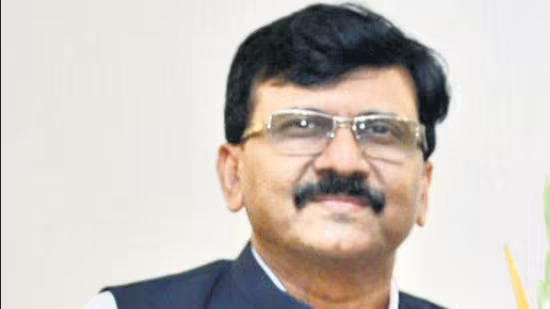
According to sources familiar with the developments, Sena (UBT) leader and Rajya Sabha MP Sanjay Raut contacted Rahul Gandhi to urge the Congress to reconsider its decision to contest the BMC elections independently in Mumbai. Raut reportedly conveyed concerns that without a broader Opposition alliance involving the Congress, Sena (UBT), and possibly the MNS, anti-BJP votes would be split, creating an easier path for the BJP to retain or expand its influence in the civic body.
The move comes after the Congress publicly declared that it would stay separate from its MVA partners in Mumbai, citing its unwillingness to align with the MNS. Instead, the Congress has initiated talks with the Vanchit Bahujan Aghadi led by Prakash Ambedkar, signalling a different approach to coalition-building rooted in social justice politics rather than Marathi identity consolidation.
Uddhav Thackeray’s initial preference for an alliance with his cousin Raj Thackeray was driven by the belief that a reunited Thackeray front could consolidate the Marathi-speaking vote in Mumbai, traditionally a strong base for the Shiv Sena. When the Congress refused to accept an arrangement that included the MNS, Sena (UBT) leaders chose to proceed with Raj Thackeray, calculating that Marathi consolidation would outweigh the risks of alienating other allies. However, the scale of the Mahayuti’s victory in the civic polls appears to have altered that assessment.
Within Sena (UBT), there is growing recognition that electoral arithmetic in Mumbai is more complex than a single-vote-bank strategy. Party leaders privately acknowledge that while a Sena (UBT)–MNS alliance could perform well in Marathi-dominated wards, it may struggle in constituencies where Dalit and Muslim voters play a decisive role. This has renewed interest in bringing the Congress back into the equation, given its traditional support among these communities.
At the same time, the response from Rahul Gandhi remains unclear, and neither party has issued an official statement on the outreach. The silence reflects the delicacy of the situation, with Congress leaders wary of being seen as bending under pressure while Sena (UBT) attempts to balance competing alliance priorities.
Congress dilemma, MNS talks and the battle for Mumbai’s voter blocs
The Congress’s reluctance to engage with the MNS has become a central fault line in Opposition negotiations. Senior Congress leaders in Maharashtra have consistently argued that an alliance involving Raj Thackeray could alienate sections of the party’s core voter base, particularly minorities and Dalits. This concern has driven the party’s decision to chart an independent course in Mumbai and to explore an understanding with the Vanchit Bahujan Aghadi instead.
Initial discussions between Congress leaders and Prakash Ambedkar have already taken place, with both sides expressing cautious optimism about a possible alliance. However, negotiations are still at an early stage, with disagreements over seat-sharing and leadership roles yet to be resolved. Ambedkar has reportedly sought a substantial number of seats, reflecting his belief that the VBA’s vote share can be a critical factor in tightly contested wards.
The Congress’s position is further complicated by internal dynamics within its Mumbai unit. Several senior leaders, including city unit chief Varsha Gaikwad, have openly opposed any alliance that includes the MNS. They have also expressed resentment over remarks by Sena (UBT) leaders suggesting that the Congress has lost its organisational base in Mumbai. These tensions have made it politically difficult for the Congress to reverse course without appearing weak or inconsistent.
At the same time, Congress leaders point to their own performance in the first phase of civic polls as evidence of enduring relevance. The party secured victories in 28 councils, outperforming its MVA partners, and saw 41 of its candidates elected as presidents of civic bodies. According to state Congress chief Harshvardhan Sapkal, more than 1,000 Congress candidates were elected as councillors, achievements he attributes to grassroots support despite what he described as the misuse of power and money by ruling parties.
For Sena (UBT), the challenge lies in stitching together a coalition that can replicate the social coalition that worked in the Lok Sabha elections, where the MVA’s Marathi–Dalit–Muslim combination delivered strong results in Mumbai. Party leaders argue that this alliance helped Sena (UBT) win three of the city’s six parliamentary seats, even though the formula failed to translate into success in the subsequent assembly elections.
A senior Sena (UBT) leader noted that there are around 60 to 70 seats in Mumbai where Marathi-speaking voters are decisive and where a Sena (UBT)–MNS alliance could be particularly effective. However, the leader added that at least 30 seats are heavily influenced by Dalit and Muslim voters, making Congress participation crucial for a comprehensive Opposition challenge. Without unity, these leaders fear, vote-splitting could hand these seats to the BJP by default.
Meanwhile, talks between Sena (UBT) and the MNS are reportedly nearing completion. Sanjay Raut has indicated that several rounds of discussions have taken place and that an announcement on their alliance is imminent. Adding another layer of complexity, the Sharad Pawar-led NCP (SP) has conveyed its willingness to join a broader alliance involving Sena (UBT) and the MNS, further reshaping the Opposition landscape.
The evolving negotiations highlight the strategic crossroads facing Mumbai’s Opposition parties. With the BMC election looming and the Mahayuti riding high on recent victories, each party must decide whether ideological differences outweigh the practical need for unity. Sena (UBT)’s outreach to Rahul Gandhi underscores the urgency of this moment, even as the Congress weighs the risks of association against the costs of isolation.
As alliances are debated behind closed doors, the broader political message is clear: Mumbai’s civic battle will not be decided by sentiment alone, but by careful arithmetic, voter mobilisation, and the ability of Opposition parties to present a united alternative. Whether that unity can be achieved amid competing ambitions and ideological red lines remains one of the most consequential questions ahead of the BMC polls.