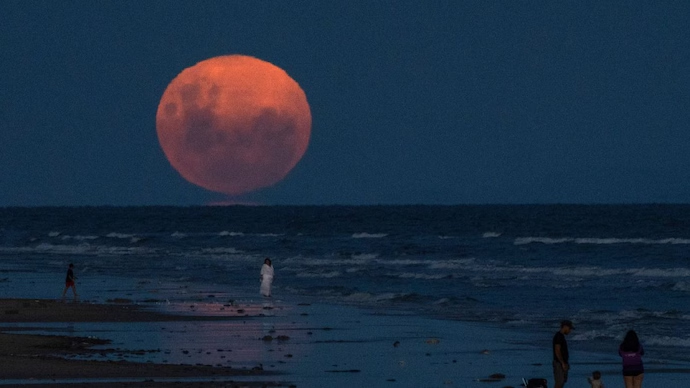
Stargazers across India are set to witness one of nature’s most dramatic sky events as a rare total lunar eclipse transforms the Moon into a glowing red orb. Popularly known as a Blood Moon, this celestial event occurs when the Earth moves directly between the Sun and the Moon, casting its shadow across the lunar surface. Unlike solar eclipses, this spectacle is completely safe to watch with the naked eye and promises a memorable experience for sky enthusiasts.
Why does the Moon turn red during a total lunar eclipse?
A total lunar eclipse happens only during a full Moon when the Sun, Earth, and Moon align almost perfectly in a straight line. As the Moon enters Earth’s darkest shadow region, known as the umbra, direct sunlight is blocked.
Instead of disappearing into darkness, the Moon glows in a deep red or copper shade. This is why it is called a Blood Moon.
The reason lies in a phenomenon known as Rayleigh scattering. Earth’s atmosphere scatters shorter blue wavelengths of sunlight while allowing longer red wavelengths to pass through. These red rays bend around Earth’s edges and illuminate the Moon.
If you were standing on the Moon during this event, you would see Earth blocking the Sun completely. Around Earth’s dark silhouette, you would notice a glowing ring made up of every sunrise and sunset happening simultaneously across the planet. That reddish light is what gives the Moon its dramatic colour.
The intensity of the red shade depends on atmospheric conditions. If there is dust, smoke, pollution, or volcanic particles in the air, the Moon may appear darker crimson. On clearer nights, it may look orange or copper.
Total lunar eclipses do not occur every month because the alignment of the Sun, Earth, and Moon must be nearly perfect. This makes each total eclipse a relatively rare and special event.
When and how to watch the total lunar eclipse in India
For viewers in India, the eclipse will unfold in phases during the evening and night.
The partial phase begins first, as the Moon gradually darkens. The totality phase, when the Moon turns fully red, is the most spectacular part of the event.
The eclipse will be visible from many parts of India, provided the skies are clear. Cloud cover may affect visibility in some regions.
Unlike a solar eclipse, you do not need any protective eyewear. It is perfectly safe to observe a lunar eclipse with the naked eye. However, using binoculars or a small telescope can enhance the experience by revealing lunar craters and surface details bathed in red light.
How to capture the Blood Moon on your phone
Photographing a lunar eclipse can be rewarding with a few simple adjustments.
Use a tripod or keep your phone steady to avoid blurry images during longer exposures. Turn off the flash, as it will not help when photographing the Moon. Manually adjust the focus to ensure the Moon appears sharp.
Since the Moon becomes dimmer during totality, slightly increasing the ISO setting can help capture its reddish glow. Many smartphones now offer night mode or pro mode, which can improve low-light photography.
This rare total lunar eclipse offers an opportunity to observe the beauty of celestial mechanics in action. As Earth’s shadow slowly envelops the Moon and turns it red, skywatchers across India can witness a quiet yet powerful reminder of the dynamic universe above.