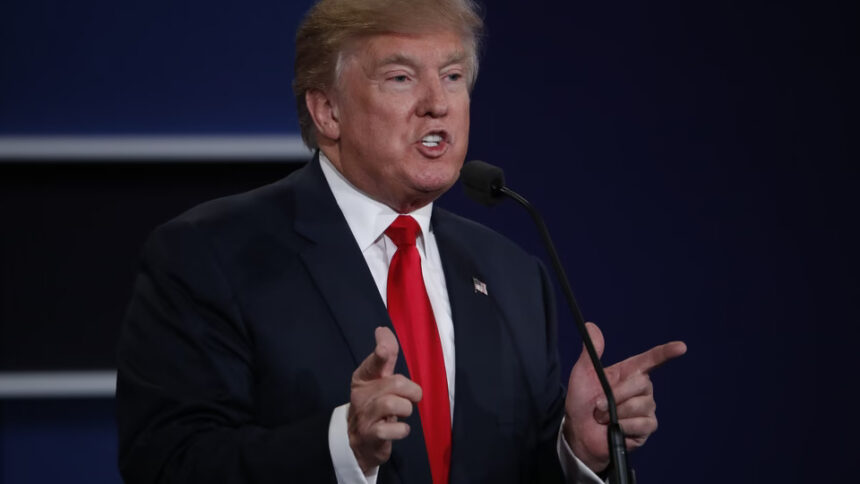
Former United States President Donald Trump has once again raised concerns over the Joe Biden administration’s decision to allocate $21 million to India for “voter turnout,” suggesting that the funds may have been used to influence the country’s electoral process. Addressing a summit in Miami on Thursday, Donald Trump openly questioned the rationale behind such international spending and hinted at possible political motivations.
“Why do we need to spend $21 million on voter turnout in India? I guess they were trying to get somebody else elected. We have got to tell the Indian government… This is a total breakthrough,” Donald Trump stated, criticizing the allocation of United States taxpayer money for electoral activities in another sovereign nation.
His remarks followed disclosures by the United States Department of Government Efficiency, an agency led by billionaire entrepreneur Elon Musk, which revealed that the United States Agency for International Development had contributed $21 million towards increasing voter turnout in India. The agency, also known as the Department of Government Efficiency, was originally established by Donald Trump to curb unnecessary government expenditure.
The disclosure of these funds has sparked controversy, particularly since the Department of Government Efficiency report listed the amount as part of a series of international financial allocations that were later canceled. Alongside the $21 million to India, the report mentioned an additional $29 million intended for “strengthening the political landscape in Bangladesh,” a country that has seen political unrest amid allegations of United States involvement in the ouster of former Prime Minister Sheikh Hasina. Another $39 million was earmarked for “fiscal federalism” and “biodiversity conservation” in Nepal.
Donald Trump used the Miami summit to further defend the Department of Government Efficiency’s actions in cutting these expenditures, arguing that the agency had already saved over $55 billion in a single month by eliminating such foreign aid programs. “Over the past month, we have effectively eliminated the United States Agency for International Development, which was funding much of this lunacy,” he said. “In less than a single month, the Department of Government Efficiency has already saved over $55 billion – and we’re just getting started. We will rapidly grow our economy by dramatically shrinking the federal government.”
Earlier, during an address at his Mar-a-Lago residence in Florida, Donald Trump reiterated his concerns about why United States taxpayer money was being directed to India when, according to him, the country has significant financial resources of its own. “Why are we giving $21 million to India? They got a lot more money. They are one of the highest taxing countries in the world in terms of us; we can hardly get in there because their tariffs are so high. I have a lot of respect for India and their prime minister, but giving $21 million for voter turnout? In India? What about voter turnout here?” he remarked.
The revelations and subsequent comments by Donald Trump have sparked political debates in India as well. The ruling Bharatiya Janata Party criticized the United States Agency for International Development’s funding, calling it an instance of external interference in India’s electoral process. Bharatiya Janata Party leader Amit Malviya pointed out that the ruling party had nothing to gain from such financial allocations, implying that it was aimed at supporting opposition parties. “Who gains from this? Not the ruling party for sure!” Amit Malviya stated.
He further linked the funding to what he described as “systematic infiltration” of Indian institutions by foreign entities, citing Hungarian-born American billionaire George Soros, who has been accused by conservative political figures worldwide of influencing domestic politics through his Open Society Foundations. “Once again, it is George Soros, a known associate of the Indian National Congress and the Gandhi family, whose shadow looms over our electoral process,” Amit Malviya claimed.
Additionally, Amit Malviya flagged a controversial 2012 memorandum of understanding signed between the Election Commission of India and The International Foundation for Electoral Systems, an organization with alleged links to George Soros’s Open Society Foundations.
The funding controversy has reignited discussions on foreign influence in Indian elections and the broader implications of international financial contributions to democratic processes in sovereign nations.