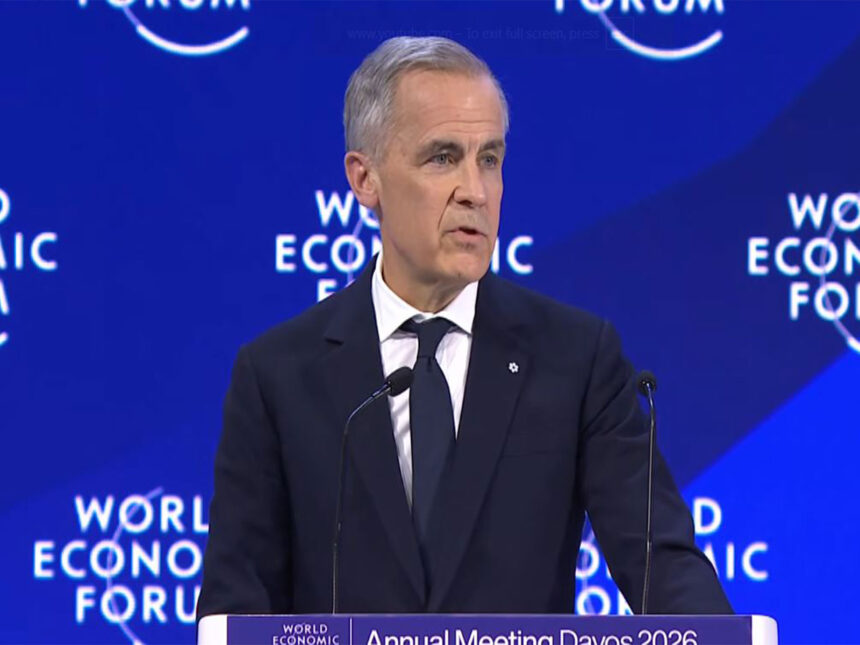
Davos [Switzerland], January 20 (ANI): Canadian Prime Minister Mark Carney on Tuesday warned that the world is witnessing a fundamental “rupture” in the global order rather than a gradual transition, cautioning against weaponising trade, finance, and supply chains.
In his address at the 56th Annual Summit of the World Economic Forum (WEF), Carney opposed tariff coercion in a veiled reference to Washington –including measures linked to Greenland–and urged renewed multilateral engagement to safeguard sovereignty, stability and prosperity.
The Canadian PM noted that the era of a stable, rules-based international system had given way to a harsher geopolitical reality marked by great power rivalry.
“Today, I will talk about a rupture in the world order–the end of a pleasant fiction and the beginning of a harsh reality, where major geopolitical powers operate with few limits and constraints… Countries like Canada have the capacity to help build a new order that reflects our values, including respect for human rights, sustainable development, solidarity, sovereignty, and territorial integrity,” Carney said.
“Every day, it seems we are living in an era of great power rivalry, where the rules-based order is fading, the strong do what they can, and the weak suffer what they must… This aphorism of vicissitudes is presented as inevitable, as if the natural logic of international relations is simply reasserting itself,” he added, stating that the world was facing a rupture, “not a transition.”
Canada acknowledged that the current international system was never perfect, noting that powerful states such as the US often bent or ignored rules when convenient.
However, he said that the framework set up by Washington had still delivered global public goods such as open sea lanes, a stable financial system, collective security and mechanisms for dispute resolution.
“For decades, countries like Canada prospered under the rules-based international order. Because of this, we valued a foreign policy aimed at protecting it. We knew that the story of a rules-based international system was partially false: the strongest often exempted themselves when convenient, trade rules were enforced asymmetrically, and international law applied differently to the accused and the victim,” he said.
“This fiction was nevertheless useful. American hegemony helped provide public goods–open sea lanes, a stable financial system, collective security, and frameworks for resolving disputes. We participated in this ritual and largely avoided calling out the gaps between rhetoric and reality,” Carney added.
“That bargain no longer works,” he further noted, warning that economic integration is increasingly being used as a tool of coercion. Tariffs, financial infrastructure and supply chain dependencies are now being leveraged to exert pressure on sovereign states, undermining the very premise of mutual benefit through globalisation.
Carney’s remarks were a subtle reference to US President Donald Trump’s recent tariff threats against European allies over his intention to purchase of Greenland.
Highlighting the risks of this shift, the Canadian leader cautioned that a world retreating into protectionism and economic fortresses would be poorer, more fragile and less sustainable, while acknowledging that many countries are now seeking greater strategic autonomy to protect themselves, arguing that isolation and unilateralism are not viable long-term solutions.
“You cannot live within the lie of mutual benefit through integration when integration becomes the source of your subordination. As a result, many countries have drawn the same conclusion: they must develop greater strategic autonomy… This impulse is understandable. When rules do not protect you, you must protect yourself,” the Canadian PM said.
“But we must be clear about where this leads. A world of fortresses will be poorer, more fragile, and less sustainable… If great powers abandon even the pretence of rules and values in pursuit of unchecked power and interests, the gains from globalisation will be far harder to replicate… Hegemons cannot continue to monopolise their relationships. Allies will diversify to hedge against uncertainty. They will buy insurance, increase options, and seek greater sovereignty. This is classic risk management,” he noted.
Calling for cooperation over confrontation, Carney said the costs of strategic autonomy and sovereignty could be shared through common standards, reduced fragmentation and complementary economic partnerships, underlining that adaptation to the new geopolitical reality was essential, but said the choice lay between “building higher walls” or pursuing more ambitious cooperative frameworks.
“The costs of strategic autonomy and sovereignty can also be shared. Shared standards reduce fragmentation, complementarities create positive-sum outcomes, and for Canada, adaptation to this new reality is not optional–it is essential. The question is whether we respond by building higher walls or by pursuing something more ambitious,” Carney said.
In this context, he stated that Canada is actively diversifying its economic partnerships and negotiating free trade agreements with India, ASEAN, Thailand, the Philippines and the Mercosur bloc.
He also opposed the use of tariffs linked to Greenland, calling instead for focused dialogue to advance shared objectives of security and prosperity in the Arctic region.
Reaffirming its commitment to multilateralism, Canrey said it would continue working with like-minded partners to defend sovereignty, territorial integrity and sustainable development, warning that unchecked power politics would only deepen global instability. (ANI)