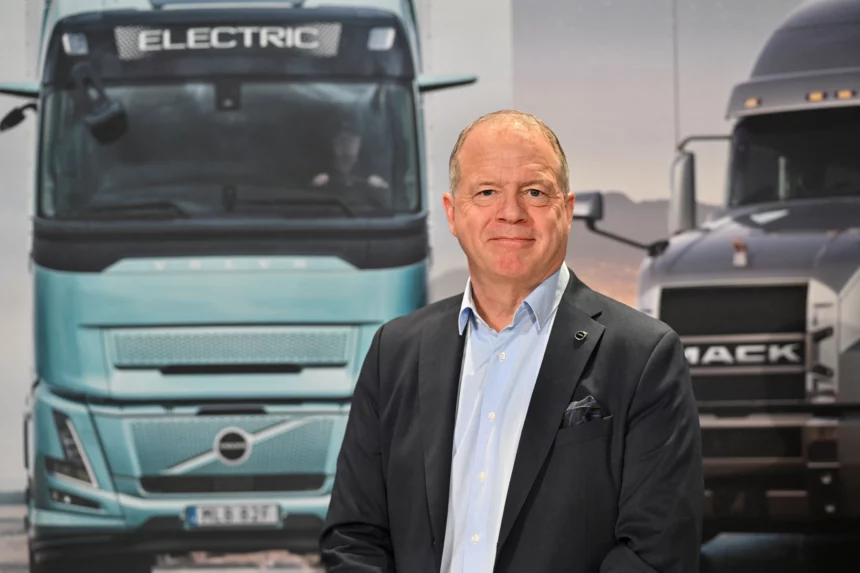
Volvo Group, the Swedish commercial vehicle manufacturer, has revealed plans to lay off up to 800 employees across its U.S. operations after experiencing a significant drop in earnings for the first quarter of 2025. The company’s decision comes in response to weakening demand for heavy-duty trucks and the ongoing challenges posed by global trade tensions. As Volvo faces a sharp decline in profits, the company has also adjusted its forecast for the North American truck market, anticipating slower sales this year.
Job Cuts and Financial Challenges
The job reductions will be rolled out over the next three months and will affect workers at various Volvo facilities, including Mack Trucks in Macungie, Pennsylvania, and Volvo Group sites in Dublin, Virginia, and Hagerstown, Maryland. The company has faced difficulties due to a 9% year-over-year drop in vehicle deliveries, primarily driven by economic uncertainty and changing trade dynamics, such as the U.S.-China tariff dispute. Martin Lundstedt, Volvo’s CEO, acknowledged the tough conditions in a statement, noting that the company needs to adjust its operations to align with the evolving market.
In its financial results, Volvo reported a $500 million decline in operating income for Q1 2025, with profits falling to SEK 13.3 billion (approximately $1.39 billion) from SEK 18.2 billion in the same period the previous year. This sharp drop in earnings fell short of market expectations, prompting the company to revise its outlook for North America. Originally expecting sales of 300,000 heavy-duty trucks in North America, Volvo has now adjusted its projection to 275,000 units for 2025.
Concerns Over Market Conditions and Trade Issues
Despite maintaining its European forecast at 290,000 units, Volvo highlighted that both North America and Europe remain vulnerable to economic fluctuations and shifting trade policies. The revised outlook also reflects broader concerns in the global automotive industry about inflationary pressures, slower economic growth, and the impact of new tariffs. As part of its response to these challenges, Volvo continues to focus on adapting its production and cost structure to meet the current demand environment.
In the wake of this news, Volvo’s stock dropped by 1.7% in early trading. However, the company reassured investors that it remains dedicated to long-term innovation, particularly in clean transport solutions, despite facing tough conditions in the short term.