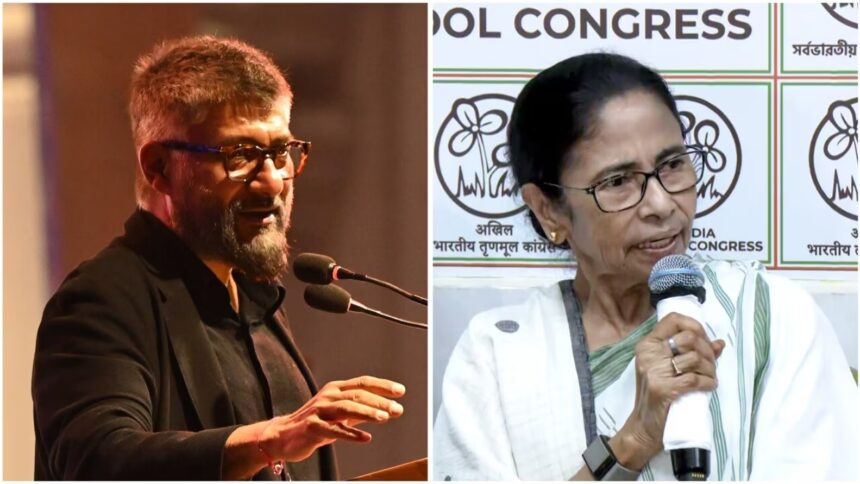
Vivek Agnihotri Alleges Bengal Ban Culture After Mamata Banerjee’s Electoral Defeat
Filmmaker Vivek Agnihotri has reacted strongly following the dramatic political developments in West Bengal, where the Bharatiya Janata Party secured a major electoral breakthrough against Chief Minister Mamata Banerjee in the Bhabanipur constituency. The director used the moment to revisit his long-running allegations against the Trinamool Congress government, claiming that he was “cancelled” in Bengal and that his films faced systematic suppression inside the state.
The political atmosphere in West Bengal changed dramatically after the election results triggered intense reactions across political and entertainment circles. Among the most vocal responses came from Vivek Agnihotri, whose films over the last few years have frequently generated controversy and political debate across India.
Taking to Instagram on May 5, the filmmaker shared a lengthy statement celebrating what he described as a “historic” and “unprecedented” political shift in Bengal. In the same post, he accused the Mamata Banerjee-led administration of allegedly targeting him personally and obstructing the release and promotion of his films within the state.
Agnihotri specifically referred to The Kashmir Files and The Bengal Files, two projects that generated major nationwide discussion because of their politically sensitive themes and historical narratives.
According to the filmmaker, The Kashmir Files was allegedly removed from theatres in West Bengal after its release, while he himself was supposedly prevented from entering the state. He further claimed that The Bengal Files faced even stronger resistance before and after its release.
In his statement, Vivek Agnihotri wrote that he had effectively been “cancelled” in Bengal following the success of The Kashmir Files. He alleged that the West Bengal government blocked the trailer launch of The Bengal Files, filed multiple FIRs against him, and created an environment where screenings and promotional activities became extremely difficult.
The filmmaker also alleged that members of his team faced attacks and intimidation during attempts to promote the film in the state. According to Agnihotri, despite these obstacles, supporters and volunteers continued showing the film through unofficial channels during the election period.
He described this effort as a symbolic resistance movement against what he called censorship and suppression.
The Instagram post quickly went viral across social media platforms, triggering strong reactions from both supporters and critics. Supporters praised Agnihotri for speaking openly against political pressure, while critics accused him of politicising cinema and using election results to further ideological narratives.
The controversy once again highlighted the increasingly blurred lines between politics, cinema, and public discourse in India.
Vivek Agnihotri has emerged as one of the country’s most politically discussed filmmakers in recent years. His films frequently focus on controversial historical and political subjects, often sparking nationwide debates over representation, historical interpretation, and ideological messaging.
The Kashmir Files, released in 2022, became one of the most polarising films in recent Indian cinema history. The movie depicted the exodus of Kashmiri Pandits during the insurgency in Jammu and Kashmir in the 1990s. While supporters praised the film for bringing attention to the suffering of displaced Kashmiri Pandits, critics accused it of promoting communal narratives and political polarisation.
The film nevertheless became a major commercial success and significantly elevated Vivek Agnihotri’s public profile.
Following that success, Agnihotri announced The Bengal Files, another politically sensitive project based on historical violence linked to the 1946 Direct Action Day and the Noakhali riots in undivided Bengal.
The film featured actors including Mithun Chakraborty, Anupam Kher, Pallavi Joshi, Darshan Kumaar, and Simrat Kaur. Released in September 2025, the movie explored communal tensions and historical trauma associated with pre-Partition Bengal.
Even before its release, The Bengal Files had generated significant controversy because of its subject matter and political implications. Several political groups and activists criticised the film’s narrative approach, while supporters argued that the project sought to document overlooked historical events.
Agnihotri now claims that opposition to the film within West Bengal went beyond criticism and crossed into direct obstruction.
His allegations include claims that authorities prevented official promotional events, blocked screenings, and facilitated legal pressure through multiple police complaints and FIRs.
So far, there has been no detailed official response from the Trinamool Congress leadership regarding Agnihotri’s latest allegations following the election results.
However, this is not the first time political disagreements between Mamata Banerjee’s government and Vivek Agnihotri have surfaced publicly.
During the release period of The Kashmir Files, Mamata Banerjee had reportedly criticised the film’s political environment and questioned its narrative framing. The controversy surrounding the film became part of a larger national political debate, with several BJP leaders strongly endorsing the movie while opposition parties criticised it.
Agnihotri’s latest remarks now connect those earlier tensions directly to the current political changes in Bengal.
In his statement, the filmmaker congratulated the people of West Bengal and suggested that the election outcome represented liberation from fear and political suppression. He claimed that Bengal residents could now “walk without fear” following the political change.
These comments further intensified online debate, especially because the election results themselves have already generated nationwide political discussion.
The involvement of cinema personalities in political commentary is not new in India, but the intensity of political polarisation in recent years has significantly increased the impact of such statements.
Film industry figures now frequently become central participants in national ideological debates, especially through social media platforms where political and cultural narratives increasingly overlap.
Vivek Agnihotri’s public image has evolved far beyond that of a conventional filmmaker. Supporters often view him as a voice challenging mainstream narratives and raising uncomfortable historical issues, while critics accuse him of creating politically motivated cinema designed to provoke division.
Regardless of perspective, his films undeniably continue generating massive public attention.
The renewed discussion surrounding The Bengal Files may also impact the film’s long-term commercial and political legacy.
Although the movie had a mixed theatrical performance compared to The Kashmir Files, it maintained significant visibility in political discourse due to its subject matter and controversy surrounding its release.
Agnihotri’s latest comments are likely to bring the film back into public conversation once again.
The broader issue raised by the filmmaker also touches on questions surrounding artistic freedom, censorship, and political influence over cinema in India.
Filmmakers across ideological lines have repeatedly alleged political interference, selective censorship, or pressure from governments and activist groups depending on the content of their films.
This ongoing conflict between creative expression and political sensitivity has become increasingly common in modern Indian cinema.
Agnihotri’s allegations about being “cancelled” in Bengal therefore connect to a much larger national debate regarding freedom of expression and the politicisation of entertainment.
At the same time, critics of politically charged cinema argue that filmmakers themselves must accept scrutiny and criticism when dealing with sensitive historical or communal subjects.
The sharp reactions to films like The Kashmir Files and The Bengal Files demonstrate how cinema in India often functions not merely as entertainment but also as a powerful political and ideological tool.
Meanwhile, the electoral developments in West Bengal continue dominating national headlines, with reactions pouring in from political leaders, celebrities, commentators, and public figures.
For Vivek Agnihotri, however, the political outcome appears deeply personal.
His emotional and strongly worded response suggests that the filmmaker views the election not only as a political event but also as vindication after years of conflict, controversy, and allegations surrounding his work in Bengal.
Whether his claims regarding bans, FIRs, and suppression receive formal investigation or political response remains uncertain.
But the controversy has once again placed Vivek Agnihotri at the centre of India’s ongoing collision between politics, cinema, ideology, and free expression.
As the debate intensifies online and across political circles, The Bengal Files controversy may continue shaping discussions far beyond the world of cinema itself.