The United States has seized a Russian-flagged oil tanker linked to Venezuela in the North Atlantic, prompting sharp objections from Moscow and raising fresh questions over sanctions enforcement, freedom of navigation, and escalating geopolitical rivalries at sea.
US operation against the marinera tanker and sanctions enforcement
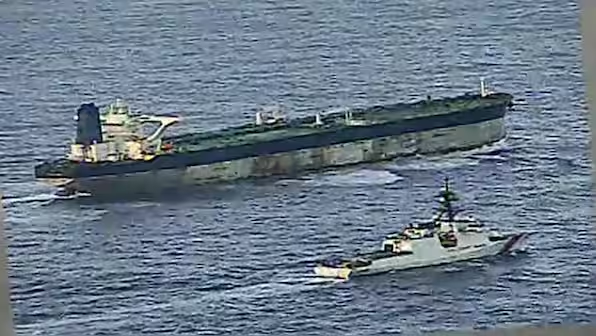
The seizure of the oil tanker Marinera, previously known as Bella-1, marks a significant escalation in Washington’s campaign against what it describes as a global network of sanctioned oil shipments. According to the US military’s European Command, American special forces boarded and commandeered the vessel in the North Atlantic after weeks of surveillance and pursuit. US authorities stated that the action was taken due to violations of US sanctions, asserting that the tanker had been involved in transporting illicit Venezuelan oil despite existing restrictions.
The operation followed repeated attempts by US agencies to intercept the vessel. American officials said the tanker had evaded earlier efforts by the US Coast Guard to board it while transiting near the Caribbean, after which it crossed the Atlantic Ocean. The Marinera was described by US officials as part of a so-called shadow fleet, a collection of tankers accused of covertly transporting oil for sanctioned states such as Venezuela, Russia, and Iran by obscuring ownership, disabling tracking systems, or frequently changing names and flags.
US Defense Secretary Pete Hegseth said on social media that the enforcement of sanctions against Venezuelan oil shipments remains fully in effect worldwide, signalling that Washington intends to apply pressure far beyond the Western Hemisphere. The seizure took place amid a broader US crackdown under President Donald Trump, who has publicly vowed to aggressively enforce oil sanctions linked to Venezuela and reshape the country’s energy future.
Russian state media reported that US forces boarded the tanker using a helicopter, releasing images showing an aircraft hovering above the vessel during the operation. According to these reports, a US Coast Guard ship had been shadowing the tanker for days, and at least one earlier attempt to seize it had failed due to severe weather conditions. The final boarding reportedly occurred in international waters after the ship continued to resist compliance with US directives.
Tracking data indicated that the Marinera was approaching Iceland’s exclusive economic zone when it was seized. While a Russian submarine and a warship were said to be operating in the wider area, there were no reports of direct confrontation between US and Russian forces. Observers described the episode as a tense but controlled encounter, highlighting the risks inherent in enforcing sanctions on the high seas amid heightened great-power competition.
American officials also linked the timing of the seizure to broader US military actions targeting Venezuela, including a recent operation to detain Venezuelan President Nicolás Maduro. In the lead-up to that operation, US forces had reportedly intensified monitoring of maritime traffic connected to Venezuelan oil exports, with the Marinera emerging as a high-priority target due to its alleged role in sanctions evasion.
Russia’s response, maritime law concerns, and wider implications
Moscow reacted strongly to the seizure, accusing the United States of violating international maritime law. The Russian Transport Ministry said the action breached the principle of freedom of navigation enshrined in the 1982 United Nations Convention on the Law of the Sea. According to the ministry, vessels lawfully registered under one country’s flag cannot be subjected to force by another state on the high seas, except under narrowly defined circumstances.
Russian officials said the Marinera had received temporary permission to sail under the Russian flag on December 24 and that contact with the vessel was lost after US naval forces boarded it in international waters beyond the jurisdiction of any coastal state. The ministry characterised the seizure as an unlawful use of force and warned that such actions undermine established maritime norms designed to prevent conflict at sea.
The Russian Foreign Ministry echoed these concerns, stating that the level of attention directed at the tanker by US and NATO forces appeared disproportionate to its civilian and commercial status. Russian officials questioned why a single vessel had become the focus of such extensive military activity, suggesting that the operation reflected broader political motives rather than purely legal enforcement of sanctions.
Journalists reporting from Moscow described the episode as a prolonged cat-and-mouse game, with at least two prior attempts to intercept the tanker failing before the final seizure. While Russian authorities have not confirmed whether naval assets were specifically deployed to escort the Marinera, the presence of a submarine and warship nearby underscored the sensitivity of the situation and the potential for miscalculation.
The Marinera had been sanctioned by the United States in 2024 for allegedly transporting oil on behalf of a company linked to the Lebanese group Hezbollah. US officials have argued that such operations not only violate sanctions but also contribute to the financing of groups Washington considers hostile. From this perspective, the seizure was framed as part of a broader effort to disrupt illicit financial and logistical networks operating under the cover of commercial shipping.
The incident also drew attention to a second vessel seized by US forces. US Secretary of Homeland Security Kristi Noem confirmed that a supertanker named M Sophia was intercepted in international waters near the Caribbean. The vessel, which was reportedly Panama-flagged, was also under US sanctions and had recently departed Venezuelan waters. Shipping data suggested it was operating in dark mode, with its transponder switched off, a tactic commonly associated with sanctions evasion.
According to US officials, both the Marinera and the M Sophia were either en route to Venezuela or had recently docked there, reinforcing Washington’s claim that a coordinated effort is underway to transport sanctioned oil despite international restrictions. Analysts say the dual seizures signal a more assertive phase in US maritime enforcement, one that extends beyond traditional interception zones and into distant international waters.
The broader implications of the operation are significant. By seizing a Russian-flagged vessel on the high seas, the United States has set the stage for potential diplomatic and legal disputes over the scope of sanctions enforcement and the limits of state power in international waters. For Russia, the incident is seen as part of a pattern of Western overreach that threatens global shipping norms. For Washington, it represents a demonstration of resolve in enforcing sanctions and disrupting what it views as illicit energy trade.
The episode also highlights the growing strategic importance of maritime routes in global geopolitics. As sanctions regimes expand and enforcement becomes more aggressive, commercial shipping is increasingly caught in the crossfire of great-power rivalry. The North Atlantic seizure underscores how economic measures, military capabilities, and legal frameworks intersect in ways that can rapidly escalate tensions.
As reactions continue to unfold, the seizure of the Marinera stands as a stark illustration of the risks associated with enforcing unilateral sanctions in a multipolar world. It raises unresolved questions about jurisdiction, legality, and the future of maritime security, particularly as major powers test the boundaries of international law in pursuit of strategic objectives.