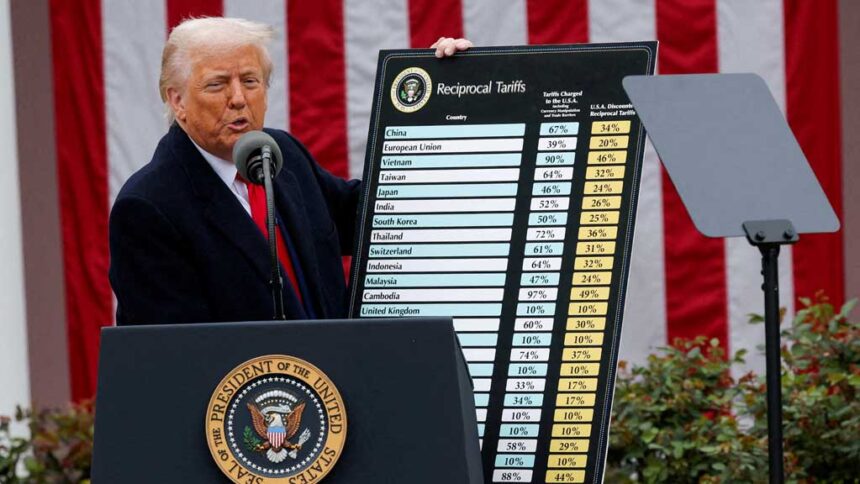
A sweeping tariff announcement by US President Donald Trump has shaken global financial markets, sparking fears of an escalating trade war. With reciprocal tariffs targeting over 180 countries, including a 26% levy on India, investors are scrambling to reassess strategies amid the rising economic uncertainty. From plunging stock indices to gold selloffs and falling bond yields, the impact is widespread and immediate
On April 2, US President Donald Trump declared a blanket 10% tariff on imports from all countries excluding those under the US-Mexico-Canada Agreement (USMCA), positioning it as a step toward reviving American industry. For India, he announced a 26% reciprocal tariff effective April 9, 2025, arguing that India’s high import duties on US goods demanded a retaliatory move. US President Donald Trump criticized India’s trade policies while referring to Prime Minister Narendra Modi as a friend. Though lower than the 34% tariff slapped on China, the India-specific rate still sent ripples through markets.
Wall Street took a major hit, with the S&P 500 recording its biggest weekly drop since the 2020 COVID crash. The Nasdaq Composite fell over 20% from its December peak, and the Dow Jones Industrial Average dropped more than 10% in the same period. China’s retaliatory move — imposing a 34% tariff on all US imports — deepened market fears, wiping over $5 trillion from US equities. Gold prices tumbled too, with COMEX June contracts slipping by over 2%. Meanwhile, benchmark 10-year US bond yields declined 0.92%, hitting a six-month low at 3.86%, marking the sharpest weekly fall since July 2024.
Although Indian markets also reacted negatively, the impact was less severe. The Nifty 50 fell 1.5% on Friday, registering a 1.8% decline since US President Donald Trump’s announcement. Analysts attribute the relative resilience to India’s modest trade surplus with the US, valued at $36.8 billion in FY24, with exports of $77.5 billion and imports of $40.7 billion. Sectors like textiles, pharmaceuticals, IT, agriculture, and auto are seen as more exposed to the new tariffs.
Experts suggest investors remain cautious and avoid aggressive positions until clarity emerges. A focus on domestic consumption themes and selective exposure to pharma within externally impacted sectors is advised. Many await the outcome of India–US bilateral trade talks, which could lead to potential tariff relief or renegotiation, offering hope for market stability in the months ahead.