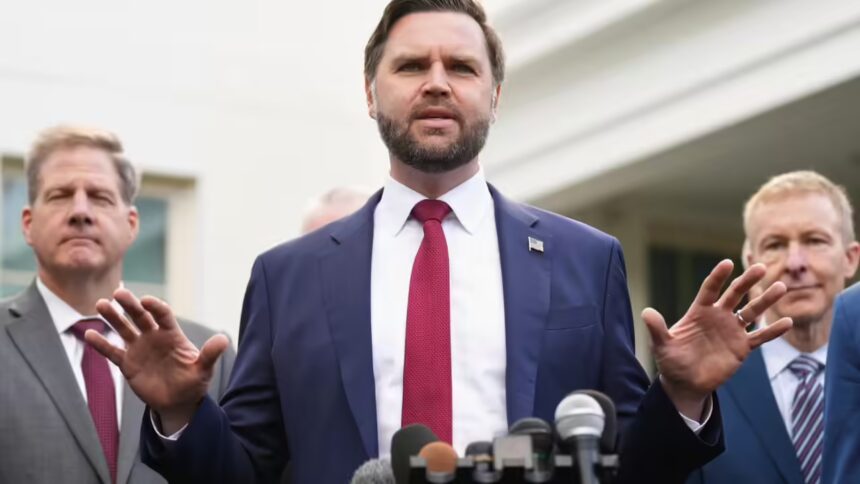
US Vice President JD Vance has found himself at the centre of a heated religious debate after remarks surfaced in which he expressed hope that his Hindu wife, Usha Vance, might one day convert to Christianity. The comment has drawn sharp criticism from Hindu communities in the United States, with the Hindu American Foundation (HAF) publicly rebuking JD Vance for what it called a lack of understanding of Hinduism’s inclusive philosophy. The controversy has since reignited discussions about religious tolerance, interfaith marriages, and the perception of Hinduism within American society.
JD Vance’s Comment Sparks Controversy Over Religious Conversion
The controversy began when a video of JD Vance, the US Vice President, went viral on social media. In the clip, taken during his appearance at the *Turning Point USA event in Mississippi*, JD Vance was asked whether he hoped his wife, who is Hindu by faith, would “come to Christ” one day. In response, he said he would indeed like to see her embrace Christianity at some point in the future. His remarks quickly spread online, drawing a mix of criticism and defense from political and religious communities alike.
JD Vance, who converted to Catholicism in 2019, later clarified that his wife had no plans to convert and that he respected her faith. He emphasized that religion is a personal matter guided by “God-given free will” and insisted that he would never pressure his wife to change her beliefs. The Vice President credited his wife with inspiring him to re-engage with his own faith, describing it as an integral part of his life.
In his clarification, JD Vance elaborated on the dynamics of his interfaith marriage, saying, “My wife did not grow up Christian. She grew up in a Hindu family, but not a particularly religious one in either direction.” He explained that both he and his wife had found a “balanced way” to manage their differing religious backgrounds while maintaining mutual respect. However, despite his clarifications, the initial statement continued to spark backlash, especially among members of the Hindu diaspora in the United States.
The issue touches upon a sensitive intersection of religion and politics. As a high-profile political figure, JD Vance’s comments carry weight, and critics argue that even seemingly personal statements can have wider implications for how minority faiths are perceived and treated in American society.
Hindu American Foundation Calls for Mutual Respect and Understanding
In response to the remarks, the *Hindu American Foundation (HAF)*—a prominent advocacy group representing Hindu Americans—issued a detailed post on X (formerly Twitter), challenging JD Vance’s stance and urging him to approach his wife’s faith with the same openness and respect she has shown toward his. The post read, “If your wife encouraged you to re-engage with your faith, why not reciprocate that and engage with Hinduism too?”
The foundation described Hinduism as inherently inclusive and pluralistic, pointing out that it does not seek to convert others or impose its beliefs. The organization stressed that Hinduism allows individuals the freedom to pursue their spiritual paths without requiring others, including spouses, to adopt the same faith. “We do not seek to convert anyone,” HAF stated, emphasizing that the essence of Hinduism lies in coexistence and acceptance rather than conversion.
HAF further noted that JD Vance’s comments seemed rooted in a worldview that assumes there is only one true path to salvation — a concept alien to Hinduism. “Your statements regarding your wife’s religious heritage reflect a belief that there is only one true path to salvation, and that path is through Christ — a concept that Hinduism simply doesn’t have,” the post read.
The foundation also highlighted a troubling pattern of *anti-Hindu sentiment online*, alleging that some Christian accounts have been sharing content aimed at undermining Hindu beliefs. HAF claimed there have been organized efforts “to convert Hindus through sometimes unethical means,” adding that such practices are deeply concerning for a community that values mutual respect and peaceful coexistence.
In another part of its message, HAF reminded JD Vance that religious freedom — one of America’s founding principles — extends to all faiths, including Hinduism. “Some of the most vocal voices in your base seem to not actually believe religious freedom should extend to Hindus,” the foundation wrote, directly addressing the Vice President. “You are the VP. It’s more than reasonable for a Christian public figure such as yourself to acknowledge the positive impact of Hinduism on Hindus and the rights of Hindus to practice.”
The post concluded by calling for an open-minded approach to interfaith dialogue, one that recognizes the richness of multiple belief systems rather than insisting on religious conformity.
Broader Implications for Interfaith Relations and Religious Freedom
The exchange between JD Vance and the Hindu American Foundation has reignited broader conversations about interfaith relationships and the treatment of Hinduism within Western discourse. The United States is home to more than *4.5 million Indian-Americans*, many of whom identify as Hindu. Over the past few years, there has been growing concern within this community about the spread of misinformation and stereotyping related to Hindu beliefs and practices.
Vance’s comments, critics say, reflect a subtle but persistent misunderstanding often found in the West — that Hinduism is somehow incomplete or secondary compared to Abrahamic faiths. This perception, they argue, can lead to insensitivity toward Hindu traditions and contribute to a culture of quiet marginalization.
Supporters of Vance, however, have defended his statement as a *personal expression of faith*. They argue that his remarks were not intended to demean Hinduism but rather reflected a common sentiment within Christianity — the desire to share one’s faith with loved ones. His later clarification, they point out, made clear that he respects his wife’s autonomy and religious beliefs.
Still, the debate underscores the challenges of navigating interfaith relationships in the public eye, particularly for figures in positions of power. The discussion around conversion and faith touches deep cultural nerves, especially among communities that have historically faced proselytization efforts or misrepresentation.
The HAF’s response is also part of a broader movement among Hindu Americans to assert their identity and demand fair representation in mainstream discourse. Over the past decade, the organization has been vocal in pushing back against what it views as biased portrayals of Hinduism in academia, media, and political spaces.
Meanwhile, interfaith experts have weighed in, noting that the episode reflects a valuable opportunity for dialogue rather than division. They argue that true religious pluralism requires not only tolerance but also curiosity and engagement — precisely what the HAF urged in its post. The call for Vance to “engage with Hinduism” was not meant as a challenge but as an invitation to explore another faith with empathy and respect.
This controversy also arrives at a time when questions about religious freedom are under renewed scrutiny in the United States. Several reports have documented a rise in anti-Hindu hate incidents, mirroring a broader pattern of religious intolerance. Advocacy groups have warned that political rhetoric, even when unintended, can embolden prejudice and misunderstandings.
For many observers, the issue goes beyond JD Vance himself. It serves as a reminder of how interfaith dynamics play out in multicultural democracies — where the coexistence of belief systems depends not just on legal protections but on mutual understanding at a human level.
In the weeks following the uproar, HAF’s post has been widely shared, with many praising its articulate and respectful tone. It has also sparked renewed discussion about how faith-based organizations can promote constructive dialogue rather than confrontation.
As for Vance, while his clarification has quelled some of the outrage, the episode has become a case study in the complexities of religion, identity, and politics in the modern world — especially when personal faith intersects with public office.