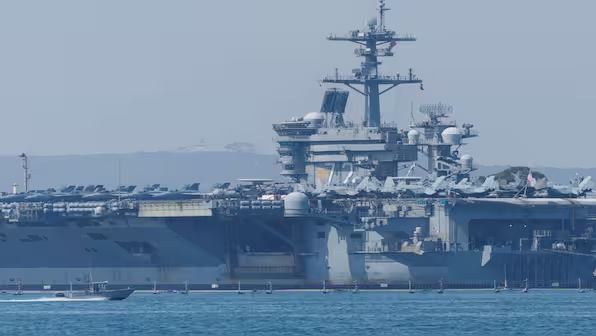
The United States is significantly ramping up its military presence in West Asia as tensions with Iran continue to escalate. According to multiple reports, three major US naval vessels — USS Tripoli (LHA-7), USS San Diego (LPD-22), and USS New Orleans (LPD-18) — are moving toward the region carrying approximately 2,200 Marines. These troops belong to the elite 31st Marine Expeditionary Unit, which is trained for rapid response operations including amphibious assaults, combat missions, and crisis interventions.
Satellite imagery cited in international reports indicates that these warships, which were previously stationed near Japan, have now moved into the southern Indian Ocean near India and are expected to reach the conflict zone soon. This deployment marks one of the most significant US military mobilisations in the region in recent years and signals a possible escalation in the ongoing conflict involving Iran, the United States, and its allies.
Strategic Build-Up and Possible Military Objectives
The deployment of these warships suggests that the United States is preparing for a range of military scenarios, including potential ground operations. One of the key strategic objectives under consideration is securing the Strait of Hormuz, a vital maritime corridor through which nearly 20% of the world’s oil and gas supply passes. Since the conflict intensified in late February 2026, Iran has significantly disrupted shipping activity in this region, leading to sharp increases in global oil prices and heightened economic uncertainty.
Reports indicate that the US administration, led by Donald Trump, is exploring options to ensure the free flow of oil shipments through the Strait of Hormuz. This could involve deploying Marines to secure coastal areas or nearby islands, thereby preventing further disruptions. The damage reportedly sustained by Iran’s naval capabilities has made such operations more feasible, although they still carry significant risks.
Another critical objective being discussed is the possibility of targeting Kharg Island, which handles nearly 90% of Iran’s crude oil exports. Capturing or blocking this island could exert substantial economic pressure on Iran, potentially forcing it to reconsider its stance on maritime restrictions. However, such a move would represent a major escalation and could expose US forces to direct attacks, increasing the likelihood of a broader conflict.
Military Capabilities and Role of USS Tripoli
At the center of this deployment is the USS Tripoli, a state-of-the-art amphibious assault ship capable of launching both air and ground operations. The vessel is equipped with advanced military assets, including F-35B stealth fighter jets, MV-22 Osprey tiltrotor aircraft, and landing craft designed to transport troops and equipment to shore. This combination of capabilities makes it a versatile platform for a wide range of missions, from combat operations to humanitarian assistance.
The 2,200 Marines aboard USS Tripoli are part of the 31st Marine Expeditionary Unit, based in Okinawa, Japan. This unit is specifically trained for rapid deployment in crisis situations and is capable of conducting amphibious assaults, reconnaissance missions, and coordinated air-ground operations. Their presence underscores the seriousness of the situation and the potential for direct military engagement.
The USS San Diego and USS New Orleans, both amphibious transport dock ships, provide additional support by carrying troops, vehicles, and equipment necessary for sustained operations. Together, these vessels form a powerful naval task force capable of projecting force and responding to a variety of scenarios in the region.
Nuclear Concerns and Uranium Security
In addition to securing maritime routes and strategic locations, another key concern for the United States is Iran’s nuclear program. Reports suggest that Iran possesses a significant quantity of highly enriched uranium, estimated at around 950 pounds, which could potentially be used for nuclear weapons. This material is believed to be located at sites that have been targeted in recent US and Israeli strikes.
Securing this uranium is considered a priority, as it would prevent the possibility of nuclear proliferation and reduce the risk of escalation. However, achieving this objective may require ground operations, as aerial strikes alone may not be sufficient to locate and secure the material. This adds another layer of complexity to the situation, as deploying ground troops would mark a significant escalation in US involvement.
Geopolitical Risks and Global Implications
The movement of US warships toward West Asia has far-reaching implications for global security and economic stability. The region is a critical hub for energy supplies, and any disruption can have a ripple effect on global markets. The ongoing conflict has already led to rising oil prices, impacting economies worldwide, including major importers like India.
The potential for escalation also raises concerns about a broader regional conflict involving multiple countries. Iran has already launched retaliatory attacks on US and allied interests in the Gulf, and further military action could trigger a chain reaction. Diplomatic efforts to de-escalate the situation remain crucial, but the current trajectory suggests that tensions are likely to remain high in the near term.
The deployment also reflects the challenges faced by the United States in securing international support for its actions. While Washington has called on allied nations to contribute to efforts in the Strait of Hormuz, responses have been limited. This has increased the burden on US forces and may influence the strategic decisions being considered.
Outlook: A Potential Turning Point in the Conflict
The arrival of US warships in the region could mark a turning point in the ongoing conflict. If the United States proceeds with more aggressive actions, such as securing strategic locations or deploying ground troops, the situation could escalate into a larger confrontation. On the other hand, the presence of a strong military force could also serve as a deterrent, encouraging diplomatic negotiations and reducing the likelihood of further escalation.
As the situation develops, the focus will be on how both sides respond to the evolving dynamics. The decisions made in the coming days will have a significant impact on regional stability and global security. For now, the deployment of the USS Tripoli and its accompanying vessels signals a heightened state of readiness and a willingness to take decisive action if necessary.