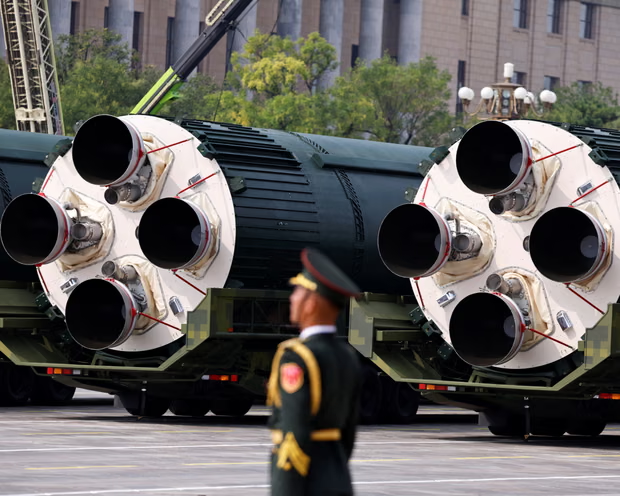
The United States has accused China of massively expanding its nuclear arsenal and conducting secret low-yield nuclear tests, escalating tensions at a time when the expiration of the New Start treaty has raised global fears of a renewed nuclear arms race among major powers.
The sharp exchange unfolded at the Conference on Disarmament in Geneva, where senior American and Chinese officials presented starkly opposing narratives about nuclear policy, transparency and strategic intent. With New Start – the last remaining nuclear arms control treaty between the US and Russia – having expired earlier this month, the absence of formal limits on deployed nuclear warheads has intensified anxiety over the direction of global arms control.
At the centre of the dispute are claims by Washington that Beijing is undertaking a rapid and opaque expansion of its nuclear capabilities. Christopher Yeaw, the US assistant secretary of state for arms control and non-proliferation, told delegates in Geneva that previous arms control frameworks failed to account for what he described as an unprecedented Chinese buildup. He argued that New Start was “seriously flawed” because it did not incorporate China into its restrictions.
New Start, signed in 2010 between the United States and Russia, capped deployed nuclear warheads at 1,550 for each side and placed limits on delivery systems such as intercontinental ballistic missiles and strategic bombers. Its expiration on February 5 marks the first time in decades that there is no binding treaty constraining the two largest nuclear arsenals in the world. According to the International Campaign to Abolish Nuclear Weapons, both the US and Russia each possess more than 5,000 nuclear weapons in total stockpiles, including deployed and reserve warheads.
Washington has asserted that Russia exceeded treaty limits prior to expiration and that China is rapidly approaching comparable levels of fissile material capacity. Yeaw stated that Beijing is on track to accumulate enough fissile material for more than 1,000 nuclear warheads by 2030. He accused China of expanding its arsenal deliberately and without transparency, adding that there has been no clear indication of Beijing’s intended end point.
Diplomatic confrontation in Geneva and competing narratives
China firmly rejected the US accusations. Shen Jian, speaking at the same conference, dismissed the allegations as distortion and smearing of China’s nuclear policy. He insisted that Beijing would not engage in any nuclear arms race with any country and maintained that China’s nuclear arsenal is not in the same league as those of the United States and Russia.
Shen argued that it would be neither fair nor realistic to expect China to participate in trilateral arms control talks alongside Washington and Moscow, given the disparity in arsenal size. Beijing has long maintained that its nuclear doctrine is based on minimum deterrence and a no-first-use policy, though Western analysts have increasingly questioned whether ongoing modernisation efforts signal a doctrinal shift.
Despite the public exchange, diplomatic channels appear to remain open. A US State Department source indicated that a preparatory meeting with a Chinese delegation took place in Washington shortly after New Start expired, with a more substantive meeting scheduled in Geneva. The discussions suggest that both sides may be exploring frameworks for future engagement, even amid rhetorical escalation.
The broader strategic landscape is complicated by allegations that Russia has supported China’s nuclear development, a charge raised by Yeaw in Geneva. While Moscow and Beijing have deepened defence and technological cooperation in recent years, concrete evidence linking Russia to direct expansion of China’s arsenal remains contested.
The expiration of New Start has fundamentally altered the arms control architecture that has underpinned strategic stability since the Cold War. Without verification mechanisms or numerical limits, both the US and Russia are technically free to expand deployed arsenals. Analysts warn that the absence of constraints increases the risk of miscalculation, particularly if China continues to modernise its capabilities at pace.
Allegations of secret testing and testing policy implications
The controversy intensified further with renewed US allegations that China conducted a low-yield nuclear test in June 2020. Yeaw told delegates that seismic data from Kazakhstan indicated a 2.75-magnitude underground explosion on June 22, 2020, at China’s historic Lop Nur test site in Xinjiang. He estimated the yield to be roughly equivalent to a 10-tonne nuclear explosion, assuming full coupling in hard rock below the water table.
Washington has accused Beijing of preparing additional explosions with larger yields, suggesting possible non-compliance with the spirit of the Comprehensive Nuclear-Test-Ban Treaty, though the treaty has never entered into force globally. China has denied conducting any such tests and described the allegations as groundless.
Shen countered that the United States was using the accusations as a pretext to justify resuming its own nuclear testing programme. Former US President Donald Trump had previously indicated that Washington was prepared to return to testing if rivals were perceived to be doing so. The potential resumption of nuclear testing by any major power would represent a profound shift in global non-proliferation norms.
Independent analysis has not conclusively supported the US claims. A recent report by the Center for Strategic and International Studies found no definitive evidence of unusual activity at Lop Nur based on satellite imagery, though it did not categorically rule out the possibility of low-yield events. The ambiguity underscores the challenges of monitoring compliance in the absence of robust, universally adopted verification frameworks.
Strategic analysts note that China’s nuclear modernisation programme has included the construction of new missile silos, development of advanced delivery systems and enhancement of its sea-based deterrent. While these developments suggest expansion, Beijing argues they remain consistent with a defensive posture designed to ensure credible deterrence rather than parity with the US and Russia.
The geopolitical context further complicates matters. Growing tensions in the Indo-Pacific, the war in Ukraine and heightened US-China rivalry across economic and technological domains have intensified strategic mistrust. Arms control discussions now unfold against a backdrop of deteriorating relations, making consensus more difficult to achieve.
Washington has maintained that it is not abandoning arms control but seeks a broader and more inclusive agreement that incorporates China. Yeaw stated that the US objective is a better agreement toward a world with fewer nuclear weapons. However, persuading Beijing to enter formal limitations without parity guarantees remains a central diplomatic challenge.
The debate over China’s arsenal expansion and alleged testing activities reflects deeper structural shifts in the global balance of power. As the nuclear order transitions from a primarily bipolar US-Russia framework to a more complex multipolar environment, existing treaties may no longer suffice to manage emerging risks.
With no binding treaty currently limiting the deployment of the world’s most destructive weapons, the international community faces renewed uncertainty. Whether the post-New Start environment leads to fresh negotiations or a new cycle of competitive buildup will depend on political will, verification mechanisms and mutual trust among the world’s leading nuclear powers.