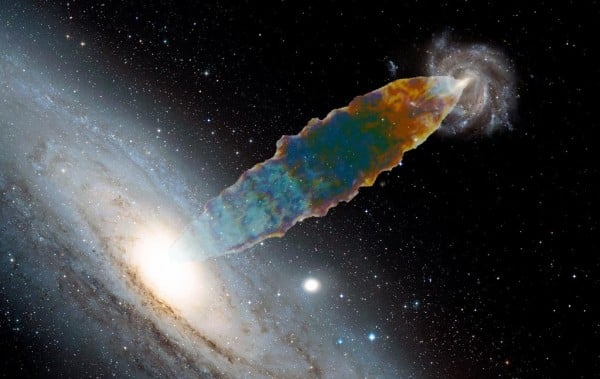
Pretoria – Enabled by supercomputing, University of Pretoria (UP) researchers have led an international team of astronomers that has provided deeper insight into the entire life cycle (birth, growth and death) of giant radio galaxies, which resemble “cosmic fountains” – jets of superheated gas that are ejected into near-empty space from their spinning supermassive black holes.
The findings of this breakthrough study were published in the journal Astronomy & Astrophysics, and challenge known theoretical models by explaining how extragalactic cosmic fountains grows to cover such colossal distances, raising new questions about the mechanisms behind these vast cosmic structures.
The research team – which was led by astrophysicist Dr Gourab Giri, who holds a postdoctoral fellowship from the South African Radio Astronomy Observatory at UP – consisted of Associate Professor Kshitij Thorat and Extraordinary Professor Roger Deane of UP’s Faculty of Natural and Agricultural Sciences; Prof Joydeep Bagchi of Christ University in India; Prof DJ Sailkia of the Inter-University Centre for Astronomy and Astrophysics, also in India; and Dr Jacinta Delhaize of the University of Cape Town (UCT).
This study tackles a key question in modern astrophysics: how these structures, which are larger than galaxies and are made up of black hole jets, interact over cosmological timescales with their very thin, gaseous surroundings.
“We mimicked the flow of the jets of the fountains in the universe to observe how they propagate themselves over hundreds of millions of years – a process that is, of course, impossible to track directly in the real cosmos,” Dr Giri explains. “These sophisticated simulations enable a clearer understanding of the likely life cycle of radio galaxies by revealing the differences between their smaller, early stages and giant, mature stages. Understanding the evolution of radio galaxies is vital for deepening our knowledge of the formation and development of the universe.”
“While such studies are computationally expensive,” Prof Thorat adds, “the team embarked on this adventure informed by the exciting, cutting-edge observations carried out by new-generation radio telescopes, such as the South African MeerKAT telescope, which has been instrumental in providing us with the details of the structure of these cosmic fountains.”
Astronomers study galaxies for more than just the stars they can see, Dr Giri says. “We also look at many, often interrelated, phenomena. One of the most amazing things to see is when a supermassive black hole at the centre of a galaxy, which is relatively tiny in size compared to the galaxies they grow in, ‘wakes up’ and starts eating up lots of nearby gas and dust. This isn’t a calm, slow or passive process. As the black hole pulls in material, the material gets superheated and is ejected from the galaxy at near-light speeds, creating powerful jets that look like cosmic fountains. These fountains emit radio signals as the accelerated high-speed plasma matter generates radio waves. These signals are detected by very powerful radio telescopes, built through the collaborative efforts of multiple countries working together.”
With the recent advent of powerful and sensitive radio telescopes – such as MeerKAT in South Africa, the Low Frequency Array (LOFAR) in Europe and the Giant Metrewave Radio Telescope (GMRT) in India – astronomers are now detecting these fountains even in their faintest stages, Dr Giri adds.
“These advanced telescopes can capture the weakest signals from dying or fading parts of the jet, leading to new discoveries of more such extended sources that were previously undetectable.”
The study also implies that these giant jets may be more common than previously thought.
Since the discovery of these high-speed fountains in the 1970s, astronomers have been curious about how far the ejected matter travels before eventually fading out. The answer was astounding as they began to discover that cosmic jets travel vast distances – some reaching nearly 16 million light-years (nearly six times the distance between the Milky Way and Andromeda).
“I took on the challenge of developing theoretical models for these sources, rigorously testing the models with the advanced capabilities of modern supercomputers,” Dr Giri says. “This computer-driven study aimed to simulate the behaviour of giant cosmic jets within a mock universe, constructed according to known physical laws governing the cosmos. Our primary focus was to answer two questions: Is the enormous size of these jets due to their exceptionally high speeds; or is it because they travel through regions of space that are nearly empty of surrounding matter, offering minimal resistance to the jets’ free propagation?”
The UP-led study presents evidence that a combination of these considerations is a key aspect in the formation of these giant jets.
With the help of the supercomputing power of the Inter-University Institute for Data Astronomy (a collaborative network consisting of UP, UCT and the University of Western Cape), the international research team was able to analyse the vast quantities of simulated data, effectively spanning millions of years.
“These computer-based models, which simulate jet evolution in a mock universe, do more than explain the origin of most giant radio galaxies,” Dr Giri says. “They’re also powerful enough to address puzzling exceptions that have confused astronomers in this field. For example, they help explain how some cosmic fountains bend sharply, forming the shape of an X in radio waves instead of following a straight path, and clarify the conditions under which giant fountains can still grow in dense cosmic environments.” These findings can be tested further by radio astronomers using advanced telescopes.
“Studies like this lead the way in formulating our understanding of these wonderful objects from a theoretical perspective,” Prof Thorat adds. “ This provides a complementary picture to deep-sky observations by telescopes like MeerKAT and the upcoming SKA, making simulations a key tool along with artificial intelligence techniques and high-performance computing to maximise the discovery space and optimise the scientific understanding of these and other ‘exotic’ objects.”
Prof Sunil Maharaj, Vice-Principal for Research, Innovation and Postgraduate Education at UP, noted that the University is proud of the rapid growth of its radio astronomy research group.
“This was enabled by strategic investment in the Inter-University Institute for Data Astronomy and key personnel focused on science with world-leading African telescopes,” he says. “It’s just one example of UP’s leadership role in harnessing cutting-edge technology that increases Africa’s contributions to pushing scientific frontiers while developing the next generation of researchers on the continent. The research we are doing today is opening up new worlds and possibilities for the future.”
https%3A%2F%2Fwww.newswise.com%2Farticles%2Fup-led-astronomy-research-team-explores-formation-of-giant-radio-galaxies%2F%3Fsc%3Drsla