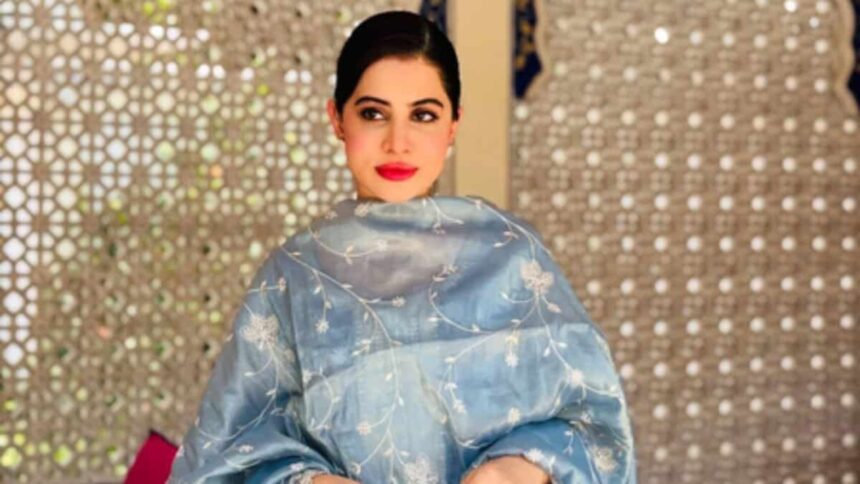
The entertainment industry is no stranger to controversies, but actress Uorfi Javed has recently found herself at the center of an unexpected storm of public attention and online debate. This time, the controversy revolves around claims that the actress has been expelled from Islam, with reports circulating that she has even changed her name to Geeta Bhardwaj. The rumors, which quickly gained traction on social media platforms, have sparked widespread discussion among fans, critics, and observers of celebrity culture. Uorfi Javed, who has always been candid about her personal beliefs and lifestyle choices, has now addressed these claims publicly, asserting that as an atheist, she does not follow any religion and therefore cannot be expelled from one. Her statements challenge the narratives being spread online and highlight the complex intersections between personal freedom, public perception, and social media-fueled controversies in today’s celebrity-driven culture.
The Origin of the Rumors and Social Media Backlash
The rumors about Uorfi Javed’s religious status reportedly began when a popular influencer, Faizan Ansari, released a video claiming that the actress had insulted Islam and the Quran multiple times. In the video, Ansari asserted that due to her repeated actions and alleged comments, the Muslim community had collectively decided to expel her from Islam. He further claimed that her legal and social name was no longer Uorfi Javed, but Geeta Bhardwaj, and that he had even sent a written letter to a cleric requesting an official declaration or fatwa regarding her expulsion. This video, shared widely across platforms like Instagram, YouTube, and Twitter, quickly went viral, leading to widespread debates and speculation among the public.
As the video circulated, many social media users began discussing Uorfi’s beliefs, questioning her religious affiliations and her personal statements. Some criticized her for supposedly disrespecting religious sentiments, while others came to her defense, emphasizing the right of individuals to choose their personal beliefs freely. The debate exemplified the speed at which unverified claims can escalate in the digital age, where viral content often sparks discussions far beyond the intentions of its creators. Uorfi’s name, her statements about religion, and even the alleged change to Geeta Bhardwaj became trending topics, highlighting the way modern celebrity controversies are amplified and distorted by online narratives.
In response to the growing chatter and claims, Uorfi Javed took to interviews to clarify her stance. Speaking candidly to IANS, she dismissed the rumors, saying, “When was I expelled? I left myself a long time ago. What kind of question is this?” By emphasizing her personal choice to not adhere to any religion, Uorfi highlighted the absurdity of the claims against her. Her response not only refuted the notion of expulsion but also reinforced her consistent position as an independent thinker who does not conform to societal pressures regarding religion.
Uorfi also addressed the claim about her adopting the name Geeta Bhardwaj. She stated, “Who said this? There is no report. People are making all this up on their own. I don’t follow any religion. I am an atheist. So where will you remove me from? Where will you remove someone who has no place?” Her words underscore the performative nature of social media outrage and the way misinformation can spread unchecked, particularly when it involves public figures who are known for their bold and unconventional choices.
Uorfi Javed’s Beliefs and Public Statements on Religion
The controversy surrounding Uorfi Javed is not new in the sense that she has consistently maintained an unconventional approach to religion and social norms. In multiple interviews and public appearances, Uorfi has openly expressed her views on the importance of personal freedom and the limitations she perceives in organized religion. She has spoken about the societal pressures faced by women in religious frameworks, particularly in Islam, where she believes men often maintain control over women’s lives and restrict their freedoms. Her candid commentary on these issues has both attracted attention and provoked criticism, positioning her as a polarizing figure in Indian media culture.
Uorfi’s self-identification as an atheist is central to understanding her dismissal of the recent expulsion rumors. By asserting that she does not follow any religious doctrine, she challenges the very basis of claims that she could be removed from a faith she has already chosen to distance herself from. This stance aligns with her broader worldview, which emphasizes individual choice, rational thinking, and independence from traditional societal expectations. Her position also invites a broader discussion on the treatment of atheism and non-belief in societies where religion remains a dominant cultural and social force.
The situation has also sparked debates about accountability, freedom of speech, and social media ethics. While influencers like Faizan Ansari may claim to speak on behalf of a larger community, Uorfi’s statements illustrate that personal belief cannot be dictated by online opinion or external pressure. This clash between public perception and individual autonomy underscores the tension that arises when digital platforms are used to amplify claims about a person’s private life, particularly when those claims involve sensitive topics like religion.
Uorfi has previously articulated her views on religion in a way that challenges conventional norms. She has stated that religion should not be imposed on anyone and has emphasized that personal faith or non-belief is a matter of individual choice. Her outspoken approach resonates with a segment of society that values self-expression and autonomy but also attracts criticism from those who interpret her comments as controversial or provocative. In this context, the recent rumors about her expulsion are part of a larger narrative in which public figures are often scrutinized for beliefs or actions that deviate from societal expectations.
Her atheist stance also reflects a deliberate effort to carve out a public identity that is independent of religious labels. Uorfi’s willingness to address rumors and misinformation directly demonstrates a proactive approach to managing her public persona, particularly in an environment where viral content can significantly influence public opinion. By engaging with the claims in a clear and reasoned manner, she not only clarifies her own beliefs but also challenges broader societal assumptions about conformity, faith, and the role of religion in defining identity.
Social Media Dynamics and the Spread of Misinformation
The Uorfi Javed expulsion controversy also sheds light on the dynamics of social media and its role in shaping public discourse. Platforms such as Instagram, YouTube, and Twitter allow influencers and ordinary users alike to share opinions, rumors, and claims with minimal verification. In Uorfi’s case, Faizan Ansari’s video exemplifies how a single narrative, amplified across multiple channels, can create widespread perceptions that may have little basis in fact.
The rapid spread of such content underscores the challenges faced by public figures in managing their image and responding to misinformation. Uorfi’s candid interviews and statements serve as corrective measures, but the persistence of viral videos and speculative commentary often means that clarifications may not reach all audiences equally. This highlights a broader cultural phenomenon in which celebrity controversies are not just about individual actions but are amplified and transformed by the mechanisms of digital media.
The nature of the rumors—claiming both expulsion from Islam and a name change—illustrates how sensationalized narratives are constructed to attract attention and engagement. By combining elements of religion, identity, and personal reputation, such narratives are designed to provoke emotional reactions and encourage sharing. In this environment, distinguishing between fact and speculation becomes increasingly difficult, particularly when content is presented with a sense of authority or insider knowledge.
Uorfi’s response, emphasizing her atheism and the absence of any formal expulsion, counters these dynamics by reaffirming her personal autonomy. She demonstrates that credibility and clarity come from direct communication rather than reliance on second-hand reports or social media narratives. This approach not only protects her own reputation but also encourages audiences to critically evaluate the information they consume online.
The controversy further reflects how discussions around religion, gender, and social norms are increasingly played out in public digital spaces. For Uorfi, being at the center of such debates underscores both the opportunities and risks of visibility in the entertainment industry. Her willingness to openly discuss her beliefs, while managing public perception, positions her as a figure navigating the complex intersection of celebrity culture, personal autonomy, and societal expectations.