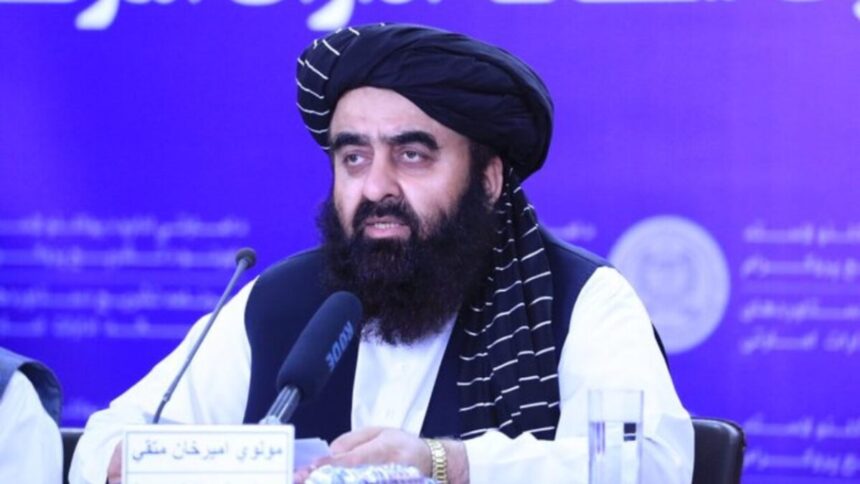
In a significant geopolitical development, the United Nations Security Council (UNSC) has granted approval for Afghan Taliban Foreign Minister Amir Khan Muttaqi to travel to New Delhi from October 9 to 16, following India’s formal request for exemption from his existing international travel ban under the UNSC’s 1988 sanctions regime. The approval, confirmed on September 30, paves the way for high-level interactions in the Indian capital, reflecting India’s evolving approach toward Afghanistan’s Taliban regime at a time when regional alignments involving Pakistan, China, and Russia are undergoing major transformations. The visit is expected to shape India’s strategy in the region, positioning New Delhi more firmly in the dialogue surrounding Afghanistan’s future, while also challenging Pakistan’s long-standing influence in Kabul.
India’s Strategic Move and the Importance of the UNSC Waiver
The UNSC’s clearance of Amir Khan Muttaqi’s India visit is not only a procedural formality but a development of significant symbolic weight in contemporary South Asian diplomacy. Under the UNSC Resolution 1988 sanctions framework, individuals associated with the Taliban leadership are barred from international travel without explicit clearance from the Security Council’s sanctions committee. Muttaqi, serving as Afghanistan’s foreign minister since the Taliban’s takeover of Kabul in August 2021, has been on this restricted list. The approval for his travel highlights how India has succeeded in mobilizing support at the international stage for engaging the Taliban leadership within a structured and rules-based framework.
This move comes after earlier attempts by the Taliban foreign minister to secure exemptions were denied by the UNSC due to concerns from multiple member states regarding his ties to the Taliban’s leadership core. The fact that the exemption has now been granted signals both India’s diplomatic weight and a broader recognition that engaging Afghanistan under Taliban control is unavoidable for regional stability.
For India, the visit offers a platform to recalibrate its Afghanistan policy, which has remained cautious since the Taliban’s return to power. New Delhi has so far resisted formal recognition of the Taliban regime but has engaged pragmatically through humanitarian aid and quiet back-channel dialogue. By hosting Muttaqi in Delhi, India is elevating its engagement, potentially to assert its role as a stakeholder in Afghanistan’s stability at a time when Pakistan and China are seeking to expand their influence in Kabul.
The timing of the visit is also significant. Muttaqi is scheduled to travel to Russia before arriving in Delhi, reflecting his broader diplomatic outreach efforts. His presence in India underscores New Delhi’s growing readiness to hold official exchanges even as it maintains its reservations about Taliban policies, especially on issues of women’s rights, terrorism, and governance. India’s engagement with the Taliban has historically been shaped by security concerns, particularly the risk of terror groups like Jaish-e-Mohammed and Lashkar-e-Taiba using Afghan soil to destabilize the region. Hosting the Taliban foreign minister offers India a direct channel of communication to convey its red lines while also balancing regional competition.
Regional Context: India, Pakistan, China, and the Shifting Afghan Equation
Muttaqi’s forthcoming visit cannot be separated from the shifting geopolitics of Afghanistan and South Asia. Since the Taliban seized power in Kabul in 2021, Pakistan has sought to cement its role as the Taliban’s primary partner, capitalizing on historical ties and geographical proximity. However, relations between Islamabad and Kabul have been far from smooth, marked by tensions over border clashes, trade restrictions, and the Taliban’s reluctance to rein in anti-Pakistan militant groups operating from Afghan territory.
China has also deepened its engagement with the Taliban regime, seeking to integrate Afghanistan into its ambitious Belt and Road Initiative (BRI) through the expansion of the China-Pakistan Economic Corridor (CPEC). In May this year, Amir Khan Muttaqi held an informal meeting in Beijing with Chinese Foreign Minister Wang Yi and Pakistan’s then-finance minister Ishaq Dar, during which they agreed in principle to extend the CPEC into Afghanistan. The expansion, if realized, would give Beijing greater economic and strategic influence over Kabul, while further sidelining India.
India has consistently opposed the USD 60 billion CPEC project, citing sovereignty concerns as the corridor passes through Pakistan-occupied Kashmir (PoK), a territory claimed by India. The prospect of its expansion into Afghanistan therefore heightens New Delhi’s security and strategic anxieties. By bringing Muttaqi to Delhi for official meetings, India is signaling its unwillingness to be excluded from discussions over Afghanistan’s future and asserting its intent to counterbalance the China-Pakistan axis in the region.
The UNSC’s approval of Muttaqi’s travel to India also comes against the backdrop of India’s careful outreach to Russia and Central Asian states over the Afghan question. New Delhi has consistently argued for an Afghan-led, Afghan-owned peace process, while emphasizing the need to prevent Afghanistan from becoming a safe haven for global terrorism. Hosting the Taliban foreign minister could provide India an opportunity to test whether the Taliban leadership is willing to accommodate international expectations on these fronts, even as global recognition of their government remains elusive.
India’s engagement is also informed by humanitarian imperatives. Since the Taliban takeover, Afghanistan has faced acute economic and humanitarian crises, exacerbated by the freezing of international aid and restrictions imposed on Afghan women. India has extended humanitarian assistance, including food grains and medical supplies, through United Nations agencies and bilateral channels. By engaging the Taliban leadership, India may be looking to ensure that its aid reaches the intended beneficiaries while also protecting its developmental investments in Afghanistan, such as the Salma Dam and the Afghan Parliament building.
For the Taliban, meanwhile, the Delhi visit is a chance to gain legitimacy and showcase diplomatic acceptance. Despite not being formally recognized by most countries, the Taliban regime has actively sought international engagement to overcome its isolation. A visit to India, the region’s largest democracy and an emerging global power, would bolster their claim of being treated as the de facto rulers of Afghanistan.
The visit also complicates Pakistan’s narrative that it remains the sole gateway for international engagement with the Taliban. If New Delhi can carve a direct channel with Kabul, it would mark a strategic setback for Islamabad, which has often leveraged its influence over the Taliban for geopolitical bargaining.
Diplomatic Implications and the Road Ahead
Amir Khan Muttaqi’s India visit, facilitated by the UNSC waiver, carries multiple layers of diplomatic significance. At one level, it underscores the shifting international consensus that isolation of the Taliban regime may no longer be a sustainable option. At another, it demonstrates India’s determination to be an active player in the Afghan theatre, rather than a passive observer constrained by Pakistan’s maneuvering.
The week-long visit, stretching from October 9 to 16, provides ample scope for structured dialogue between Indian officials and the Taliban delegation. Key issues expected to be discussed include counterterrorism assurances, humanitarian aid delivery, regional security, and the economic future of Afghanistan. For India, the meetings will be an opportunity to press its concerns regarding anti-India groups operating from Afghan soil and to emphasize that Afghan stability cannot come at the cost of regional security.
India’s decision to host Muttaqi without formally recognizing the Taliban regime reflects its nuanced approach. On the one hand, New Delhi is aware of the reputational risks of appearing to endorse a government that has rolled back women’s rights and curtailed freedoms. On the other, India recognizes that practical engagement is necessary to secure its interests in Afghanistan, particularly given its geographical proximity and history of ties with the Afghan people.
This balancing act is emblematic of India’s broader foreign policy strategy: engaging pragmatically without offering unqualified recognition, ensuring its voice is heard in regional forums, and safeguarding its long-term security concerns. The UNSC’s approval of the visit further strengthens India’s position, demonstrating that its approach enjoys a measure of international legitimacy.
As the Taliban foreign minister prepares to arrive in Delhi, the diplomatic world will closely watch the interactions. The visit could either open new avenues for constructive engagement between India and the Taliban or underline the persistent challenges of dealing with a regime struggling for legitimacy. Either way, the significance of Amir Khan Muttaqi’s presence in New Delhi, sanctioned by the United Nations, cannot be overstated. It represents a turning point in India’s approach to Afghanistan and a moment of recalibration in the shifting sands of regional geopolitics.