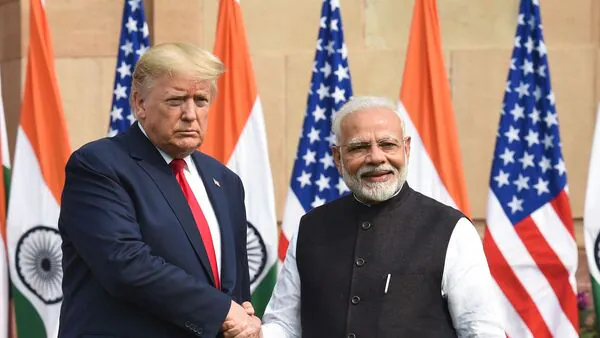
The announcement of a renewed 10% global tariff regime by Donald Trump, confirmed by the White House, has rapidly escalated into a multi-layered controversy involving legal interpretation, international trade dynamics, and India’s domestic political discourse. What initially appeared to be a technical adjustment in tariff policy soon evolved into a broader narrative of institutional confrontation, economic recalibration, and political messaging. The decision has placed India at the center of a complex debate about trade diplomacy, policy stability, and the strategic implications of tariff-driven economic measures.
The controversy gained momentum following the US Supreme Court’s striking down of what were widely referred to as “Trump tariffs,” a ruling that questioned the constitutional authority underpinning executive-led tariff impositions. Within hours of the court’s verdict, Trump announced the imposition of a fresh 10% global tariff on trading partners, framing the move as both corrective and necessary. The executive order formalizing the decision signaled not merely a policy continuation but an assertive response to judicial intervention.
For India, the implications of Trump global tariffs India policy adjustments extend beyond numerical changes in trade duties. They intersect with ongoing negotiations, market expectations, and political interpretations. The tariff reset, accompanied by statements indicating that the new levy would be applied in addition to baseline tariffs, has intensified scrutiny regarding trade stability and the predictability of international economic engagements.
Simultaneously, India’s opposition party Indian National Congress launched pointed criticism, questioning Prime Minister Narendra Modi’s approach toward the interim trade agreement with the United States. The rhetoric framed the situation as a matter of urgency, strategy, and perceived haste, reflecting how international trade decisions often reverberate within domestic political arenas.
Judicial intervention, executive authority, and the evolving legal-economic tension
The Supreme Court’s ruling striking down Trump’s earlier tariff measures marked a pivotal moment in the intersection of law and economic policy. By asserting that only Parliament holds the authority to impose taxes and tariffs under the Constitution, the court underscored foundational questions regarding executive power. The majority verdict highlighted institutional boundaries, reinforcing long-standing principles of legislative supremacy in fiscal matters.
Trump’s immediate criticism of the ruling reflected the inherent tension between judicial interpretation and executive policy priorities. His remarks conveyed frustration with institutional constraints, framing the verdict as a setback to economic governance. Yet the subsequent announcement of new global tariffs demonstrated the executive branch’s capacity to recalibrate policy within alternative legal frameworks.
This sequence of events illustrates a recurring dynamic in modern governance systems, where economic policy often becomes a site of constitutional interpretation. Tariffs, traditionally viewed as instruments of trade regulation, increasingly serve as tools of strategic economic signaling. Judicial scrutiny, therefore, transforms tariff debates into broader discussions about institutional authority and policy legitimacy.
For global markets, such developments introduce elements of uncertainty. Investors and trade stakeholders prioritize stability, predictability, and clarity. Sudden reversals or legal challenges can reshape expectations, influencing currency movements, investment flows, and trade strategies. The Trump global tariffs India announcement, emerging amid legal recalibration, exemplifies how policy shifts reverberate across interconnected economic systems.
Experts have interpreted the Supreme Court’s decision as potentially constraining executive leverage in trade negotiations. The argument suggests that reduced executive autonomy could alter bargaining dynamics, particularly in agreements involving tariff concessions. Yet Trump’s insistence that there would be “no change” to the trade deal with India reflects the layered nature of trade diplomacy, where legal constraints coexist with strategic policy continuity.
India’s response, articulated through statements from the Ministry of Commerce & Industry, indicates a cautious evaluative approach. Studying the impact of judicial decisions on trade arrangements underscores the complexity of navigating external policy shifts. Trade agreements, especially interim or transitional frameworks, often contain clauses designed to manage contingencies arising from legal or policy disruptions.
Research institutions have highlighted the existence of opt-out mechanisms within the India-US interim trade deal. Such provisions illustrate how modern trade agreements increasingly incorporate flexibility to address evolving legal and economic contexts. These mechanisms reflect recognition that international economic relationships operate within dynamic policy environments.
Political reactions, trade optics, and the domestic contest over economic diplomacy
While the legal dimensions captured immediate attention, the Trump global tariffs India developments quickly became embedded within India’s domestic political discourse. Congress leaders framed the episode as evidence of perceived vulnerability in India’s trade strategy, questioning the government’s urgency in concluding the interim agreement.
Political reactions to international economic developments frequently reflect broader narratives about governance competence, policy foresight, and national interest. Congress’s rhetoric, invoking terms such as “desperation” and “compromise,” illustrates how trade diplomacy often becomes intertwined with domestic electoral messaging. Economic policy decisions, particularly those involving major global partners, carry symbolic significance beyond their technical parameters.
The opposition’s allegations regarding tariff adjustments within the trade deal highlight competing interpretations of economic outcomes. Claims that the agreement enables tariff increases underscore anxieties about trade imbalances, market access, and sectoral vulnerabilities. Agricultural imports, in particular, emerged as focal points of concern, reflecting the enduring political sensitivity surrounding farmers’ livelihoods and market protections.
Statements from leaders like Jairam Ramesh emphasized perceived risks associated with concessions on agricultural imports. Such arguments illustrate how trade agreements are evaluated not solely through macroeconomic metrics but also through distributional impacts. Different sectors, regions, and stakeholder groups often experience trade policy effects unevenly, shaping political narratives accordingly.
Conversely, economic experts have presented alternative interpretations, suggesting that judicial intervention could yield benefits for exporters and consumers. Lower tariffs may enhance competitiveness, reduce input costs, and stimulate trade flows. These divergent perspectives underscore the inherently contested nature of trade policy analysis, where economic outcomes are filtered through varying analytical lenses.
Trump’s assertion of personal rapport with Modi adds another dimension to the discourse. Diplomatic relationships frequently blend institutional negotiations with leader-level interactions. Political leaders often leverage personal diplomacy to signal continuity, reassurance, and strategic alignment. Yet such statements also become subjects of domestic political interpretation.
The tariff timeline presented by research institutions illustrates the fluidity of trade measures over recent years. Shifts in reciprocal tariffs, MFN structures, and total duties reflect evolving negotiation dynamics and policy recalibrations. For businesses navigating such environments, adaptability and risk assessment become critical operational imperatives.
The Trump global tariffs India episode thus reflects a convergence of legal, economic, and political narratives. Judicial rulings reshape executive policy tools, executive decisions recalibrate trade frameworks, and domestic political actors reinterpret developments within broader governance debates. Trade diplomacy, once perceived primarily as economic management, increasingly functions as a site of institutional negotiation and political signaling.
In contemporary global politics, tariffs represent more than fiscal instruments. They operate as strategic levers influencing market behavior, diplomatic relations, and political narratives. The unfolding discourse surrounding Trump’s tariff reset and India’s trade strategy underscores how interconnected legal decisions, executive policies, and political interpretations collectively shape economic diplomacy landscapes.