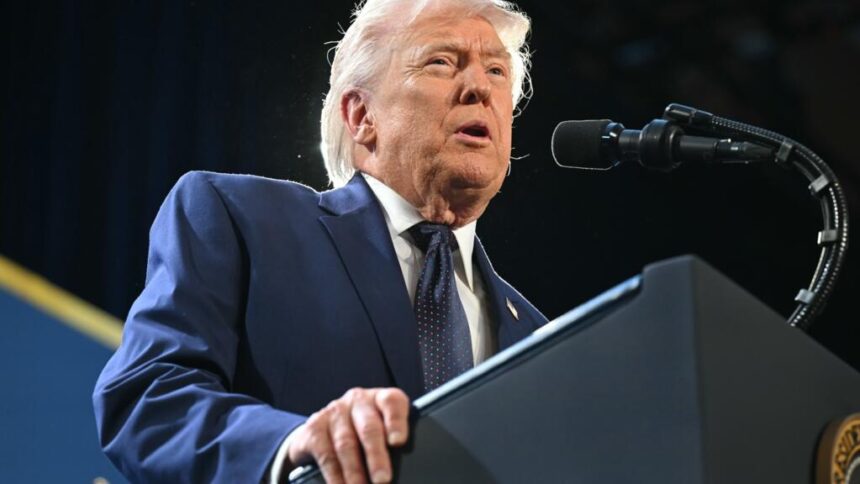
On the 12th day of the escalating US-Israel-Iran conflict, United States President Donald Trump said the war with Iran may soon come to an end, claiming that American military strikes have already destroyed most of Iran’s key strategic targets. Speaking in an interview with the US news outlet Axios, Trump stated that the military operation has progressed faster than initially planned and has inflicted more damage than anticipated on Iranian military installations. The remarks come as tensions across the Middle East continue to intensify, with oil markets, regional security and global diplomacy all facing mounting uncertainty.
Trump said the United States had achieved many of its objectives earlier than expected. According to him, the campaign that was initially designed to last six weeks has already seen significant success within a much shorter time frame. “We’ve destroyed everything. There’s almost nothing left to attack,” Trump said during the interview, suggesting that the military campaign is now entering its final phase. He also praised the performance of the US military, saying the operation had exceeded expectations and had significantly weakened Iran’s ability to conduct further attacks.
However, Iran has responded with strong warnings about the potential economic and geopolitical consequences of the war. Tehran officials have cautioned that the ongoing conflict could push global crude oil prices to as high as $200 per barrel, a scenario that could trigger a severe global energy crisis. Ebrahim Zolfaqari, spokesperson for Iran’s Khatam al-Anbiya military headquarters, said Iran would intensify its military operations and would not allow oil shipments to reach the United States, Israel or their allies. He warned that ships heading to these countries could be treated as legitimate military targets.
The impact of the conflict is already being felt across global energy markets. The International Energy Agency (IEA) has approved the release of 400 million barrels of oil from emergency reserves, marking one of the largest coordinated energy interventions in history. The move is aimed at stabilizing global oil supplies after the effective closure of the Strait of Hormuz, one of the world’s most critical maritime trade routes. Nearly 20 percent of global oil shipments normally pass through the narrow waterway connecting the Persian Gulf to international markets.
Meanwhile, several Gulf countries have begun preparing for worst-case scenarios, including the possibility of a nuclear emergency. Reports indicate that a government agency in Bahrain has contacted a pharmaceutical manufacturer in Chandigarh, India, seeking large quantities of Prussian Blue capsules, which are used to treat radioactive exposure in nuclear incidents. The request highlights growing fears that the conflict could escalate beyond conventional warfare.
Diplomatic voices in the region have also called for restraint and dialogue. In an interview with Al Jazeera, Qatar’s Minister of State Mohammed Al-Khulaifi emphasized that the crisis can only be resolved through negotiations. He stated that Qatar does not view Iran as an enemy and warned that continued fighting would destabilize the entire Middle East. The minister urged the United States, Iran and Israel to halt hostilities and return to diplomatic talks to prevent further escalation.
According to Iranian officials, the conflict has already caused significant civilian casualties and infrastructure damage. Iran’s ambassador to the United Nations, Amir Saeid Iravani, claimed that around 9,600 civilian locations including homes, hospitals, schools and markets have been targeted during the attacks. Tehran also reported that more than 1,300 people have been killed and approximately 8,000 residential buildings have been damaged since the conflict began.
The United States Central Command (CENTCOM) has reported several military developments in recent days. American forces said they destroyed 16 Iranian vessels suspected of laying naval mines near the Strait of Hormuz after Trump warned Tehran against attempting to block the strategic waterway. The US military also confirmed that approximately 140 American soldiers have been injured during the conflict.
The war has also spread beyond Iran’s borders, affecting multiple countries across the region. Israeli forces launched airstrikes on targets linked to the Hezbollah militant group in Beirut, Lebanon’s capital. Drone and missile attacks have also been reported across several Gulf states, including Bahrain and the United Arab Emirates.
The conflict has disrupted global shipping routes as well. Multiple cargo ships have reportedly been attacked in or near the Strait of Hormuz, prompting warnings from maritime authorities and governments worldwide. India’s Ministry of External Affairs condemned the targeting of commercial vessels after a Thai cargo ship bound for Gujarat came under attack in the region.
Amid the intensifying conflict, global leaders and international organizations are increasingly concerned about the wider consequences. The United Nations has warned that continued fighting could disrupt global food supply chains, energy markets and international trade routes.
Despite Trump’s optimism that the war may soon end, analysts believe the situation remains volatile. Military operations are continuing across several locations in the Middle East, and both Iran and Israel have indicated that they will pursue their objectives until their strategic goals are achieved.
For now, the world is closely watching developments as diplomatic efforts continue alongside military operations. Whether the conflict will indeed conclude soon, as Trump predicts, or escalate into a broader regional war remains one of the most pressing questions facing global leaders today.