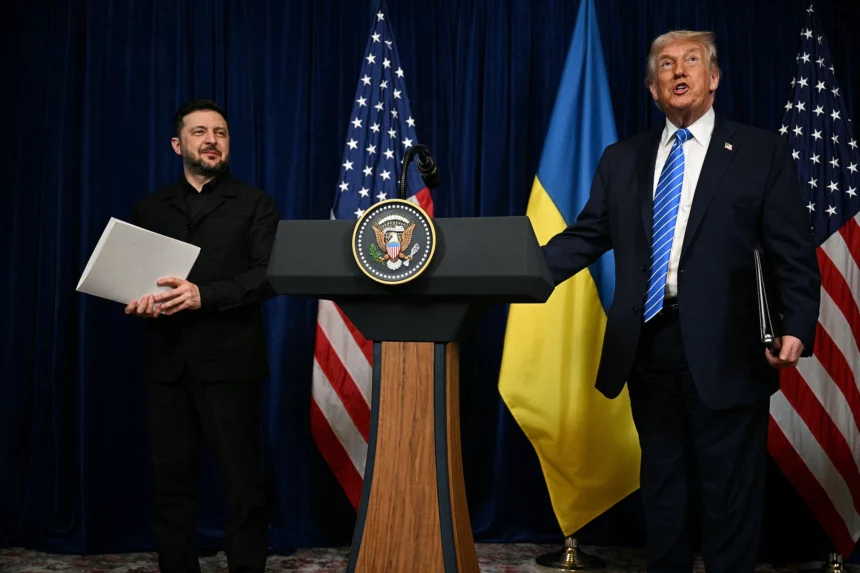
United States president Donald Trump and ukrainian president Volodymyr Zelenskiy indicated renewed momentum toward a potential peace agreement to end the prolonged war in ukraine, saying negotiations have moved significantly closer to a breakthrough even as unresolved disputes over territory, security guarantees, and postwar arrangements continue to complicate the path to a final settlement.
The two leaders met in palm beach, florida, where they held extended discussions focused on ending nearly four years of conflict that has reshaped european security, strained global diplomacy, and inflicted widespread humanitarian and economic damage. Following the meeting, both presidents struck a cautiously optimistic tone, emphasising progress while acknowledging that deeply complex and politically sensitive issues still remain. Trump described the talks as productive and said the sides were “a lot closer, maybe very close” to an agreement, though he stopped short of committing to a deadline or outlining the final contours of a deal.
security guarantees, diplomacy, and the search for a durable peace framework
At the heart of the discussions was the question of security guarantees for ukraine, an issue zelenskiy has repeatedly described as essential to ensuring that any peace agreement is not merely temporary. According to zelenskiy, a broad understanding has been reached with the united states on the framework for such guarantees, which he characterised as a key milestone toward lasting peace. He stressed that ukraine cannot accept an agreement that leaves it vulnerable to renewed aggression once hostilities cease.
Trump, while expressing confidence, adopted a more measured tone. He said negotiations were about ninety-five percent complete on security arrangements and suggested that european countries would need to assume a substantial role in guaranteeing ukraine’s safety, with backing from washington. This approach reflects growing expectations that europe will take greater responsibility for regional security, particularly in the context of a potential postwar settlement.
European leaders quickly weighed in to reinforce this message. French president Emmanuel Macron said progress had been made on security guarantees and announced that countries forming a so-called coalition of the willing would meet in paris in early january to finalise concrete commitments. The announcement signalled europe’s intention to move from general statements of support to specific, coordinated actions designed to underpin any agreement reached between kyiv and moscow.
Despite these developments, details of the proposed guarantees remain unclear. Russia has consistently rejected the presence of foreign troops in ukraine, complicating proposals involving peacekeeping forces or long-term military deployments by nato or european states. Zelenskiy has maintained that guarantees must be credible and enforceable, whether through military assistance, economic mechanisms, or binding international agreements. The challenge, diplomats acknowledge, lies in designing a system that deters future aggression without triggering new escalation.
Trump also addressed the issue of democratic legitimacy, stating that any agreement would need to be approved by ukraine’s parliament or potentially by a national referendum. Zelenskiy echoed this position, emphasising that the ukrainian people must have a decisive voice in determining the country’s future. Trump said he would be willing to address the ukrainian parliament directly if that would help secure support for the deal, underscoring the political complexity of selling a peace agreement domestically.
Beyond security guarantees, negotiators discussed broader diplomatic coordination involving european and transatlantic partners. European commission president Ursula von der Leyen said europe stands ready to continue working closely with ukraine and the united states, stressing that ironclad guarantees are of paramount importance. European leaders have framed the peace talks as a test of collective resolve and a defining moment for the continent’s security architecture.
donbas, russia’s role, and the most difficult unresolved questions
While progress on security arrangements appears tangible, the future of territory remains the most contentious and emotionally charged issue. The donbas region in eastern ukraine, parts of which have been under russian control since the early stages of the conflict, continues to divide the negotiating parties. Moscow has insisted on retaining full control over the region, while kyiv has rejected any settlement that formally cedes territory seized through force.
Zelenskiy has previously signalled openness to pragmatic compromises, but only within limits that preserve ukraine’s sovereignty and constitutional order. He has resisted proposals requiring ukrainian forces to withdraw completely from donbas, arguing that such a move would legitimise aggression and set a dangerous precedent. Ukraine has instead favoured freezing the conflict along current battle lines as a temporary measure, leaving final status questions to future negotiations.
Trump confirmed that the fate of donbas remains unresolved, describing it as a “very tough issue” but insisting that discussions are moving in the right direction. In an effort to bridge differences, the united states has floated the idea of establishing a free economic zone in donbas if ukraine were to withdraw. However, how such a zone would function, who would govern it, and how security would be maintained remain unanswered questions, fuelling scepticism among ukrainian officials and analysts.
The diplomatic complexity of the talks was heightened by trump’s engagement with russian president Vladimir Putin. Shortly before zelenskiy arrived in florida, trump held a lengthy phone call with putin, which he described as productive and friendly. According to the kremlin, putin criticised a proposed sixty-day ceasefire backed by the european union and ukraine, arguing that it would prolong the war rather than resolve it. He also urged ukraine to make a swift decision on donbas.
Trump said the call lasted more than two hours and claimed putin expressed willingness to help rebuild ukraine after the war, including through the supply of cheap energy. The comments drew attention because they contrasted sharply with the reality of ongoing russian military operations. As trump spoke positively about putin, zelenskiy’s reserved reaction highlighted the delicate balance ukraine must strike between diplomacy and distrust.
The kremlin has publicly endorsed trump’s peace efforts, with senior russian figures praising washington’s role in facilitating dialogue. Trump said he plans to speak with putin again following his meeting with zelenskiy, signalling that the united states views continued engagement with moscow as essential to any final settlement.
Negotiators have also addressed the fate of strategic infrastructure, including the zaporizhzhia nuclear power plant, which has been under russian control and has raised international alarm due to repeated fighting nearby. Trump said progress had been made on deciding the plant’s future and suggested it could resume operations almost immediately. The international atomic energy agency has reported that power line repairs are underway following a locally brokered ceasefire, highlighting fragile but ongoing cooperation on nuclear safety.
The broader military context remains volatile. On the eve of zelenskiy’s visit, russian forces launched large-scale missile and drone attacks on kyiv and other cities, knocking out power and heating in parts of the capital. Zelenskiy described the strikes as russia’s response to us-brokered peace efforts, while trump said he believes both leaders are serious about ending the war despite continued violence.
Russia currently controls all of crimea, annexed in 2014, and claims to hold roughly twelve percent of ukraine’s territory, including most of donbas and large portions of the zaporizhzhia and kherson regions. Moscow has also made incremental advances in other areas in recent months, strengthening its bargaining position even as diplomatic talks intensify.
As discussions move into the new year, the stakes extend far beyond ukraine. The outcome of the talks could reshape european security, redefine transatlantic relations, and set precedents for how territorial disputes and security guarantees are handled in future conflicts. For now, leaders on all sides are emphasising progress while preparing for difficult decisions that will determine whether the current momentum can be translated into a durable and credible peace.