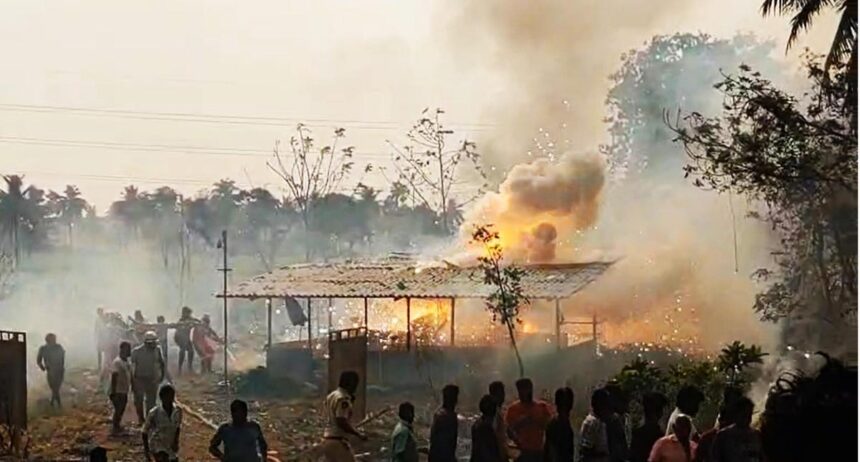
At least 21 people were killed in a devastating explosion at a firecracker manufacturing unit in Vetlapalem village of Samarlakota in Kakinada district, Andhra Pradesh, on Saturday. The powerful blast tore through the facility, triggering panic in surrounding areas and leaving dozens injured. Rescue teams rushed to the site as emergency services scrambled to contain the aftermath of one of the deadliest industrial accidents in the region in recent times. Authorities have launched a detailed investigation to determine the cause of the explosion, even as hospitals struggle to treat critically injured victims.
Massive blast devastates factory and nearby area
The Andhra Pradesh firecracker factory explosion occurred at a manufacturing unit in Vetlapalem village, located in Samarlakota of Kakinada district. According to police officials, the intensity of the explosion was so severe that it caused widespread destruction within the premises and was felt in nearby villages. The blast ripped through the unit, sending shockwaves through the surrounding locality and sparking immediate fear among residents.
Emergency response teams, including police, health personnel, and fire and emergency services, were swiftly deployed to the site. Rescue operations began promptly, with ambulances transporting the injured to the Government General Hospital in Kakinada. The coordinated effort aimed to search for survivors amid debris while ensuring that the injured received urgent medical attention.
Hospital authorities confirmed that 18 people are currently undergoing treatment. Among them, seven patients were admitted with severe burn injuries ranging from 90 to 100 per cent. The hospital superintendent stated that these critically injured victims are receiving intensive care, highlighting the gravity of the situation. The high percentage of burn injuries reflects the combustible nature of materials typically used in firecracker manufacturing.
Police have so far identified 13 of the deceased, and efforts are underway to confirm the identities of the remaining victims. The scale of casualties underscores the hazardous conditions often associated with firecracker production units, where explosive substances are handled daily. While such factories operate under regulatory guidelines, lapses in safety protocols or accidental ignition can result in catastrophic consequences.
The impact of the explosion not only claimed lives but also instilled fear among local communities. Residents reported hearing a loud blast and witnessing smoke rising from the site. The intensity of the explosion suggests that a significant quantity of combustible material may have ignited simultaneously, although officials have refrained from speculating until investigations are complete.
Investigation underway as Chief Minister reviews situation
The Andhra Pradesh firecracker factory explosion has prompted a high-level review by state authorities. Chief Minister N. Chandrababu Naidu, who was on a tour of Vijayanagaram at the time of the incident, reviewed the situation with senior officials soon after receiving reports. He sought immediate details regarding the cause of the explosion and directed ministers and top administrative authorities to visit the accident site.
The state government has initiated an investigation to ascertain the exact circumstances that led to the blast. Officials are expected to examine whether the factory adhered to prescribed safety standards, licensing conditions, and storage regulations for explosive materials. Determining whether the explosion resulted from negligence, technical malfunction, or accidental ignition will be central to the inquiry.
Industrial accidents involving firecracker manufacturing units have periodically raised concerns about compliance with safety norms, especially in units located in semi-urban or rural areas. Such factories require strict adherence to guidelines governing the storage of chemicals, separation of work areas, fire suppression mechanisms, and employee training. Any deviation can have tragic consequences, as evidenced by the magnitude of this incident.
Beyond the immediate rescue and medical response, authorities face the task of ensuring accountability and preventing similar tragedies in the future. Strengthening oversight mechanisms, conducting regular inspections, and enhancing worker safety training may become focal points in the aftermath of the explosion.
The Government General Hospital in Kakinada remains at the center of the emergency response, with doctors and medical staff working around the clock to stabilise patients. The condition of those with extensive burn injuries remains critical, and medical teams are employing specialised treatment protocols to manage severe trauma.
As investigations continue, the Andhra Pradesh firecracker factory explosion stands as a stark reminder of the inherent risks in industries dealing with highly flammable materials. The tragedy has left families grieving and communities shaken, even as authorities work to uncover the precise cause and ensure that necessary measures are implemented to prevent recurrence.