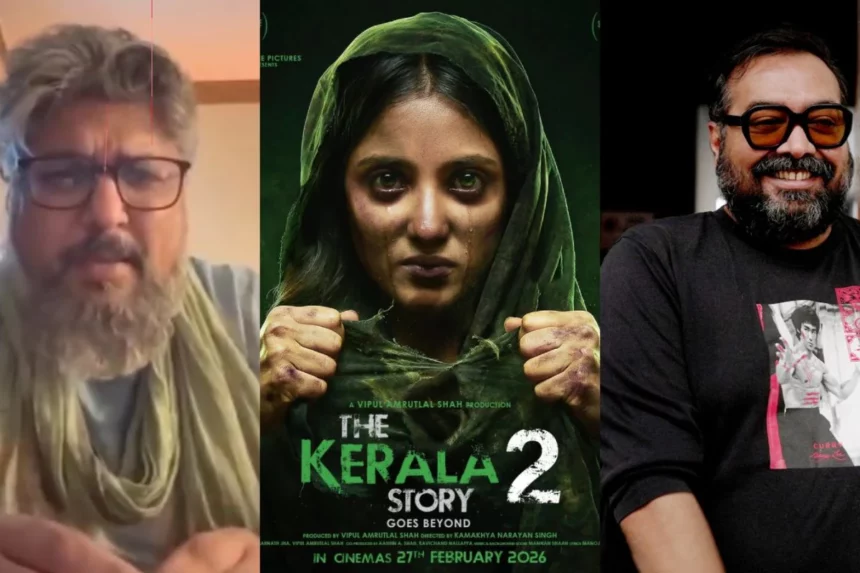
Even before its theatrical release, The Kerala Story 2 has become the centre of a heated public debate, with director Kamakhya Narayan Singh launching a sharp counterattack against filmmaker Anurag Kashyap after he criticised a controversial scene in the film’s trailer, escalating tensions within the film industry and sparking wider political and social reactions.
Trailer scene ignites debate, Anurag Kashyap calls film propaganda
The controversy began after the trailer of The Kerala Story 2 was released, featuring a scene in which a Muslim family is shown allegedly forcing the female protagonist to consume beef. The sequence quickly drew attention online, triggering polarised reactions from viewers and members of the film fraternity.
Filmmaker Anurag Kashyap responded strongly to the scene, questioning its portrayal and credibility. He remarked that no one forcibly feeds beef to someone in such a manner and sarcastically asked whether even khichdi could be forcibly fed in that way. Kashyap went further, describing the film as “completely rubbish” and labelling it as propaganda. He also raised concerns about the intent behind the narrative and its potential impact on social harmony.
His remarks were widely circulated and sparked fresh debate around the film’s themes and messaging. Critics of the trailer argued that the depiction risked inflaming communal sensitivities, while supporters defended the film as an attempt to highlight real issues.
As the exchange gained momentum, reactions began pouring in from various quarters, including film personalities and political figures. The controversy expanded beyond the cinematic context, touching upon broader discussions about freedom of expression, representation, and responsible storytelling in Indian cinema.
Kamakhya Narayan Singh responds with sharp criticism
In response to Kashyap’s comments, director Kamakhya Narayan Singh posted a video message on social media, strongly criticising the filmmaker. In the video, Singh alleged that Anurag Kashyap had become “mentally weak” and claimed that he seems to have a problem with everything, whether it concerns the film industry, specific communities, or streaming platforms.
Singh stated that Kashyap habitually complains and reacts negatively to various issues. He further defended the controversial scene, asserting that incidents of girls being forcibly fed beef as part of religious conversion do occur and that such acts constitute serious crimes. According to Singh, the film seeks to address sensitive realities rather than promote division.
He also referred to Kashyap’s earlier film The Girl in Yellow Boots, criticising its portrayal of a father-daughter relationship, which he described as morally questionable and disturbing. Singh argued that such narratives were difficult to accept within what he termed a civilised society.
In addition, Singh commented on Kashyap’s recent box-office performance, suggesting that his films had not performed well for some time and expressing hope that he would “come to his senses.” He reiterated that The Kerala Story 2 is based on facts and maintained that the trailer has received a positive response from audiences.
Meanwhile, Anurag Kashyap, in media interactions, maintained his stance, describing the film as nonsensical and cautioning that it could deepen social divisions and disturb communal harmony. The exchange between the two filmmakers has intensified discussions about artistic responsibility and the line between storytelling and political messaging.
With the film scheduled for theatrical release on February 27, 2026, the controversy shows no signs of subsiding. Instead, it has become a focal point of national conversation, drawing attention to the evolving intersection of cinema, politics, and public discourse in India.