

China’s Foreign Minister Misses BRICS Meeting During High-Stakes Trump Visit to Beijing
China’s decision to skip the upcoming BRICS Foreign Ministers’ meeting in New Delhi has sparked major diplomatic discussions across global political circles, especially because the development comes at the same time as U.S. President Donald Trump prepares for a crucial visit to Beijing. The absence of Chinese Foreign Minister Wang Yi from the important multilateral summit has intensified speculation over Beijing’s diplomatic priorities at a time of rising geopolitical competition.
China’s Foreign Ministry confirmed that Wang Yi would not attend the BRICS Foreign Ministers’ gathering scheduled in New Delhi on May 14 and 15 due to “scheduling reasons.” Instead, Beijing announced that its Ambassador to India, Xu Feihong, would represent China during the discussions.
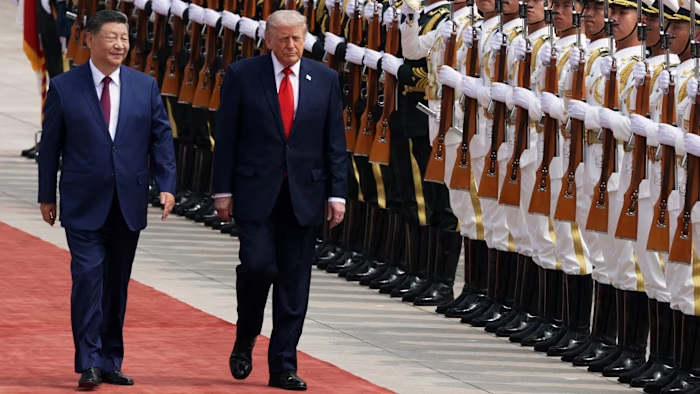
Although Chinese officials attempted to downplay the significance of the absence, the timing has drawn international attention because it overlaps with Donald Trump’s high-profile diplomatic visit to China. Trump is expected to arrive in Beijing just a day before the BRICS meeting begins, placing the focus of global diplomacy on the evolving relationship between Washington and Beijing.
The BRICS grouping — consisting of Brazil, Russia, India, China, and South Africa along with recently expanded members — has emerged as one of the most influential platforms representing developing economies and the Global South. India, currently chairing the bloc, had been preparing for strong ministerial participation from all member nations.
However, China’s decision not to send its foreign minister has shifted attention away from the summit agenda toward broader strategic calculations unfolding behind the scenes.
Trump-Xi Talks Become the Center of Global Attention
The overlap between the BRICS summit and Donald Trump’s Beijing visit has become one of the most discussed geopolitical developments of the week. Trump’s meetings with Chinese President Xi Jinping are expected to focus heavily on trade tensions, Taiwan, technology restrictions, Indo-Pacific security concerns, and economic rivalry between the world’s two largest economies.
International analysts believe Beijing may have prioritized bilateral engagement with the United States over multilateral diplomacy at a particularly sensitive moment in global affairs. While China publicly insisted there was no political message behind Wang Yi’s absence, diplomatic observers argue that the symbolism cannot be ignored.
Relations between China and the United States remain highly complex. Disputes over semiconductor exports, military presence in the Indo-Pacific region, sanctions, tariffs, and Taiwan continue to shape the strategic competition between the two nations. Trump’s return to direct diplomacy with Beijing therefore carries enormous global implications.
Several experts believe China sees the Trump-Xi discussions as an opportunity to stabilize communication channels while defending its geopolitical interests. This may explain why Beijing chose to keep its top diplomat focused on preparations related to the American visit rather than the BRICS summit in India.
The development has also fueled debate about the internal dynamics within BRICS. The organization has increasingly projected itself as an alternative voice to Western-led global institutions, advocating multipolarity and greater representation for developing nations. In that context, the absence of one of its most powerful members at a high-level meeting naturally raises questions about priorities and cohesion.
India Continues BRICS Leadership Push
Despite growing international attention surrounding China’s absence, India appears determined to keep the summit focused on cooperation and policy outcomes. Under the leadership of External Affairs Minister S. Jaishankar, New Delhi is expected to push discussions on economic partnerships, digital governance, climate financing, supply chain resilience, and reforms in global financial institutions.
India has increasingly positioned itself as a leading voice for developing economies. Over recent years, New Delhi has strengthened diplomatic engagement with both Western nations and emerging powers while simultaneously expanding its role in international forums.
Officials associated with the summit preparations indicated that India remains fully committed to ensuring productive discussions among BRICS members despite the absence of China’s foreign minister. Beijing also released a statement expressing readiness to work with all BRICS countries and support India in its role as Chair.
Still, analysts point out that India-China relations remain layered and complicated. Border tensions, regional influence, trade competition, and strategic positioning in Asia continue to shape interactions between the two countries. Platforms such as BRICS and the Shanghai Cooperation Organisation provide important channels for continued engagement despite broader geopolitical differences.
India’s broader diplomatic strategy during its BRICS chairmanship has focused heavily on strengthening the collective voice of emerging economies. New Delhi has consistently advocated reforms in global governance systems, fairer trade structures, and increased financial support for developing countries.
The ministerial meeting is expected to address several pressing global challenges, including economic instability, regional conflicts, energy security, and technological cooperation. However, China’s absence at the highest diplomatic level has inevitably become one of the defining talking points surrounding the summit.
BRICS Faces Questions Over Unity and Strategic Priorities
The situation has highlighted the growing complexity inside BRICS as the bloc attempts to expand its global influence. What began primarily as an economic grouping of emerging markets has evolved into a broader geopolitical platform representing countries seeking a more multipolar world order.
At the same time, member nations often maintain different strategic interests and foreign policy goals. China and India continue to compete for regional influence despite cooperating on several international issues. Russia’s tensions with Western nations have further altered the strategic environment surrounding BRICS diplomacy.
Experts note that diplomatic representation at major international gatherings often carries symbolic importance beyond formal discussions. High-level attendance signals political commitment, strategic messaging, and diplomatic alignment. Because of this, Wang Yi’s absence has naturally attracted significant attention from policymakers and media outlets worldwide.
However, some analysts caution against reading too deeply into the move. They argue that global diplomacy frequently involves overlapping schedules and competing international commitments. China’s public support for India’s BRICS chairmanship suggests Beijing is trying to avoid creating perceptions of division within the grouping.
Even so, the contrast between China prioritizing Trump’s visit and missing a BRICS ministerial meeting has become difficult to ignore. The episode reflects the broader reality of today’s geopolitical landscape, where nations constantly balance bilateral rivalries, economic interests, and multilateral partnerships simultaneously.
As leaders and diplomats gather in New Delhi for crucial discussions, attention will remain equally focused on Beijing, where Donald Trump and Xi Jinping are expected to engage in high-stakes negotiations with far-reaching global implications.
The coming days may ultimately determine whether China’s absence is remembered as a temporary scheduling conflict or as a symbol of shifting geopolitical priorities within an increasingly fragmented international order.