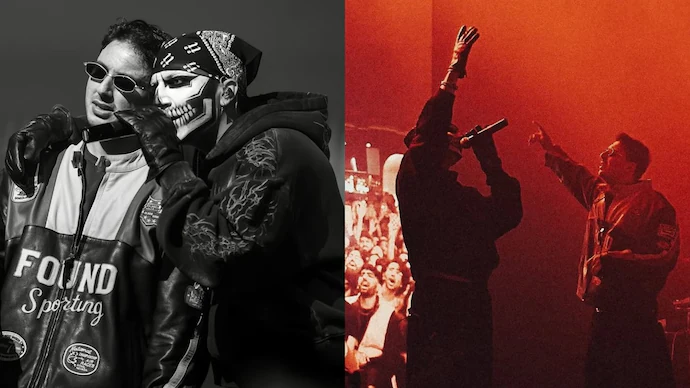
The global music scene witnessed an unexpected cultural crossover in Toronto when Indian singer Talwiinder appeared on stage with Pakistani artist Hasan Raheem during a live concert, triggering both celebration and controversy across social media platforms. The surprise collaboration, which was not officially announced in advance, quickly became one of the most discussed entertainment moments of the week, drawing sharply divided reactions from fans in India, Pakistan, and the global diaspora.
The performance, held in front of a packed audience, showcased both artists sharing the stage in an informal, energetic set that blended contemporary South Asian sounds with global pop influences. Videos from the event spread rapidly online, showing the two singers greeting each other warmly, performing together, and engaging with the audience in an atmosphere that many described as electric and spontaneous. However, the reaction offstage has been far more complicated, with political tensions once again spilling into the cultural space.
A Surprise Collaboration That Caught Fans Off Guard
The collaboration between Talwiinder and Hasan Raheem was not part of any officially announced lineup, which added to the shock value of the moment. Attendees at the Toronto concert were reportedly unaware that the Indian singer would make an appearance, making the performance feel like a special surprise segment.
Talwiinder, who has built a strong independent music following through streaming platforms and social media virality, joined Hasan Raheem mid-show. The two artists performed, interacted on stage, and shared a lighthearted rapport that resonated strongly with sections of the audience. The crowd response appeared overwhelmingly positive during the performance itself, with cheers and visible excitement capturing the moment.
Hasan Raheem, known for his mellow vocal style and contemporary fusion sound, has developed a global fan base, particularly among South Asian youth. His collaboration with Talwiinder added a fresh dimension to the concert, blending two distinct musical identities into a shared stage presence.
The moment was widely shared on Instagram and X shortly after the event, with clips accumulating millions of views within hours. However, what began as a musical highlight soon evolved into a heated digital debate.
Social Media Backlash and Political Undercurrents
The online reaction to Talwiinder’s appearance was sharply divided, with criticism emerging primarily from sections of users who linked the collaboration to ongoing geopolitical tensions between India and Pakistan. Some users questioned the timing and optics of the performance, while others expressed disappointment, arguing that public figures should be more sensitive to national sentiment during periods of strained relations.
A significant portion of criticism focused on resurfaced remarks attributed to Hasan Raheem regarding past political and military incidents, which intensified scrutiny of the collaboration. These discussions quickly overshadowed the musical aspect of the event, turning what was intended as an artistic moment into a broader cultural flashpoint.
At the same time, many users defended the collaboration, arguing that music should remain separate from political disputes. Supporters highlighted that international stages like Toronto naturally bring together artists from different backgrounds and that cultural exchange is an essential part of global entertainment.
One section of fans described the performance as a symbol of unity and creativity, emphasizing that artists often serve as bridges between divided communities. Others pointed out that diaspora audiences regularly consume music across borders without political constraints and that such collaborations reflect modern global listening habits.
The Role of Diaspora Audiences in Shaping Reactions
The Toronto concert, attended largely by South Asian diaspora audiences, played a significant role in shaping the tone of the event. In multicultural cities like Toronto, musical collaborations between Indian and Pakistani artists are not uncommon, and audiences often respond positively to cross-border artistic expression.
Many attendees reportedly viewed the performance as a natural and enjoyable surprise rather than a politically loaded statement. Videos recorded inside the venue show audience members cheering, dancing, and reacting enthusiastically to the joint performance, suggesting that the live atmosphere was largely celebratory.
However, once the clips circulated online, the narrative shifted significantly. Social media platforms amplified contrasting viewpoints, with debates intensifying across comment sections and fan communities. The divide highlighted how digital spaces often reinterpret live cultural moments through political and emotional lenses that may differ from on-ground experiences.
This gap between live audience reception and online interpretation has become increasingly common in global entertainment, especially when artists from countries with complex political relations appear together.
Talwiinder’s Rising Career and Public Scrutiny
Talwiinder, whose real name is Talwiinder Singh Sidhu, has rapidly grown in popularity through independent releases and viral digital music success. Tracks such as Kammo Ji, Dhundhala, and Funk Song helped him establish a strong presence on streaming platforms and social media reels, particularly among younger audiences.
His music style, often blending melodic hooks with modern production, has positioned him as part of a new wave of Indian independent artists who operate outside traditional Bollywood structures. His debut album further expanded his reach, featuring collaborations with multiple emerging artists and gaining traction across global streaming charts.
However, with increased visibility has come increased scrutiny. Public interest in his personal life, including rumored associations with entertainment personalities, has also contributed to his media profile. The Toronto appearance has now added another layer to his public image, placing him at the center of a broader cultural conversation that extends beyond music.
Industry observers note that independent artists today often navigate dual pressures: expanding global reach while managing politically sensitive interpretations of their work. In Talwiinder’s case, the Toronto performance has highlighted how quickly artistic expression can become entangled in national sentiment debates.
Music, Identity, and the Politics of Collaboration
The incident has once again raised questions about the intersection of music and politics in South Asia. Cross-border collaborations between Indian and Pakistani artists have historically faced scrutiny, particularly during periods of heightened diplomatic tension. While cultural exchanges continue in international spaces, they often generate polarized reactions online.
Supporters of such collaborations argue that art should remain independent of political divisions and that music, by nature, transcends borders. Critics, however, contend that public figures inevitably carry national representation and must be mindful of geopolitical sensitivities.
The Toronto performance sits directly at the intersection of these perspectives. On one hand, it represents a spontaneous artistic moment between two rising South Asian musicians on a global stage. On the other, it has become a symbol of ongoing debates about cultural diplomacy, national identity, and digital accountability.
The incident also reflects how entertainment content is consumed in the digital era. A single performance clip can rapidly evolve into a multi-layered discourse involving politics, fandom loyalty, and cultural interpretation.
Conclusion: A Performance Beyond Music
What began as a surprise musical collaboration in Toronto has transformed into a wider conversation about art, borders, and public perception. Talwiinder’s appearance with Hasan Raheem demonstrated the growing interconnectedness of South Asian music on global platforms, but it also revealed the persistent sensitivities that accompany cross-border interactions.
While the stage performance itself was brief and celebratory, its online aftermath has extended far beyond the concert hall. The debate surrounding it underscores how modern artists operate in an environment where every appearance can be reinterpreted through political, cultural, and emotional frameworks.
As both artists continue their careers in an increasingly globalized music industry, the Toronto moment is likely to remain a reference point in discussions about collaboration, identity, and the evolving role of music in bridging or reflecting divides.