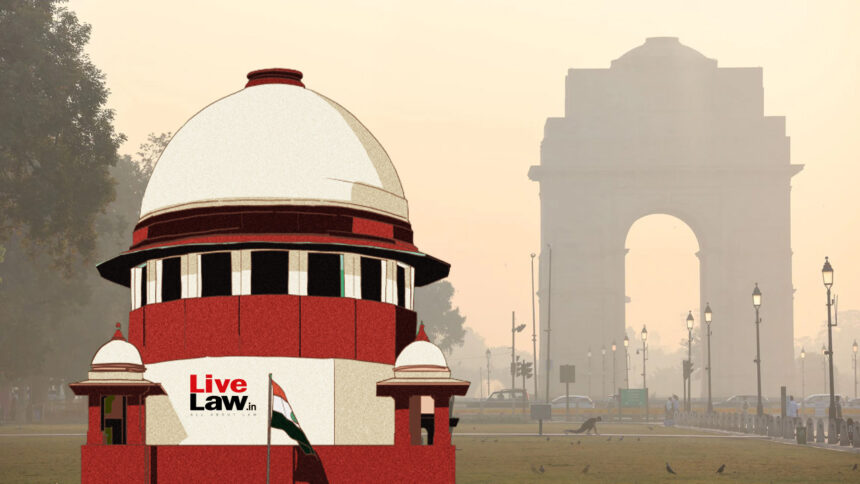
The Supreme Court of India is set to examine two of the country’s most pressing governance challenges—Delhi-NCR’s worsening air pollution and the growing overcrowding of jails nationwide—taking up both matters in an upcoming hearing that could shape long-term policy responses for public health, human rights, and administrative reform.
Court’s Focus on Delhi-NCR’s Severe Air Pollution Emergency
Over the past several years, Delhi and its surrounding National Capital Region have repeatedly found themselves trapped in hazardous air quality levels, prompting health advisories, emergency measures, and public frustration. As winter sets in, the air tends to become stagnant, trapping vehicular emissions, industrial pollutants, construction dust, waste burning fumes, and farm stubble smoke. This toxic combination regularly pushes the Air Quality Index into severe or even severe-plus categories, posing a direct threat to vulnerable populations such as children, the elderly, and those with respiratory illnesses.
The Supreme Court has long been engaged in the pollution matter, passing numerous directives—from tackling stubble burning to restricting construction activities and mandating pollution control technologies for industries. Yet, year after year, the crisis resurfaces, raising deeper questions about enforcement failures, inter-state cooperation, and the collective responsibility of authorities. The upcoming hearing is expected to take a more expansive view of the issue, especially focusing on whether existing measures have been implemented efficiently and whether additional mechanisms are required to curb emissions at the source.
A major point of concern the Court may explore is the uneven implementation of action plans by states belonging to the National Capital Region. Delhi often finds itself at the forefront of debate, but pollution inflow from Punjab, Haryana, Uttar Pradesh, and Rajasthan continues to be a significant contributor during winter months. The Court has previously noted the lack of accountability in the chain of enforcement and may choose to strengthen monitoring mechanisms or set up a supervisory framework that can ensure timely compliance.
Public health experts have repeatedly warned that prolonged exposure to such dangerous pollution levels has long-term impacts on lung function, cognitive development in children, increased risk of heart disease, and shortened life expectancy. The Supreme Court’s intervention in this round is expected not only to push for immediate relief during peak season but also to examine structural reforms such as expansion of clean public transport, stricter emissions standards, scientific waste management, urban green buffers, and curbing rampant construction dust.
The Court may also revisit the Graded Response Action Plan (GRAP), which governs emergency measures such as vehicle restrictions, halting construction activities, closing brick kilns, and allowing only essential industrial operations. Critics argue that GRAP kicks in too late and does little to prevent the build-up that leads to the annual winter emergency. As the hearing proceeds, judges may emphasize anticipatory planning rather than reactive strategies, placing the burden on both state governments and Delhi’s civic bodies.
In recent weeks, Delhi’s smog has sparked national concern, drawing attention from medical associations and environmental researchers who insist that the city is living through a public health emergency. Many schools have been forced to adopt hybrid online classes, hospitals have seen a spike in respiratory cases, and poor visibility has disrupted normal life. The Supreme Court’s upcoming examination aims to understand the gaps in governance that allow such a situation to repeat annually and whether a unified regional approach is now unavoidable.
Supreme Court to Address Overcrowding Crisis in Prisons Nationwide
Apart from environmental concerns, the Supreme Court is also preparing to assess the troubling issue of overcrowded jails across India. Despite several committees, policy reforms, and judicial directions over the years, the country’s prisons continue to operate far beyond their sanctioned capacities, raising serious questions about human rights, living conditions, and the broader criminal justice system.
India’s prison population has grown steadily, driven largely by a significant proportion of undertrial prisoners—individuals who are yet to be convicted but remain incarcerated due to delayed investigations, prolonged trials, or inability to secure bail. In many states, jails are operating at 150 to even 200 percent of their intended capacity, leading to severe stress on infrastructure, hygiene, and access to basic services. The Supreme Court has repeatedly flagged this issue, but the situation remains critical.
The upcoming hearing is expected to delve into the reasons behind this chronic overcrowding, particularly focusing on custodial management, the pace of judicial processes, and the effectiveness of alternative mechanisms such as bail reforms, plea bargaining, community service sentences, and the use of technology for virtual hearings. The Court may also examine the extent to which state governments have followed earlier directions on improving prison infrastructure and hiring adequate staff.
Prison overcrowding is not merely an administrative challenge but also a human rights concern. Many reports have highlighted that cramped barracks, poor sanitation, inadequate nutrition, and limited access to medical care are common across several facilities. Women inmates, elderly prisoners, and those suffering from mental health conditions face additional vulnerabilities. The Supreme Court’s intervention may push for a holistic reform framework, combining legal, administrative, and infrastructural measures.
Another key concern likely to be raised is the high number of undertrials who remain in custody despite being eligible for bail. Often, marginalized individuals lack financial resources, legal knowledge, or timely representation, resulting in them spending years in jail for minor offences. The Court has previously stressed that the right to life and liberty under Article 21 must not be compromised due to systemic inefficiencies. The upcoming hearing may further strengthen directions to ensure that district legal services authorities actively identify and assist eligible inmates.
In addition to legal processes, the Court might also address the shortage of trained prison staff. Many states face significant vacancies in their jail administration, creating difficulties in maintaining order, ensuring rehabilitation programmes, and managing the daily needs of inmates. Without adequate staff, prisons struggle to implement educational, vocational, and psychological support systems that are essential for reintegration of convicts into society.
The overcrowding issue is closely linked with rehabilitation and reform programmes. Prisons in India often lack structured initiatives for skill development, counselling, or post-release support. As a result, many released convicts face social stigma, unemployment, and lack of community acceptance, contributing to cycles of reoffending. The Supreme Court may recommend a comprehensive review of rehabilitation policies to ensure that prisons serve as correctional spaces rather than institutions of prolonged hardship.
The hearing is also expected to touch upon the need for modernised prison infrastructure. Several jails across the country were built decades ago and no longer meet contemporary standards for safety, hygiene, and dignity. The Court’s guidance may prompt state governments to accelerate construction of new facilities where required, upgrade sanitation systems, improve medical units, and ensure adequate space for inmates.
Judicial delays form another critical aspect of the problem. Backlogs in trial courts, insufficient judges, repeated adjournments, and delays in forensic analysis all contribute to undertrial populations remaining high. The Supreme Court may push for better case management systems, increased use of virtual hearings, and stronger coordination between police, the prosecution, and the judiciary to expedite pending cases.
The upcoming hearing reflects the Supreme Court’s recognition that the overcrowding of prisons is not merely a law-and-order concern but a reflection of deeper structural issues within the criminal justice framework. By addressing these concerns, the Court seeks to uphold constitutional values and safeguard the dignity of those who remain in custody.