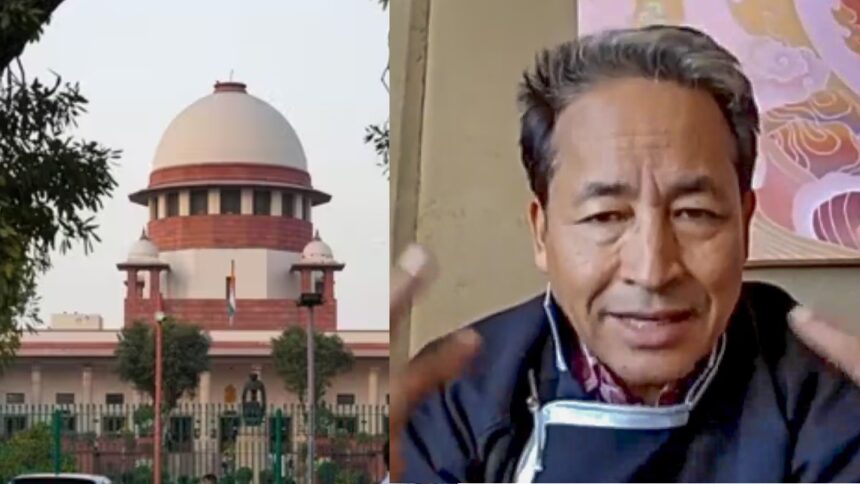
The Supreme Court of India has deferred by a day the hearing on the petition challenging the detention of Sonam Wangchuk, a move that has once again brought national focus to questions of preventive detention, civil liberties, and the limits of state power in dealing with dissent.
The case, which concerns the detention of Sonam Wangchuk under the National Security Act, has become one of the most closely watched legal battles in recent months. Known widely for his work in education reform and environmental advocacy in Ladakh, Wangchuk’s arrest and continued detention have sparked debate well beyond the courtroom, touching on constitutional guarantees, democratic protest, and the role of the judiciary in safeguarding individual freedoms. The Supreme Court’s decision to postpone the hearing signals a cautious approach, allowing the bench additional time to examine the complex factual and legal issues raised by the petition.
The plea before the apex court has been filed by Wangchuk’s wife, Gitanjali J. Angmo, who has challenged the legality of the detention order and alleged violations of constitutional safeguards. The adjournment, though brief, has heightened public interest, as supporters and critics alike await judicial scrutiny of a case that sits at the intersection of national security concerns and the right to peaceful dissent.
Detention under the national security act and the legal challenge
Sonam Wangchuk was detained following protests in Ladakh, where demonstrators were demanding greater constitutional protections, including statehood and inclusion under the Sixth Schedule. Authorities invoked the National Security Act, arguing that his actions were prejudicial to public order and security in a sensitive region. The use of this preventive detention law, which allows incarceration without trial for extended periods, immediately drew criticism from civil rights advocates and legal experts.
The petition before the Supreme Court argues that the detention order is arbitrary and lacks a proximate link between Wangchuk’s activities and any imminent threat to public order. It contends that the grounds supplied to justify the detention are vague, based on past events, and fail to meet the strict standards required for invoking preventive detention. According to the petitioner, crucial documents and materials relied upon by the authorities were either not supplied in full or were furnished belatedly, denying Wangchuk an effective opportunity to challenge his detention.
During earlier proceedings, senior advocate Kapil Sibal, appearing for Angmo, argued that preventive detention laws must be applied sparingly and with extreme caution. He maintained that Wangchuk’s public speeches and actions consistently called for peaceful protest and dialogue, and that selectively relying on certain materials while ignoring others amounted to a distortion of facts. The petition stresses that dissent, even if inconvenient to the government, cannot automatically be equated with a threat to national security.
On the other side, the government and local administration have defended the detention, asserting that due procedure was followed and that the decision was taken in the interest of maintaining public order. They argue that the protests had escalated into violence and that preventive action was necessary to prevent further unrest in a strategically important region. According to the authorities, all constitutional safeguards were adhered to, and the detention order was issued after careful consideration of the situation on the ground.
The Supreme Court bench, while hearing preliminary submissions, chose to defer the matter by a day to allow a more thorough examination of the records and arguments. The adjournment reflects the seriousness with which the court views cases involving preventive detention, particularly when they raise concerns about personal liberty and the scope of executive power.
Wider implications for civil liberties and democratic protest
Beyond the immediate legal questions, the Wangchuk detention case has become emblematic of a larger national conversation about civil liberties and the space for democratic protest in India. Wangchuk is not a conventional political figure; his prominence stems from his work in education innovation and climate action, as well as his advocacy for sustainable development in fragile Himalayan regions. For many of his supporters, his detention represents an attempt to silence a voice that has consistently highlighted environmental and social concerns through peaceful means.
Civil society organisations and activists have expressed concern that the use of the National Security Act in such cases could have a chilling effect on lawful protest and free expression. Preventive detention laws, by their nature, bypass the usual safeguards of criminal trials, making judicial oversight all the more critical. Legal scholars have pointed out that the Supreme Court’s eventual ruling could set an important precedent on how rigorously courts scrutinise executive claims of necessity and security.
At the same time, the case also raises difficult questions for governance in regions facing complex challenges. Ladakh’s strategic location, environmental fragility, and political aspirations create a backdrop in which protests can quickly take on broader implications. Governments argue that maintaining order in such contexts sometimes requires firm action. The challenge lies in ensuring that such action does not erode constitutional principles or undermine trust in democratic institutions.
Public reaction to the detention and the court proceedings has been intense. Supporters have organised campaigns calling for Wangchuk’s release, framing the issue as one of fundamental rights and moral conscience. Others have urged restraint, emphasising the need to allow the legal process to run its course and acknowledging the state’s responsibility to maintain order. The debate has played out across social media, public forums, and opinion columns, reflecting deep divisions over how dissent should be managed.
The Supreme Court’s role in this context is pivotal. As the guardian of the Constitution, it is tasked with balancing competing interests: the individual’s right to liberty and expression on one hand, and the state’s duty to ensure security and public order on the other. The decision to defer the hearing suggests an awareness of the stakes involved and a desire to engage with the issues in a considered manner rather than rushing to judgement.
As the case moves forward, it is expected that arguments will delve deeper into the proportionality and necessity of the detention, the adequacy of procedural safeguards, and the interpretation of constitutional provisions governing preventive detention. The outcome will not only determine Wangchuk’s immediate fate but may also influence how similar cases are approached in the future.
For many observers, the Wangchuk case represents a moment of reckoning for India’s democratic framework, testing the resilience of its institutions and the robustness of its commitment to civil liberties. The Supreme Court’s eventual verdict, whenever it comes, is likely to resonate far beyond the confines of this individual case, shaping public discourse on dissent, security, and the rule of law.