Newswise — Magicians often talk while performing their acts, using a type of speech called “patter.” This can include scripted dialogue, storytelling, and interactions, and is often used to entertain and manage audiences, with many people—including magicians—believing that it can even misdirect spectators and make sleight-of-hand tricks harder to spot. But does patter actually pull focus and make it difficult for viewers to see what’s happening?
A new study published in the journal Scientific Reports tests that assumption directly—and the results are surprising.
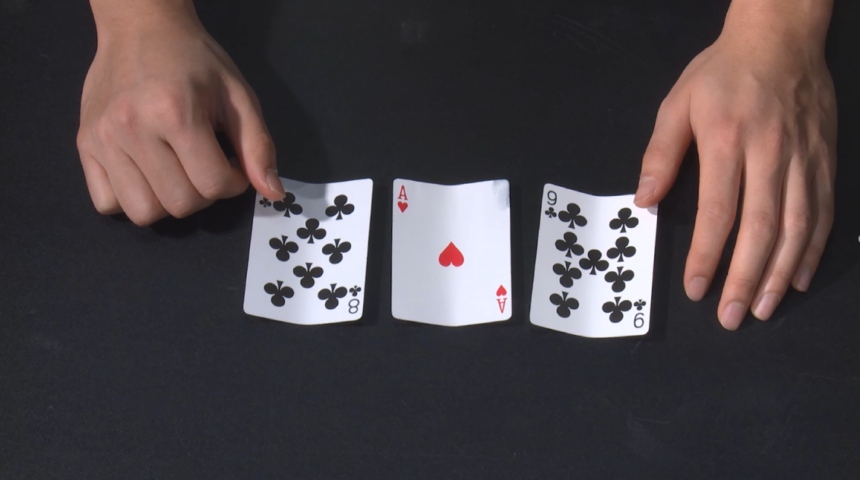
The researchers, including a first author at New York Institute of Technology, analyzed a classic sleight-of-hand trick called the Three-Card Monte. During this trick, a performer shuffles three cards and challenges viewers to follow the one red card, while using sleight-of-hand to deter spectators. Participants viewed a recorded Three-Card Monte act under three conditions: with a story that matched the card movements, with a story unrelated to the action, or with no sound at all. Notably, the target card had a visible water stain, and anyone who noticed it could easily identify the correct card every time, regardless of the magician’s actions. The researchers used a combination of behavioral performance (asking viewers to identify the red card) and eye-tracking technology to assess differences in gaze patterns across conditions.
Surprisingly, the magician’s patter had no meaningful impact on whether participants noticed the watermark. Viewers were just as likely to notice the mark whether they heard a related story, a mismatched story, or no story at all. One possible explanation for this is that, as viewers tracked the target, they were more focused on the moving cards themselves. This is a demanding visual task, and the brain may have ignored the audio altogether. Another possibility is that the magician’s stories simply did not capture viewers’ attention enough to miss the mark.
Regardless, the researchers conclude that patter still has its place and purpose in magic acts, helping to intensify the audience’s emotional engagement, strengthening the connection between the magician and the audience, and increasing entertainment value.
“This doesn’t mean patter is irrelevant—it likely shapes something else, such as viewer engagement, rapport, or emotional experience. That is, it might not control where you look, but how you feel while looking,” said cognitive neuroscientist Robert Alexander, Ph.D., assistant professor of psychology and counseling at New York Institute of Technology and one of the study’s co-lead authors.
The study’s other contributors include co-lead author Arthur Nguyen, Ph.D., a postdoc at the University of Geneva, as well as researchers from SUNY Downstate Health Sciences University, including neuroscientist Susana Martinez-Conde, Ph.D.
About New York Institute of Technology
New York Institute of Technology’s six schools and colleges offer undergraduate, graduate, doctoral, and other professional degree programs in in-demand disciplines, including computer science, data science, and cybersecurity; biology, health professions, and medicine; architecture and design; engineering; IT and digital technologies; management; and energy and sustainability. A nonprofit, independent, private, and nonsectarian institute of higher education founded in 1955, it welcomes nearly 8,000 students worldwide. The university has campuses in New York City and Long Island, New York; Jonesboro, Arkansas; and Vancouver, British Columbia, as well as programs around the world. More than 118,000 alumni are part of an engaged network of physicians, architects, scientists, engineers, business leaders, digital artists, and healthcare professionals. Together, the university’s community of doers, makers, healers, and innovators empowers graduates to change the world, solve 21st-century challenges, and reinvent the future. For more information, visit nyit.edu.
https%3A%2F%2Fwww.newswise.com%2Farticles%2Fstudy-magicians-talk-doesn-t-trick-the-eyes%2F%3Fsc%3Drsla