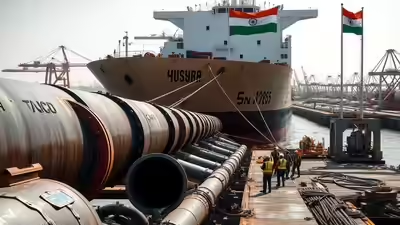
The escalating Iran–Israel conflict has triggered concerns about its far-reaching economic consequences for India, particularly if tensions disrupt shipping through the Strait of Hormuz. Nearly 50% of India’s monthly crude oil imports pass through this narrow but strategically critical waterway. Any closure or military escalation affecting this route could significantly disrupt oil supplies, increase inflationary pressures, strain the stock market, and push gold and silver prices higher. Beyond energy, more than 10% of India’s non-oil exports also rely on maritime routes linked to the region, amplifying the potential economic fallout.
Why the Strait of Hormuz impact on India is critical
The Strait of Hormuz, located between Iran and Oman, connects the Persian Gulf to the Gulf of Oman and the Arabian Sea. It is widely regarded as the world’s most important oil transit chokepoint. Approximately 20% of global petroleum consumption flows through this narrow corridor daily, making it indispensable to international energy markets.
For India, the Strait of Hormuz impact on India is particularly acute. A significant share of crude imports from major suppliers such as Saudi Arabia, Iraq, and the United Arab Emirates travels through this passage. Estimates indicate that roughly half of India’s monthly oil supply depends on shipments crossing Hormuz.
If the conflict escalates and Iran blocks the strait or Israel targets Iranian oil infrastructure, the resulting supply disruption could send crude oil prices soaring. Even a partial slowdown in tanker movement could tighten global supply chains and elevate freight and insurance costs.
Crude oil prices are a sensitive variable for India’s economy. When Brent crude climbs beyond the $80–85 per barrel range, inflationary concerns intensify. Recently, Brent prices rose to $72.87 per barrel, reflecting rising geopolitical risk. A sustained increase could erode corporate margins and dampen investor sentiment.
Sectors such as aviation, logistics, paints, and tyres are particularly vulnerable, as their cost structures are directly tied to petroleum derivatives. Rising fuel costs also feed into broader transportation expenses, affecting retail prices of food and essential commodities. This, in turn, could elevate India’s retail inflation rate and complicate monetary policy decisions.
Beyond oil, the Strait of Hormuz impact on India extends to trade. More than 10% of India’s non-oil exports transit through maritime routes connected to the Gulf region. Goods such as basmati rice, tea, spices, fresh produce, and engineering products are shipped extensively to West Asian countries, especially members of the Gulf Cooperation Council.
Recent trade figures show that India exported approximately $47.6 billion worth of non-oil goods to Gulf nations, accounting for about 13.2% of its total non-oil exports valued at $360.2 billion. Disruptions or higher shipping costs could raise exporters’ expenses, reduce competitiveness, and strain foreign exchange earnings.
Financial markets, gold, and silver under pressure
The Strait of Hormuz impact on India also resonates strongly within financial markets. Historically, Indian stock markets react sharply to crude price spikes and geopolitical tensions. Rising oil prices tend to widen India’s current account deficit and increase fiscal strain, prompting investor caution.
Foreign institutional investors have already shown signs of cautious positioning, and heightened geopolitical uncertainty could accelerate capital outflows. In such scenarios, market volatility increases, and sectors dependent on energy inputs may experience heavy selling.
Conversely, gold and silver often benefit during periods of global instability. Investors typically shift capital from risk assets to safe-haven instruments amid war fears. Commodity experts suggest that if tensions intensify further or if the United States becomes directly involved, demand for gold could surge, especially against the dollar.
Silver, with its dual industrial and investment demand, may also see price appreciation. Recent domestic price movements reflect this trend. According to industry data, 10 grams of 24-carat gold rose to ₹1.59 lakh, up by ₹1,075 in a single day, while silver increased to ₹2.66 lakh per kilogram, gaining ₹6,033. Such upward momentum often accelerates when geopolitical risk premiums expand.
Inflation remains another looming concern. If oil prices climb significantly, prospects for fuel price reductions in India would diminish. Elevated petrol and diesel costs would cascade into higher transportation expenses, pushing up prices of fruits, vegetables, and essential goods. This scenario could strain household budgets and weaken consumer demand.
Market analysts describe the current climate as one of cautious observation. Much depends on the trajectory of the conflict. If military actions remain contained and avoid direct disruption to oil infrastructure or the Strait of Hormuz, markets may stabilise quickly. However, any direct targeting of refineries or shipping routes could signal a prolonged period of economic uncertainty.
The Strait of Hormuz impact on India therefore encompasses energy security, trade flows, inflation management, and financial stability. As tensions persist, policymakers, investors, and businesses alike remain alert to developments that could reshape India’s economic landscape in the months ahead.