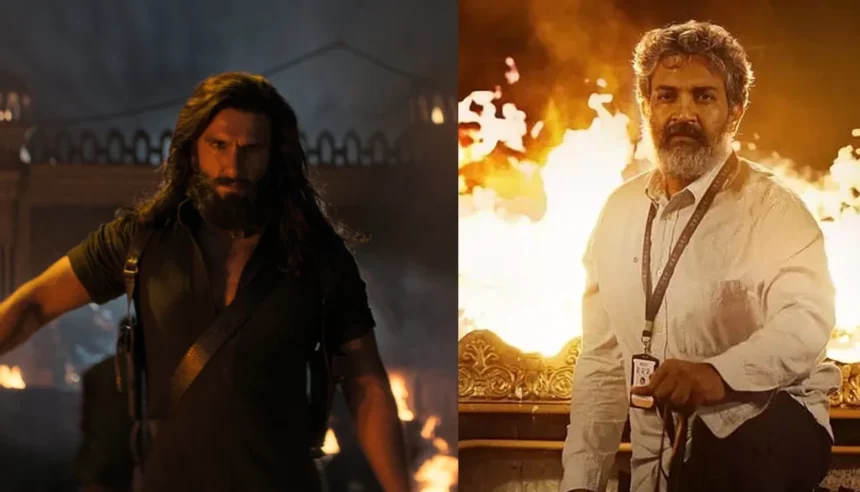
SS Rajamouli’s review of Dhurandhar: The Revenge has added major weight to the growing conversation around whether the sequel has surpassed the first film, and his answer appears clear: in his view, Dhurandhar 2 goes further both in scale and in emotional reach. Reports on March 21 say Rajamouli praised the film’s writing, performances, technical execution, and especially its emotional core, while also noting the boldness of releasing a nearly four-hour film in today’s theatrical climate. That matters because Rajamouli is not just another celebrity reviewer. When a filmmaker associated with large-scale, emotionally driven blockbusters publicly backs a sequel for expanding both spectacle and feeling, it shapes the way the industry and audiences read the comparison between part one and part two.
Rajamouli’s review points to emotional scale, not just visual scale
What seems to have impressed Rajamouli most is that Dhurandhar: The Revenge did not try to win the sequel contest through size alone. The reporting around his reaction suggests he saw the film as bigger in emotional depth as well as cinematic ambition. That is an important distinction. Sequels often become louder, longer, and more elaborate without becoming more affecting. Rajamouli’s praise implies that Dhurandhar 2 avoided that trap by deepening its emotional stakes rather than merely enlarging its action grammar.
That also explains why the “Dhurandhar 1 vs 2” debate has become so lively. Fans usually split over sequels in familiar ways: some prefer the freshness and narrative surprise of the original, while others respond to the confidence and scale of the follow-up. Rajamouli’s review appears to come down firmly on the sequel’s side because it expands the first film’s world without hollowing out its emotional centre. That is usually the hardest thing for a franchise film to achieve.
The nearly four-hour runtime is part of this conversation too. Rajamouli reportedly highlighted that it takes courage to release a film of that length today. In itself, length proves nothing. But when a filmmaker like Rajamouli singles it out positively, the implication is that the runtime has been justified by narrative payoff and emotional immersion rather than indulgence. Given that the film has also been racing through major box-office milestones, audiences appear to be accepting that wager. Reports on March 22 said the film had already crossed ₹500 crore worldwide and was approaching ₹400 crore net in India within days of release.
The review strengthens the film’s aura at a key moment
Rajamouli’s endorsement lands at a time when the film is already operating with enormous momentum. Trade and entertainment reports today describe Dhurandhar: The Revenge as a record-smashing hit that has topped major markets and broken several opening benchmarks. In that context, his praise does more than flatter the makers. It gives artistic legitimacy to a film that is already winning commercially, and that combination is often what settles fan debates most decisively.
It also matters that Rajamouli reportedly praised the emotional core alongside performances and technical craft. That keeps the discussion away from a simple “bigger equals better” argument. Instead, it suggests that Dhurandhar 2 succeeds because it enlarges the first film’s emotional universe. That is probably why many viewers are now treating the sequel not as an extension of the original, but as the film that fully realizes the franchise’s potential.
So the real significance of Rajamouli’s review is not that one famous director liked a hit film. It is that he seems to have given a clear answer to the question fans are asking: in his reading, Dhurandhar 2 is not just bigger than Dhurandhar 1; it is more complete.