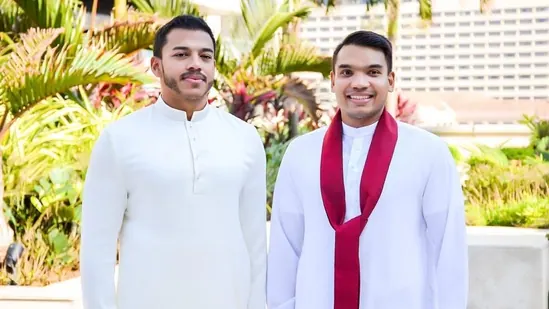
Sri Lankan police on Saturday arrested Yoshitha Rajapaksa, the second son of former president Mahinda Rajapaksa, on corruption charges linked to a controversial property purchase. The arrest occurred in Beliatta, the Rajapaksa family’s home territory, as part of an ongoing investigation into alleged misconduct during Mahinda Rajapaksa’s presidency, which lasted from 2005 to 2015.
Yoshitha Rajapaksa, a former navy officer, is accused of irregularities in acquiring a property in Kataragama, a southern religious resort town. This investigation has gained momentum recently, with police also questioning Gotabaya Rajapaksa, Yoshitha’s uncle and former president, regarding the same property last week. The case has drawn widespread attention, given its association with the influential Rajapaksa family, which has played a dominant role in Sri Lankan politics for decades.
The arrest is part of a broader anti-corruption drive by the administration of President Anura Kumara Dissanayake, who assumed office in November last year. The new government, committed to its pre-election promises, has vowed to prosecute individuals accused of corruption or malpractice during Mahinda Rajapaksa’s decade-long tenure. These efforts have already led to multiple inquiries involving the Rajapaksa family.
In addition to Yoshitha Rajapaksa’s arrest, police previously questioned Namal Rajapaksa, Mahinda Rajapaksa’s eldest son and a serving legislator, in connection with another property case. An employee of Mahinda Rajapaksa was also interrogated as part of the investigation, signaling the widening scope of the anti-corruption campaign.
This development follows Mahinda Rajapaksa’s filing of a fundamental rights petition in the Supreme Court on Friday. The former president is seeking the restoration of his security detail, which was significantly reduced by the current government. He argued that the reduction compromises his safety and undermines his stature as a former head of state.
The Rajapaksa family has faced growing scrutiny and public criticism since the political shift in Sri Lanka. Allegations of corruption and mismanagement during Mahinda Rajapaksa’s presidency have fueled calls for transparency and accountability. The new government’s crackdown on alleged wrongdoing marks a significant departure from the past, challenging the legacy of one of Sri Lanka’s most powerful political families.
Yoshitha Rajapaksa’s arrest underscores the government’s resolve to investigate corruption, setting the stage for heightened political tensions in the country.