Newswise — ROCKVILLE, MD (October 2, 2025) — Preeclampsia is a pregnancy complication with serious risks for mother and child. The only real cure for preeclampsia is delivery. Now, a new mouse study in The FASEB Journal reports that high levels of an mRNA splicing factor may contribute to the condition. The findings suggest that targeting this splicing factor with drugs could alleviate preeclampsia and help placental cells provide the fetus with an adequate blood supply.
Preeclampsia develops in 2-8% of pregnancies globally, according to the World Health Organization. It is usually diagnosed after 20 weeks of gestation. In preeclampsia, placental cells do not develop normally, leading to high blood pressure, organ damage, and insufficient blood flow to the fetus. If left unmanaged, serious complications can arise, including seizures, further organ damage, and maternal and fetal death. Few treatment options exist, with most doctors prescribing bed rest and blood pressure monitoring. Some patients also receive medications to lower blood pressure or prevent seizures, but these approaches don’t fix the underlying issues. Currently, giving birth is the only way to cure the condition, but early delivery can bring on additional complications.
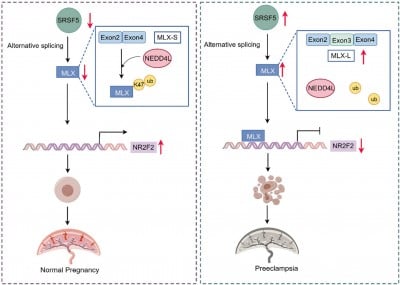
To identify possible therapeutic targets, Haiying Wu and colleagues at People’s Hospital of Zhengzhou University in China wanted to learn more about how preeclampsia develops. Using bioinformatics analyses, they found that mRNA transcripts for serine/arginine-rich splicing factor 5 (SRSF5) were upregulated in the placental tissue of human preeclampsia patients compared to tissue from healthy controls.
To better understand how elevated SRSF5 could lead to preeclampsia, the team conducted experiments in human and mouse placental cells. They found that the pre-mRNA of the transcription factor Max-like protein X (MLX) was not spliced properly when SRSF5 was elevated, making it longer and more stable. The incorrectly spliced MLX protein was more likely to bind to the promoter of another transcription factor called nuclear receptor subfamily 2 group F member 2 (NR2F2), which is involved in placental vascular and immune development. This binding reduced NR2F2 expression and led to placental cell death.
In in vivo studies, the researchers found that SRSF5 protein was highly expressed in a mouse model of preeclampsia. SRSF5 and MLX protein levels were high, whereas NR2F2 levels were low, in agreement with the in vitro cell experiments. Knocking down SRSF5 levels in the mouse model improved placental cell function, lowered blood pressure, and reduced the levels of protein in the urine.
“Our findings have elucidated the biological functions of SRSF5 in preeclampsia, thereby offering a novel and promising target for future clinical applications,” the authors say.
Read the full article, “SRSF5 regulates trophoblast apoptosis by inhibiting NR2F2 transcriptional activity through MLX ubiquitin degradation mediated by alternative splicing in preeclampsia,” published in The FASEB Journal.
###
About The FASEB Journal
The FASEB Journal, the flagship publication of the Federation of American Societies for Experimental Biology (FASEB), leads in publishing groundbreaking multidisciplinary research in biology and biomedical sciences. It spans all levels of biological organization, from molecular to population studies. The journal drives advances in basic, translational, pre-clinical, and early clinical research. Known for its rigorous peer-review process, The FASEB Journal is dedicated to advancing high-quality scientific discoveries and shaping the future of science.
About FASEB
FASEB is comprised of 22 scientific member societies with 110,000 members, making it the largest coalition of biomedical research associations in the United States. FASEB’s mission is to advance health and well-being by promoting research and education in biological and biomedical sciences through collaborative advocacy and service to member societies and their members. Visit faseb.org for more information.
Find FASEB Online
Website: www.faseb.org
X: @FASEBorg and @FASEBPubs
LinkedIn: FASEB
Instagram: @FASEBofficial
Bluesky: @faseborg.bsky.social
https%3A%2F%2Fwww.newswise.com%2Farticles%2Fsplicing-factor-could-be-therapeutic-target-for-preeclampsia%2F%3Fsc%3Drsla