Newswise — Traditional industrial hydrogen peroxide production depends on the anthraquinone process, which requires pressurized hydrogen, noble metal catalysts, and complex purification steps. These constraints limit flexibility, increase costs, and raise safety and environmental concerns. Electrochemical synthesis via the two-electron oxygen reduction reaction has emerged as a promising alternative, as it can operate under mild conditions and integrate renewable electricity. However, achieving high selectivity toward hydrogen peroxide remains challenging because oxygen reduction naturally favors a competing four-electron pathway that produces water instead. Based on these challenges, there is a strong need to develop catalysts and reactor systems that can precisely control reaction pathways and enable efficient, selective hydrogen peroxide generation.
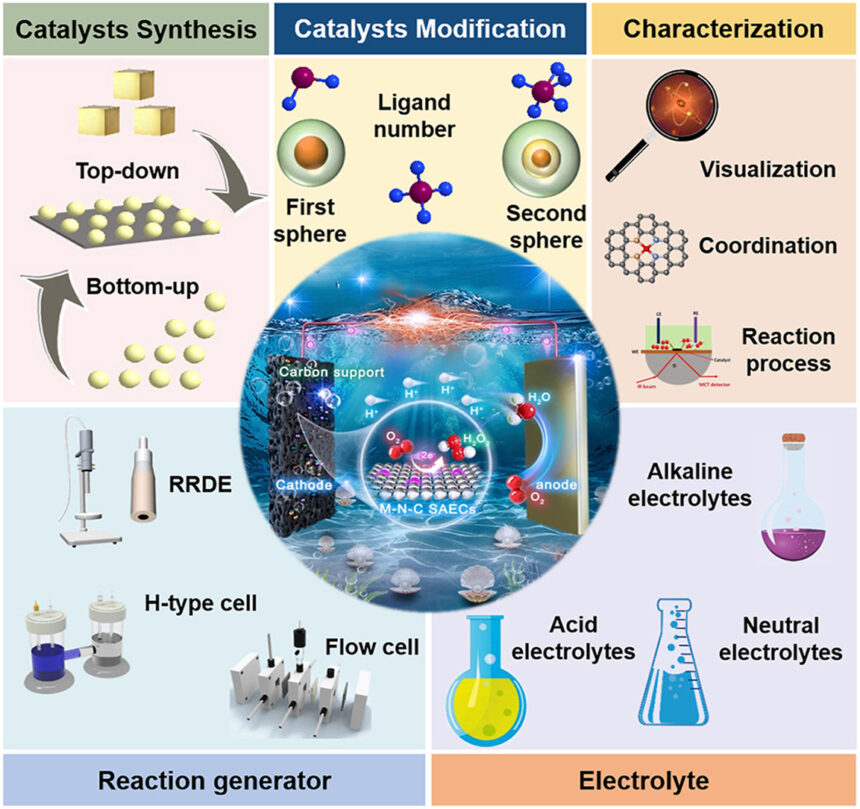
In a comprehensive review published (DOI: 10.1016/j.esci.2025.100456) online in 2026 in the journal eScience, researchers from institutions including the Chinese Academy of Sciences, Tsinghua University, and collaborating universities worldwide summarize recent advances in hydrogen peroxide electrosynthesis. The review examines how noble metal-free single-atom electrocatalysts, combined with optimized electrochemical reactors, can dramatically enhance hydrogen peroxide generation via the two-electron oxygen reduction reaction. By linking atomic-level catalyst structure with reactor design, the authors outline a roadmap for moving this green technology from laboratory studies toward real-world applications.
The review highlights that single-atom electrocatalysts—where individual metal atoms such as cobalt, iron, nickel, or manganese are anchored in nitrogen-doped carbon frameworks—play a decisive role in steering oxygen reduction chemistry. Unlike conventional metal nanoparticles, these isolated atoms favor an “end-on” oxygen adsorption mode that preserves the O–O bond, a prerequisite for hydrogen peroxide formation. Subtle changes in metal identity, coordination environment, and surrounding carbon structure can fine-tune adsorption strength and suppress unwanted pathways that lead to water.
Beyond catalyst design, the authors emphasize the often-overlooked importance of reactor engineering. Gas diffusion electrodes, flow cells, and membrane-electrode assemblies are shown to improve oxygen transport, manage local reaction environments, and stabilize hydrogen peroxide yields at industrially relevant current densities. Advanced characterization tools—such as aberration-corrected electron microscopy, X-ray absorption spectroscopy, and in situ infrared and Raman techniques—have enabled researchers to directly observe active sites and reaction intermediates in real time.
By integrating these insights, the review demonstrates that high hydrogen peroxide selectivity, near-quantitative Faradaic efficiency, and long-term operational stability are increasingly achievable without relying on precious metals, marking a significant step toward scalable and sustainable electrochemical production.
According to the authors, the true breakthrough lies in connecting atomic-scale understanding with system-level design. They note that focusing solely on catalyst performance is no longer sufficient; instead, the interaction between catalyst structure, electrolyte environment, and reactor configuration must be considered as a unified system. This integrated perspective not only clarifies why certain materials outperform others but also provides practical guidance for translating laboratory discoveries into deployable technologies for green chemical synthesis.
Efficient, decentralized hydrogen peroxide production could transform multiple sectors, from wastewater treatment and medical disinfection to chemical manufacturing and energy storage. On-site electrosynthesis reduces transportation risks and enables tailored dosing where and when hydrogen peroxide is needed. By eliminating dependence on precious metals and high-pressure hydrogen, the approach reviewed here aligns closely with global goals for carbon reduction and safer chemical processes. As reactor designs mature and durability challenges are addressed, noble metal-free single-atom electrocatalysis may underpin a new generation of modular, renewable-powered hydrogen peroxide systems, reshaping how this essential chemical is produced and used worldwide.
###
References
DOI
Original Source URL
https://doi.org/10.1016/j.esci.2025.100456
Funding information
The authors gratefully acknowledge the financial support provided by the National key research and development program of China-Key technologies and system for intelligent control of water supply network (2022YFC3203800), the Science and Technology Plan Project of Beijing City (Z231100006623001), the National Natural Science Foundation of China (52270083), the Fundamental Research Funds for the Central Universities (531119200298) and the Special Research Fund of Natural Science (Special Post) of Guizhou University [grant number: (2023) 43].
About eScience
eScience – a Diamond Open Access journal cooperated with KeAi and published online at ScienceDirect. eScience is founded by Nankai University (China) in 2021 and aims to publish high quality academic papers on the latest and finest scientific and technological research in interdisciplinary fields related to energy, electrochemistry, electronics, and environment. eScience provides insights, innovation and imagination for these fields by built consecutive discovery and invention. Now eScience has been indexed by SCIE, CAS, Scopus and DOAJ. Its first impact factor is 36.6, which is ranked first in the field of electrochemistry.
https%3A%2F%2Fwww.newswise.com%2Farticles%2Fsingle-atoms-big-impact-rethinking-hydrogen-peroxide-production-without-precious-metals%2F%3Fsc%3Drsla