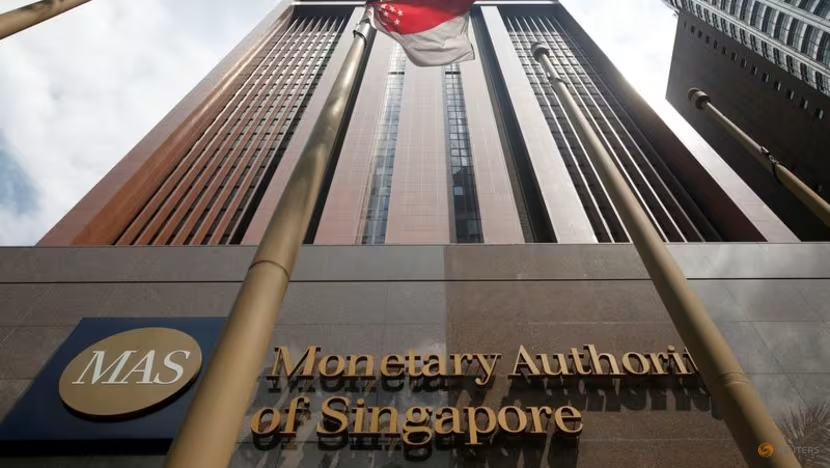
In a significant shift from its previous stance, Singapore’s central bank, the Monetary Authority of Singapore (MAS), eased its monetary policy on Friday for the first time since 2020. This decision follows a faster-than-expected decline in inflation and comes with a cautionary note about the country’s growth prospects. The move marks a pivotal moment in the economic policy of the city-state, as it attempts to balance inflation control with managing slower growth.
The MAS, in its official statement, revealed that it would make a slight reduction to the slope of its exchange rate policy band. This policy band, known as the Singapore dollar nominal effective exchange rate (S$NEER), serves as the central mechanism for managing the country’s monetary policy. The adjustment represents a shift towards a more accommodative stance, in line with the easing inflationary pressures that have been observed in recent months.
One of the key highlights of the MAS’s announcement was its updated growth projections. The authority noted that Singapore’s economic growth is expected to slow down this year, with growth momentum decelerating over the course of 2025. The country’s GDP growth is now forecast to range between 1% and 3% in 2025, a significant decline from the 4% growth expected for 2024. This forecast reflects broader global trends and the expected challenges faced by Singapore’s export-driven economy.
MAS also pointed to moderating inflation as one of the primary factors behind its decision to ease policy. The authority acknowledged that core inflation, which excludes volatile items such as accommodation and private transport, had decreased more rapidly than initially anticipated. Core inflation is now projected to be between 1% and 2% in 2025, lower than the 1.5% to 2.5% range it had projected in October 2024. This suggests that inflationary pressures have subsided, allowing for greater flexibility in monetary policy.
In terms of headline inflation, the MAS forecasted a more moderate 1.5% to 2.5% for 2025, down from the 2.4% estimated for 2024. While this is a positive development, it underscores the persistent challenges in achieving a full economic recovery, as inflation rates remain above pre-pandemic levels.
However, while inflation seems to be under control, the MAS emphasized the challenges that lie ahead. The authority warned that shifts in global trade policies could have a negative impact on Singapore’s domestic manufacturing and trade-related services sectors. This could further dampen the country’s growth prospects, as Singapore remains highly dependent on international trade for its economic stability.
The MAS’s decision to ease monetary policy by adjusting the S$NEER band is distinct from the approaches of other central banks. While many central banks around the world adjust domestic lending rates to influence economic activity, the MAS relies on changes to the Singapore dollar’s exchange rate to manage inflation and growth. The exchange rate adjustments are designed to either strengthen or weaken the local currency against a basket of major trading partners. By doing so, the MAS can indirectly influence inflation and export competitiveness without directly altering domestic interest rates.
The immediate market reaction to the policy change saw the Singapore dollar weaken slightly against the U.S. dollar. Following the announcement, the Singapore dollar depreciated marginally to 1.3556 against the greenback, while the Straits Times Index saw a modest increase.
Singapore’s monetary policy shift comes at a critical juncture for the country’s economy. While easing inflationary pressures provide room for adjustment, the growth slowdown poses a significant challenge to policymakers. The central bank’s focus on maintaining a balanced approach to growth and inflation control will be crucial as Singapore navigates the uncertain economic landscape of 2025 and beyond.