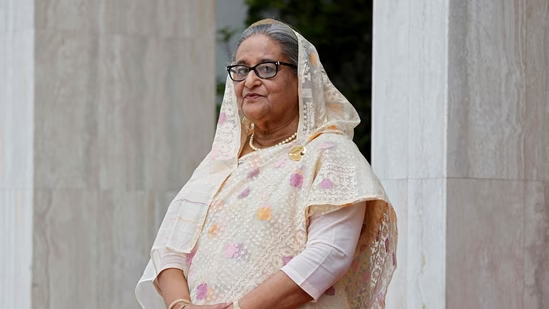
The sentencing of former Bangladesh prime minister Sheikh Hasina to death for alleged crimes committed during the 2024 student uprising has triggered a historic political moment, intense public debate, and unprecedented diplomatic uncertainty between Dhaka and New Delhi. As she remains in exile in India, the verdict has created a rare intersection of judicial action, political rivalry, and international diplomacy, while families of victims view the judgment as long-awaited justice.
The Verdict, the Charges, and the Political Repercussions in Bangladesh
The decision to sentence Sheikh Hasina to death marked one of the most dramatic developments in Bangladesh’s political and judicial history. The tribunal court found her guilty of “crimes against humanity” linked to the violent suppression of the 2024 student movement that swept across Dhaka and other major cities. This uprising, led largely by student groups demanding accountability and reform, escalated into one of the most intense and controversial political confrontations in recent years.
According to the tribunal, Hasina was found guilty on three major counts: incitement of violence, issuing orders that led to killings, and failing to act to prevent widespread atrocities. The verdict was read by Judge Golam Mortuza Mozumder, who stated that although the court considered the possibility of a life sentence, the gravity and multiplicity of charges justified imposing the death penalty. He declared that the tribunal had “decided to inflict her with only one sentence — that is, sentence of death.”
Hasina was not alone in receiving a severe punishment. Former interior minister Asaduzzaman Khan Kamal was also sentenced to death for his alleged involvement in the violent suppression of protesters. Another senior official, former inspector general of police Chowdhury Abdullah Al-Mamun, received a considerably lighter sentence of five years. The tribunal noted his cooperation with investigators and his admission of guilt in July as mitigating factors.
The charges brought against Hasina and her aides were extensive and severe. They included organizing mass killings of protesters in Dhaka, authorizing helicopter and drone assaults on civilian crowds, ordering the murder of student activist Abu Sayed, directing the burning of bodies in Ashulia to conceal evidence, and coordinating the targeted killing of demonstrators in Chankharpul. These accusations formed the core of the prosecution’s case, which portrayed the government’s actions during the uprising as systematic, brutal, and intentionally concealed.
The reactions within Bangladesh were immediate and polarized. Supporters of the student movement and families of victims viewed the ruling as a long-awaited acknowledgment of the violence that had taken place. The interim government headed by Muhammad Yunus praised the decision, describing it as a powerful message that even the most influential figures are not beyond the reach of the law. The chief adviser noted that the court’s actions “affirm a fundamental principle: no one, regardless of power, is above the law.”
On the opposite side, Sheikh Hasina condemned the verdict as fraudulent, politically motivated, and delivered by what she described as a “kangaroo court.” She insisted that the charges were fabricated by her political enemies and that the proceedings lacked fairness. From exile in India, she maintained that she had no role in the events for which she had been convicted and that the ruling represented a political vendetta rather than an impartial legal judgment.
The unrest surrounding the decision revealed divisions in Bangladeshi society and heightened the political tension that has continued since the 2024 uprising. Many supporters of the former prime minister believe the tribunal acted under political pressure, while critics argue that the violence demanded accountability at the highest levels of government. This split has left Bangladesh navigating a complex political landscape, where legal judgment, public sentiment, and political allegiance are increasingly intertwined.
International response to the verdict added another layer of complexity. The United Nations expressed mixed sentiments. While acknowledging the ruling as “an important moment for victims,” the UN also stated that it regretted the use of the death penalty, reiterating its opposition to capital punishment in all circumstances. The organization emphasized that trials involving international crimes must adhere strictly to global standards of fairness and due process.
India’s Position, Extradition Questions, and the Uncertain Future for Sheikh Hasina
Once the verdict was announced, Bangladesh immediately issued a formal request to India for the extradition of Sheikh Hasina and Asaduzzaman Khan Kamal. Both had fled Bangladesh after the August 2024 uprising and were tried in absentia. Dhaka invoked the extradition treaty and argued that New Delhi was obligated to return the two leaders to face justice.
Bangladesh’s foreign ministry stated that providing asylum to individuals convicted of crimes against humanity would be considered an unfriendly act and an obstruction of justice. This declaration increased diplomatic pressure on India, placing the country in a potentially difficult position between strategic interests, humanitarian considerations, and legal obligations.
India responded cautiously. The Ministry of External Affairs noted that it had “taken note of the verdict” and reiterated India’s long-standing commitment to peace, democracy, inclusion, and stability in Bangladesh. Importantly, India did not make any definitive statement regarding the extradition request, leaving open the question of how New Delhi would navigate the situation. India’s response signaled diplomatic sensitivity, especially because Sheikh Hasina has been one of the most consequential leaders in shaping the India–Bangladesh relationship over the past decade.
With Hasina residing in India, the question of whether New Delhi will extradite her has become central to predicting the next phase of the crisis. India’s decision will not only influence bilateral relations but may also impact regional geopolitics, given Hasina’s long-term prominence in South Asian affairs.
Meanwhile, the legal process in Bangladesh is set to continue regardless of Hasina’s physical presence. Under the tribunal’s procedures, the first step following a conviction is the confiscation of the convict’s property. Therefore, the authorities in Bangladesh are expected to seize Hasina’s assets and place them under state control. This move reflects the tribunal’s authority to enforce its judgment even in the absence of the convicted individuals.
Hasina does retain the legal right to appeal the verdict, but this right can only be exercised under specific conditions. She must either be arrested and brought back to Bangladesh or voluntarily return within 30 days of the ruling. If she fails to comply with these requirements, the court may formally classify her as a fugitive. This designation would significantly escalate the situation.
If Sheikh Hasina is officially declared a fugitive, the consequences would be substantial. Her passport may be canceled, preventing her from traveling. Her property may be permanently seized by the state. Bangladesh could also intensify its requests to India and seek broader international cooperation by asking for an Interpol red notice. An Interpol notice would alert law enforcement agencies around the world, urging them to locate and detain her.
The political implications of such a development would be enormous. Hasina’s status, the impact on Bangladesh’s domestic politics, and India’s diplomatic response would all shape the regional climate. Her role in South Asia has long been influential, and her current situation introduces uncertainties that extend far beyond the borders of Bangladesh.
The future trajectory of the case depends heavily on how different actors respond over the coming weeks. Bangladesh awaits India’s decision, the international community monitors the fairness and humanitarian dimensions of the sentence, and political analysts continue to assess how the verdict will reshape the country’s political landscape. The complex interplay of law, politics, and diplomacy ensures that the repercussions will be far-reaching and long-lasting.