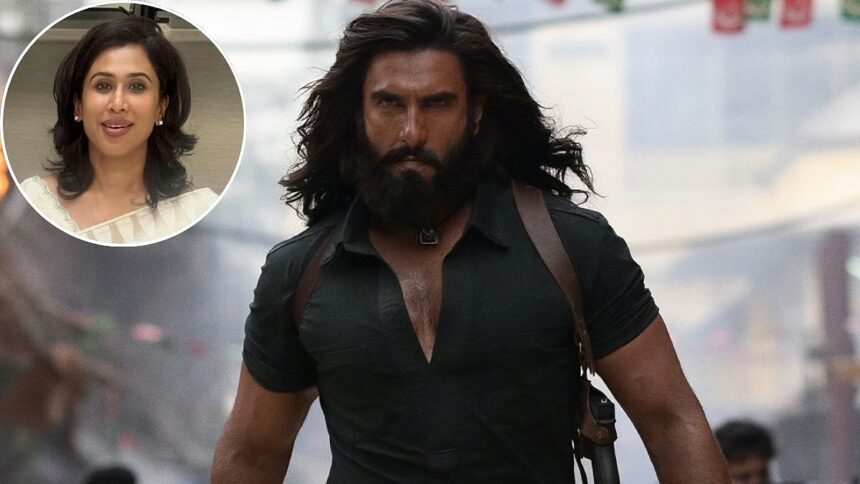
Congress spokesperson Shama Mohamed has sparked a major social media debate after defending the blockbuster film Dhurandhar against allegations that it portrays Muslims negatively. The controversy erupted after Shama Mohamed praised the film publicly on social media, leading to criticism from some users who described the movie as “propaganda cinema.”
The political and entertainment debate intensified after Shama Mohamed posted on X appreciating the film’s direction, screenplay, music integration and performances. She especially praised Ranveer Singh for his performance and commended director Aditya Dhar for the film’s storytelling style.
In her post, Shama Mohamed wrote that she recently watched Dhurandhar and found the film highly engaging. She particularly appreciated the way old Hindi songs were blended into emotionally intense scenes throughout the movie.
However, her praise triggered criticism from a social media user who accused the film of wrongly portraying Muslims and promoting propaganda narratives. The user questioned how a Congress leader could publicly support such a film and alleged that the movie created negative representation of the Muslim community.
Responding sharply to the criticism, Shama Mohamed clarified that the film portrays Pakistanis and not Indian Muslims negatively. She stated that equating Muslims with Pakistanis was itself problematic and harmful to the image of Indian Muslims.
Her response quickly went viral across social media platforms.
Shama Mohamed further remarked that individuals who constantly confuse Muslims with Pakistan weaken the position of Indian Muslims socially and politically. She also told the critic that if someone had “so much problem with India,” they were free to seek Pakistani citizenship.
The exchange immediately triggered heated online reactions, with supporters praising Shama Mohamed for drawing a distinction between Pakistani characters and Indian Muslims, while critics accused her of endorsing nationalist propaganda cinema.
The controversy has once again highlighted the growing political sensitivity surrounding representation in mainstream Indian films, especially movies involving themes of national security, espionage and cross border conflict.
Dhurandhar itself has emerged as one of the biggest commercial successes in Indian cinema history.
Directed by Aditya Dhar, the film stars Ranveer Singh alongside Sanjay Dutt, Akshaye Khanna, R Madhavan, Arjun Rampal and Sara Arjun in major roles.
The first part of Dhurandhar was globally released on December 5, 2025, and became a massive blockbuster both in India and overseas markets.
According to trade reports, the film earned approximately ₹1,307 crore worldwide. Its India gross collection crossed ₹1,005 crore while overseas earnings approached nearly ₹300 crore.
The film reportedly performed exceptionally strongly in international territories including the United States and Canada, where it even surpassed records previously associated with Baahubali 2: The Conclusion.
The franchise revolves around high intensity espionage operations and geopolitical conflict narratives, with Ranveer Singh portraying an Indian intelligence operative.
Following the success of the first installment, the sequel was released globally on March 19, 2026.
The second part has performed even more strongly at the global box office. Reports suggest the film has already earned nearly ₹1,792 crore worldwide, making it one of the highest grossing Indian films ever.
Its India net collection reportedly crossed ₹1,141 crore while overseas collections reached approximately ₹426 crore.
The Dhurandhar controversy has now added another political dimension to the film’s already massive popularity.
Over the past few years, several big budget Indian films centered around nationalism, military themes and intelligence operations have sparked debates regarding representation, patriotism and political messaging.
Supporters of such films argue that they reflect national security realities and patriotic storytelling, while critics often claim some movies simplify geopolitical issues or create stereotypes.
Shama Mohamed’s remarks have therefore entered a larger national debate surrounding cinema, identity and political interpretation.
Film industry analysts believe controversies of this nature often increase public curiosity around films, especially in the digital era where social media debates rapidly amplify attention.
Despite criticism from some sections online, Dhurandhar continues to enjoy enormous commercial success and strong audience response globally.