The controversy surrounding the high-voltage India-Pakistan encounter at the Asia Cup 2025 in Dubai has refused to settle, with former Pakistan captain Shahid Afridi launching a scathing attack on India’s Suryakumar Yadav and the Board of Control for Cricket in India (BCCI). After India’s seven-wicket victory against Pakistan, Shahid Afridi accused the Indian team of disrespecting cricketing traditions by refusing to engage in customary post-match handshakes, calling it an act of humiliation on a global stage. The refusal to extend sportsmanlike gestures, Shahid Afridi claimed, was orchestrated by the BCCI under political and social pressure, and it has since escalated into a larger dispute threatening the stability of the tournament itself.
The Dubai Match and Aftermath of the Handshake Snub
Sunday’s Group A encounter at the Dubai International Stadium was billed as another chapter in the storied rivalry between India and Pakistan. India, led by Suryakumar Yadav, secured a convincing seven-wicket win over Salman Ali Agha’s side, a result that was quickly overshadowed by what unfolded after the match. Instead of joining Pakistan players for the customary handshake, the Indian team retreated to their dressing room, shutting the door on their opponents and sparking outrage.
Pakistan coach Mike Hesson was visibly upset at what he described as unsportsmanlike behavior, an incident that prompted Agha to skip his interaction with former India cricketer Sanjay Manjrekar during the post-match presentation. This chain of events added fuel to the already fiery contest, with the Pakistan Cricket Board (PCB) escalating the issue further by demanding the removal of match referee Andy Pycroft. The PCB alleged that the referee failed to ensure proper conduct and fairness during the proceedings.
The PCB’s warning was severe: if Pycroft continued officiating Pakistan’s upcoming matches, the board threatened to withdraw from the tournament altogether. Such a decision would effectively eliminate Salman Ali Agha’s team from the Asia Cup, raising questions about both the spirit of the competition and the role of administrators in controlling tempers.
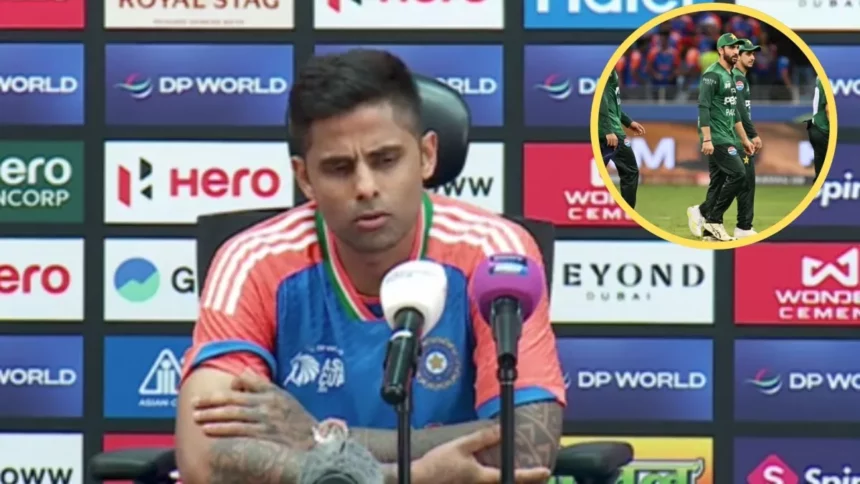
Suryakumar Yadav’s post-match remarks added another layer of complexity. The Indian skipper dedicated the team’s win to the Indian Armed Forces and expressed solidarity with victims of the Pahalgam terror attack, reinforcing the political overtones that have been attached to India-Pakistan cricket encounters. While the gesture was appreciated by many in India, it was interpreted across the border as an attempt to mix politics with sports. Shahid Afridi, picking up on this sentiment, accused India of abandoning the principles of fair play and turning cricket into a platform for political signaling.
Shahid Afridi’s reaction was blunt and uncompromising. In a televised discussion on Samaa TV, he said that India’s actions represented an embarrassment before the entire cricketing world. He noted that the refusal to shake hands was not an impulsive act but a premeditated decision influenced by public sentiment and political instructions. According to Shahid Afridi, social media campaigns in India had already created immense pressure on players and the BCCI, making it unsurprising that Indian cricketers avoided any gesture that could be seen as fraternizing with their Pakistani counterparts.
Shahid Afridi’s Scathing Remarks and Pakistan’s Stance
Shahid Afridi, known for his outspoken views, made no effort to soften his words. He insisted that the PCB chairman Mohsin Naqvi’s hardline stance was justified and that Pakistan was right to highlight the absence of sportsmanship. He argued that cricket, as a sport, demands mutual respect, and players must act as ambassadors of their nations rather than as agents of political messaging.
“In my opinion, there was no sportsman spirit,” Shahid Afridi declared, adding that India’s refusal to engage in a handshake would haunt them on the international stage. He said that instead of elevating the game, the Indian team had once again shown itself as a source of embarrassment. Shahid Afridi repeatedly stressed that it was not merely about individuals but about the orders handed down by the BCCI and those “above,” implying political interference.
Shahid Afridi also revisited the pre-tournament press conference where Suryakumar Yadav had freely shaken hands with both Pakistan captain Salman Ali Agha and ACC chairman Mohsin Naqvi. He contrasted that moment with the handshake snub in Dubai, calling it an example of double standards and hypocrisy. “The same Suryakumar shook hands during the captain’s press conference. Now, in front of the crowd, the government could not handle social media pressure. Indian players have become an embarrassment in front of the world,” Shahid Afridi said.
The PCB, emboldened by Shahid Afridi’s support, reinforced its demands for accountability. For Pakistan, the issue was not just about one match but about defending the integrity of the tournament and ensuring that cricket remains free from political manipulation. The board’s threat to pull out of the Asia Cup was a clear signal of its frustration, with Shahid Afridi openly backing the move. He described the PCB’s stand as “outstanding” and essential for preserving Pakistan’s dignity.
At the heart of Shahid Afridi’s critique lies the principle of sportsmanship. For decades, India-Pakistan matches have been more than just cricket—they have been stages for national pride and political undercurrents. Yet, the post-match handshake has traditionally served as a reminder that, beyond the intensity, cricket is a sport that demands respect. By breaking away from that tradition, Afridi believes, India undermined the very foundation of cricketing spirit.
This controversy has amplified calls within Pakistan for greater scrutiny of how cricketing authorities, including the International Cricket Council (ICC), manage matches involving arch-rivals. The demand for Andy Pycroft’s removal is rooted in the perception that the referee did not intervene to prevent a breach of protocol. By failing to ensure the handshake ceremony, Shahid Afridi and others argue, Pycroft allowed a political narrative to overshadow a sporting event.
Shahid Afridi’s remarks also resonate with a broader frustration in Pakistan, where cricket is viewed as an essential component of national identity. For him, Indian players’ actions confirmed long-held suspicions that cricketing ties are subject to political agendas rather than governed by the spirit of the game. He insisted that Indian cricketers should be “great ambassadors” for their nation rather than being, in his words, “an embarrassment.”
Shahid Afridi’s critique of Indian cricket culture, however, has been met with mixed reactions. Supporters of the Indian team argue that the players acted under extraordinary national circumstances, particularly given the recent terror incidents in Pahalgam. They claim that the gesture of dedicating the victory to the Armed Forces was a legitimate expression of solidarity rather than a violation of sportsmanship. Yet, for Shahid Afridi and many in Pakistan, the failure to acknowledge opponents through a handshake represents an unmistakable breach of cricketing etiquette.
As the Asia Cup continues, the shadow of this controversy looms large. The PCB’s threat to withdraw, Shahid Afridi’s cutting remarks, and the scrutiny of India’s cricketing conduct have all contributed to heightened tension around the tournament. For Shahid Afridi, the incident is more than a sporting slight—it is a matter of global perception and national pride, an episode that has turned a cricket match into a flashpoint for political and cultural conflict.